

Find your way into Ballet
Here you will find the right ballet class in your area, focusing on anatomically healthy training for late starters. Connect with like-minded people and start your dance journey without any pressure.


Starting ballet as an adult is a wonderful way to get to know your own body in a completely new way. Everything begins with the conscious alignment of your center: anyone who understands their pelvis and spine will dance proudly and injury-free from the very first lesson.
The neutral pelvis describes an anatomical alignment in which the front pelvic bones and the pubic bone lie on a vertical plane. This position protects the lumbar spine and is the functional starting point for all movements in ballet.
When you start ballet as an adult, you bring a fully developed bone structure and established movement patterns with you. Unlike children, whose skeletons are still soft and malleable, ballet for adults is about working healthily and efficiently with your existing anatomy. Ballet anatomy for adults requires a deep understanding of the natural alignment of the bones to avoid joint damage while simultaneously achieving the typical, weightless aesthetic.
At the center of this training is the spine. In ballet, it is not pressed into a rigid, unnatural shape, but rather pulled into its maximum, healthy length through the activation of the deep muscles. The goal is an upright posture in ballet that is based on balance instead of raw muscle power. When you learn to perceive your skeletal structure as a supporting framework, you relieve your joints and create the foundation for every subsequent movement in space.
The pelvis is the foundation of the entire ballet posture. Many beginners tend to fall into an extreme swayback or push the pelvis so far forward that the natural curve of the spine is completely lost. A correct ballet posture for beginners requires a neutrally aligned pelvis. Imagine your pelvis as a bowl filled to the brim with water: if you tilt it forward or backward, the water spills out.
To find this neutral position, the gluteal muscles and the lower abdomen must work together harmoniously. The pelvis is not fixed by clenching the buttocks extremely, but rather through a gentle alignment where the tailbone feels like it is sinking vertically down towards the floor, while the pubic bone pulls slightly upward. This alignment immediately relieves the lumbar spine and creates the necessary space in the hip joints to be able to move the legs freely later on.
Consciously place one hand on your lower abdomen and the other on your sacrum throughout your daily life. While standing, try to align both hands parallel to each other to develop a feel for your neutral pelvis.
In ballet for adults, we work with the body we have today. The correct alignment of the pelvis is the most important insurance against back pain.
As soon as the pelvis is stable and in a neutral position, the spine can fan out upwards like a string of pearls. To anchor the typical upright posture in ballet, it helps to imagine the spine being gently pulled apart at both ends. The tailbone anchors into the floor, while the crown of the head reaches towards the ceiling. This creates an active lengthening that takes the pressure off the intervertebral discs and engages the deep core muscles.
A common misconception when starting ballet is the feeling that you have to push your chest out extremely far. However, this leads to a blockage in the upper back and pulls the rib cage apart. For a healthy ballet posture, beginners learn instead to keep the ribs closed, as if you were gently lacing up a tight corset. The shoulders flow relaxed downwards and backwards, far away from the ears, while the collarbone opens wide outwards. This creates a proud, broad presence in the upper body without causing tension in the neck.
The stable center in balance
The pelvis is aligned so that the tailbone and pubic bone are positioned vertically one below the other. The lumbar spine is long and relieved of tension, while the deep abdominal muscles gently support the position.
The uncontrolled swayback
The pelvis tilts forward, which creates a swayback. The abdomen loses tension, the lumbar vertebrae are compressed, and the hip joints become blocked for turns.
An arched back is usually caused by a pelvis tilted forward and weak abdominal muscles. You can correct it by consciously letting your tailbone sink downwards and gently pulling your lower abdomen towards your spine.
Find the right studio and learn the basics from scratch in a relaxed atmosphere.
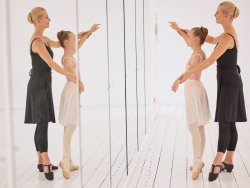 Ballet for adult beginners: Basics & postureStarting ballet is possible for adults of any age. Learn the most important positions and how to sustainably improve your body posture.
 Ballet foot positions: A guide to the perfect stanceThe five classic foot positions are the foundation of ballet. With our precise guide, you will learn how to perform positions one through five in an anatomically correct and joint-friendly way.