Ballet posture4 minutes

Stable ballet axis: Building core tension correctly

In short
  • The stable axis in ballet is based on the targeted activation of the deep core and pelvic floor muscles.
  • A conscious pelvic tilt prevents a harmful swayback and protects the lumbar spine during turns.
  • Core tension is built up through the interaction of breathing and the activation of the transversus abdominis.
  • Only a stable center allows for the complete freedom and lightness of movement in the arms and legs.

A majestic posture in ballet is not created by rigid holding, but by the subtle activation of your deepest muscles. Learn how to invisibly stabilize your center and gain maximum balance.

What you need for core training

  • A quiet space without distractions
  • Comfortable workout clothes that do not restrict movement
  • Bare feet or non-slip socks
  • A few minutes of undivided attention for your own body

Why deep strength is the foundation of every movement

If you start ballet at a mature age, you quickly realize that the proud, seemingly effortless posture does not come from sheer willpower. The proverbial lightness is the result of precisely coordinated muscle activity in the center of the body. If you want to train your body awareness in dance, your deep muscles are your most important tool. Unlike classic strength training in the gym, this is not about visible muscle bulk, but about the subtle interplay of the pelvic floor, the deep transverse abdominal muscle, and the stabilizers along the spine.

A stable center relieves the joints and ensures that arms and legs can move freely in space without you losing your balance. Targeted ballet core training starts exactly at this intersection. It teaches you to let the global, superficial muscles relax while the deep layer performs the holding work unnoticed. As soon as this connection is established, every movement at the barre immediately feels more secure and controlled.

A creative ballet teacher correcting the posture of an elegant and flexible dancer in a modern dance studio
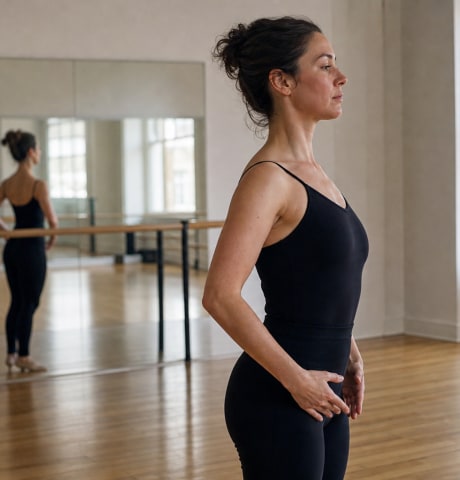
Power comes from the core: only a stabilized pelvis allows for precise and free movement of the legs in space.

Five steps to a stable ballet core

  1. Finding the neutral pelvic position

    Stand with your feet hip-width apart and place your hands on your hip bones. Consciously tilt your pelvis forward and backward to feel the extremes, and settle exactly in the middle, where your tailbone points vertically to the floor.

  2. Activating the deep transverse abdominal muscle

    Inhale deeply through your nose into your rib cage. As you exhale through your slightly parted lips, gently pull your navel inward and upward, as if you were tightening a tight belt by one notch.

  3. Gently engaging the pelvic floor

    Imagine that the sit bones at the bottom of your pelvis are moving towards each other. This activates the pelvic floor, which supports your stable axis in ballet from below.

  4. Closing the rib connection

    Avoid pushing your ribs forward. Exhale and let the front rib arches soften inwards, creating a direct, firm connection between your ribs and pelvis.

  5. Maintain core tension while standing

    Release your hands from your hips and let your arms hang loosely. Maintain the internal tension in your core for five deep breaths, without the effort being visible from the outside.

The right alignment in comparison

Correct

  • Let your tailbone sink down heavily
  • Keep your breath flowing during the tension
  • Let your ribcage melt gently inwards and downwards

Wrong

  • Tense your glutes extremely and stretch them backwards
  • Hold your breath to maintain tension
  • Push your chest far out to the front

Your checklist for a stable axis

Before training

Preparation

While practicing

During this time

After training

Follow-up

Frequently Asked Questions

  1. Pelvic alignment in ballet is the active positioning of the pelvis into a neutral stance to avoid a swayback. The pubic bone pulls gently upward toward the navel, while the tailbone sinks heavily downward. This protects the lower back and stabilizes the vertical axis.

Ballet classes for adults near you

Find the right dance school and bring your core strength directly to the dance floor.

View all matching classes

Working on your axis together

On udansa you will find like-minded people who, just like you, want to work on their posture. Discover suitable ballet courses for adults and find your ideal dance partner for training at the barre together.

Working on your axis together