Starting ballet5 minutes

Self-test: Does your body awareness suit ballet?

In short
  • For getting started in adulthood, no extreme physical requirements like splits or extreme hypermobility are necessary.
  • A healthy basic range of motion and the willingness to engage in active core tension are completely sufficient to train injury-free.
  • The ballet body awareness test helps you to assess your individual strengths in posture, balance, and flexibility yourself in advance.
  • Regular training in the beginner course builds the necessary strength and flexibility step by step and anatomically correctly.

The dream of ballet is not a question of age or innate flexibility. With our simple self-test, you can find out where you stand regarding your posture, balance, and flexibility before your first class at udansa.

Your body is ready for new movements

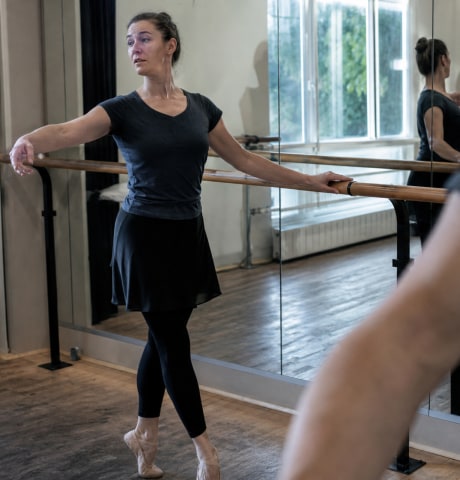
Many adults hesitate before their first ballet class because they believe that you have to be extremely flexible from birth for this dance style. That is a common misconception. In classical dance for late starters, it is not about peak acrobatic performance, but about consciously experiencing your own body, a healthy posture, and the joy of moving to music. If you are wondering whether your physical prerequisites are sufficient for getting started, our ballet body awareness test will help you gain an initial assessment.

Before you enter the studio, it is helpful to observe your own movement patterns in everyday life. Ballet demands and promotes a very special coordination: the interplay of fine muscle tension in the core and conscious release in the joints. Those who sit a lot in everyday life often have shortened muscles, but that is exactly where the training comes in. It meets you exactly where you are. If you are interested in dance but are still unsure which style suits you best, you can also take a look at the Modern Dance and Contemporary for adults section, which is often a bit freer in its movement sequences.

Take the ballet body awareness test

  1. How do you perceive your posture in everyday life?

    • A: I usually stand upright and feel my core well, but I sometimes tend to be a little stiff.
    • B: I tend to move loosely and softly, but I also like to slump into a rounded back when standing or sitting.
  2. What happens when you stand on one leg for a few seconds?

    • A: I stand quite securely and can keep my center of gravity well over my supporting leg.
    • B: I wobble a little and have to compensate for my balance using my arms or my foot.
  3. How easy is it for you to touch your toes while standing with your legs straight?

    • A: I can reach about as far as my shins, then I feel significant resistance.
    • B: I can usually touch my toes or even the floor without any major problems.
  4. How does your body react to unfamiliar, slow movements?

    • A: I can concentrate well and maintain tension, but my muscles tire out quite quickly.
    • B: I am flexible and fluid, but sometimes I lose precise control over the movement.

Your evaluation

Mostly A: The stable posture type

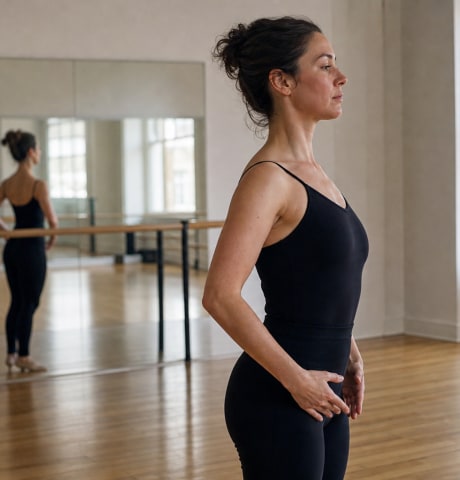
You already have a good basic tension and a fine sense for your body axis. In ballet, you will find it easy to maintain a proud, upright upper body. Use this stability to now focus completely on the coordination of your arms and legs in class.

Mostly B: The flexible movement type

Your strength lies in your natural flexibility and the ease with which you embrace new movements. During training, you should pay particular attention to activating your deep core muscles to provide your joints with the necessary support. This way, you dance elegantly and at the same time in a way that is completely gentle on your joints.

Your physical tendencies in comparison

CriterionThe stable posture type (Type A)The flexible movement type (Type B)
Greatest strengthGood core stability and axis controlHigh natural mobility in the joints
ChallengeTendency towards muscular tightness and stiffnessRisk of compensatory movements due to lack of strength
Focus in trainingConscious release and stretching of the musclesBuilding deep core and pelvic stability
Typical introductory exerciseFluid arm movements (port de bras) while standingPrecise footwork at the barre for more stability

These assessments serve as a guide for starting out in recreational dance and are not medical criteria.

How to use your test result in training

After you have evaluated your tendencies in the test, it is time for implementation. No test result in the world should stop you from booking a trial class if your heart beats for ballet. The results serve merely as a compass to understand in which areas you will be particularly challenged during training. If, for example, you notice that core stability is still difficult for you, the ballet posture for beginners will offer you valuable guidance in your first few classes.

In classes for adult beginners, you start right from the beginning. The teacher shows you how to activate your muscles in a joint-friendly way without tensing up. You learn to balance on one leg and move your arms fluidly. Every class builds your strength, flexibility, and coordination step by step. Leave perfectionism at the cloakroom and focus entirely on the feeling of moving through the room to the music. Your body will adapt to the new stimuli surprisingly quickly.

Frequently Asked Questions

  1. No, you do not need to be extremely flexible to get started. The flexibility required for the exercises is built up gradually and gently throughout the course through targeted training.

Ballet offers in your area

Find the right beginner course for adults on udansa now and start your training.

View all matching courses

Find your way into Ballet

On udansa you will find the right ballet school and like-minded people in your region who, just like you, are starting to dance as adults. Start your dance journey without any pressure to perform and discover your new sense of body.

Find your way into Ballet