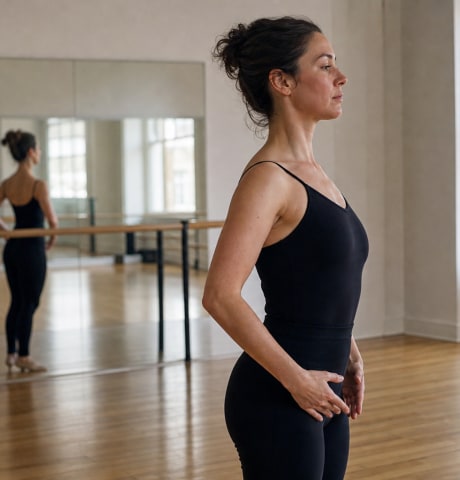
Ballet basics5 minutes

Ballet barre posture: The most important basics

In short
  • During training, the ballet barre serves exclusively as a light guide for balance and must never be misused as a firm support for holding on.
  • The optimal distance from the barre is about one forearm length, so that the elbow is slightly bent in front of the body and points relaxed downwards.
  • The hand is placed loosely on the barre with slightly rounded fingers, while the wrist remains stable and no pressure is exerted on the wood.
  • Correct alignment requires active core engagement, relaxed shoulders, and a pelvis that is in a neutral, upright position.

The first step to the ballet barre is the beginning of a wonderful journey toward greater body awareness. With the right alignment from the start, you lay the foundation for a healthy and proud posture.

DefinitionBarre

Barre refers to the wooden or metal ballet rail that is used in classical dance classes as a tool for stabilizing balance during warm-up and basic exercises.

The barre is a partner, not a support

The first encounter with the ballet bar, known in technical jargon as the barre, is a magical moment for many adult beginners. However, the bar is not a piece of gymnastics equipment, nor is it a support for you to hold onto when exhausted. Maintaining the correct posture during barre training means, above all, understanding the barre as a sensitive partner. It serves merely as a subtle guide for your balance, while your own body does all the work of holding the position. If you cling too tightly, you block your shoulders and distort your entire alignment.

In your very first class, you will notice that you usually touch the bar with only one hand, while the other hand accompanies the movement in space. To maintain this balance without losing your stability, your core must take over all the stabilization. A gentle, feather-light contact with your fingertips is completely sufficient to feel the necessary security. As soon as you learn to let go of the bar without your body tipping to the side, you have understood the most important basic principle.

Just a light touch of the fingertips ensures balance, while the body does all the holding work.

The correct distance and placement of the hand

To achieve the perfect alignment at the barre, the distance of your body from the barre is crucial. If you stand too close, your elbows will bend unnaturally and your shoulders will push upwards. If you stand too far away, you have to lean forward, which throws your spine out of alignment. The ideal distance is about one forearm's length. When you place your hand on the barre, your elbow should be slightly bent in front of your body and point downwards in a relaxed manner.

Your hand should rest on the wood slightly in front of your shoulder line. This position ensures that your shoulder blades can glide gently backwards and downwards, which enables the typical, proud ballet chest opening. Make sure not to bend your wrists or apply pressure to the wood. Your fingers should rest loosely and rounded on the barre, almost as if you were protecting a delicate bird's egg. This fine adjustment forms the foundation for all subsequent movements in the room.

The correct alignment at the ballet barre in comparison

Correct at the barre

  • Place your fingers relaxed on the wood
  • Keep a forearm's length distance from the barre
  • Keep your shoulders consciously low and wide
  • Draw your strength from your core tension

Mistakes at the barre

  • Grip the barre firmly with your whole hand
  • Stand too close to the barre and restrict your movement
  • Pull your shoulders up in a cramped way
  • Let yourself hang and lean on the barre

The ballet barre is not a railing that supports us, but a mirror that shows us if we are standing in our own center.

Ballet instructor, Hamburg

Length in the spine and a proud posture

A proud and upright posture in ballet is not created by rigid muscle strength, but by consciously creating length in your body. Imagine that your spine is being pulled upwards by an invisible thread, while your tailbone sinks heavily towards the floor. These opposing forces activate your deep core muscles in your abdomen and pelvic floor, without you having to hold your breath. Your shoulders remain completely relaxed and far away from your ears.

This interplay of posture and relaxation is the core of the entire ballet aesthetic. Before you venture into more complex movements, it helps to understand the arm position separately. A look at the guide on elegant arms in ballet: Port de Bras for beginners shows you how to harmoniously connect the fluid movements of the free arm with your stable axis at the barre. This way, your training becomes harmonious and expressive from the very first second.

Two sides of a stable balance at the barre

Leading

Sensitivity at the barre

The delicate contact with the barre

Your hand rests feather-light on the barre, your fingers are gently rounded, and your wrist remains active. The barre serves only as a gentle impulse for your own balance.

Follow

Supporting strength from the core

Balance from your own center

The entire body supports itself through the activation of the deep muscles in the core. The bar only helps to precisely align the vertical axis in space.

Frequently Asked Questions

  1. The distance is correct if your elbow is slightly bent in front of your torso when your hand is resting on it. This usually corresponds to about one forearm's length of distance between your hip and the barre.

Ballet classes for adults near you

Find the right studio for your start at the barre.

View all matching classes

Find your start at the ballet barre

At udansa you will find the right ballet school and like-minded people in your area to take your first steps at the barre with professional guidance.

Find your start at the ballet barre