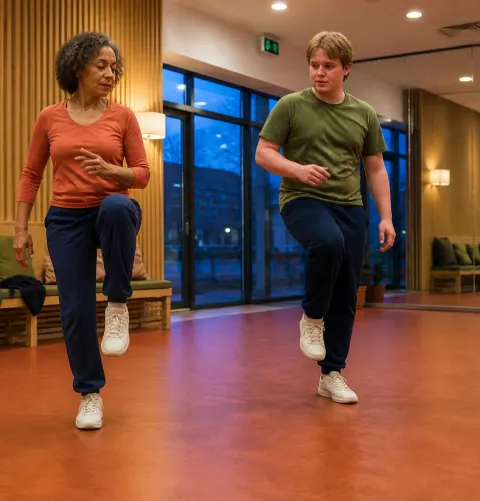
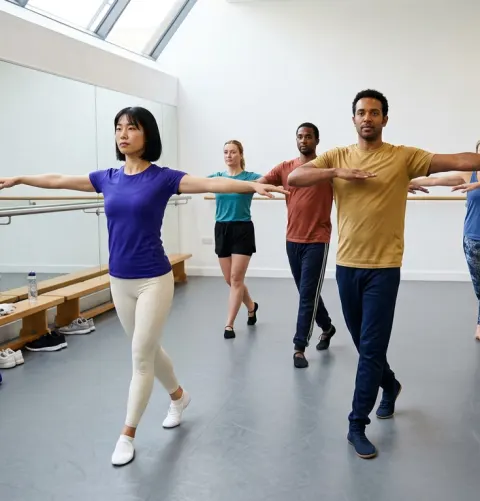
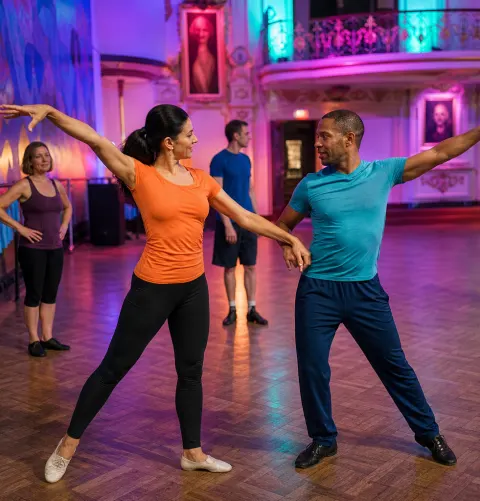
Practice turns together
On udansa connect, you can find people to practice short technique sequences with. One person turns while the other watches their supporting leg and finish.

By Bernhard De LucaUpdated
On udansa connect, you can find people to practice short technique sequences with. One person turns while the other watches their supporting leg and finish.
A turn is over in a moment, but your next marching step still has to land right. The moment between turning and moving on is exactly what shows whether you're in control of the movement or chasing your own momentum.
For this exercise, choose a simple right turn on the ball of your right foot, a single pirouette-like turn. This distinguishes it from Chaînés, where successive turning steps are supported alternately by both feet. Here, you are learning neither a chain of turns nor a prescribed competition figure, but a controlled transition from your marching sequence.
Your weight must arrive over your right foot before you create the turning momentum. Your pelvis and rib cage stay stacked; pushing your pelvis out to the side makes your axis tilt. Your right heel lifts only enough for you to turn on the ball of your foot. Your knee stays aligned and is not pushed backward. A stuck foot must not be compensated for with a twisting movement of the knee. The connection between your foot and the floor also depends on the proper fit of your majorette boots.
You also encounter weight transfer in the Step Pivot in Line Dance, but the footwork is different here: your free leg is brought in and does not help support you during the turn. Small turning angles are preparatory exercises on the same axis, not a way to walk around in quarter circles. Only attempt a full turn once you can finish smaller angles without taking a step to catch yourself.
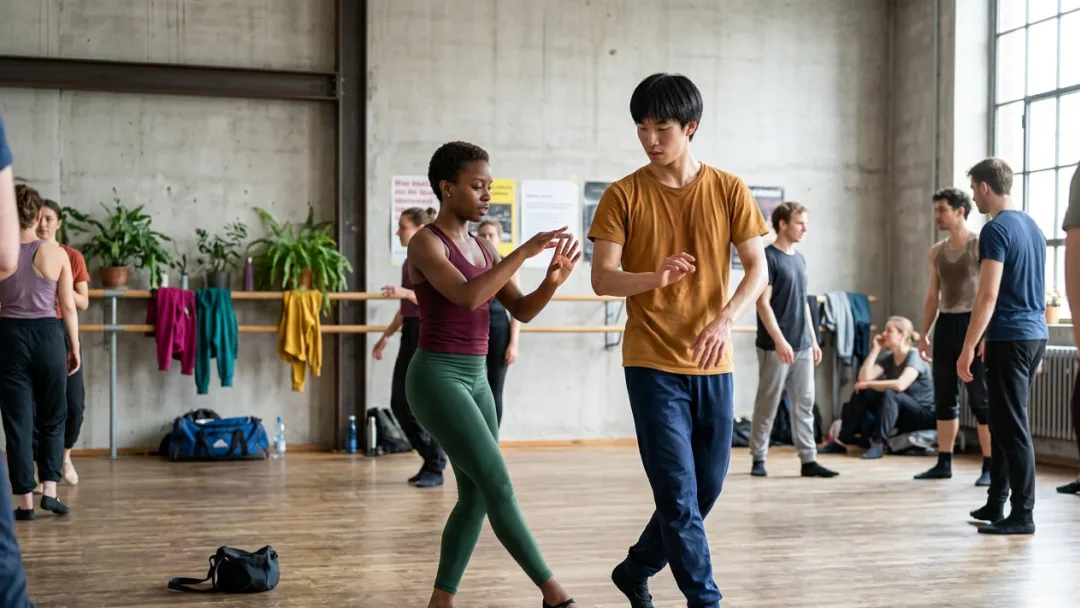
March right on 1, left on 2, right on 3. On 4, keep your weight on your right foot and continue with your left on 5; step right on 6, left on 7, and right on 8. This leaves your right foot clearly free on 3.
Repeat 1 to 3 without music. On 3, transfer your weight fully to your right leg, lift your right heel slightly, and bring your left foot close to your right ankle without putting weight on it. Lower on 4: stay over your right leg without taking a side step.
Open your arms loosely out to the sides to prepare. As you transition onto your right foot, create a slight impulse to the right and bring your arms rounded in front of your body. First, turn a quarter turn on the ball of your right foot, without twisting your standing knee against a planted foot.
For a small turn, choose a target at eye level. Let your head follow the movement and direct your gaze toward it. For a full turn, keep your gaze briefly forward at first, then bring it back there with a quick head turn, without twisting your neck too far.
Turn from 3 to 4 and lower your right heel in a controlled way on 4. Open your arms slightly as you limit your momentum; keep your left foot free for 5. The attempt is successful if you don't hop afterward or need an extra recovery step.
Repeat with a half turn and then, once your axis is steady, with a full turn. Increase the momentum only slightly and keep the same finish. If you tilt sideways or turn past the target, stick with the smaller angle, don't force the turn.
Connect right on 1 and left on 2 with the right turn starting on 3. Finish on 4 and continue marching left on 5. Start with spoken counts, then use slow marching music. Increase the tempo only once you can make the transition without an extra hop.
This way
Not like this
Preparation
Control
Next steps
No, this exercise is done on the balls of your feet, not your tiptoes. Raise your heel only as far as you can control your supporting leg. A higher stance does not automatically make the turn better. En pointe is a different technique and is not part of this guide.
For this preparatory exercise, keep your left foot close to your right ankle without putting any weight on it. This keeps the movement manageable and avoids adding a leg swing. A required leg position from your choreography comes in only once the basic turn is stable, and it may have different requirements.
Often, your turning momentum is greater than you can control as you finish. First reduce your arm swing and practice a smaller angle again. Do not try to stop a turn that is too fast by abruptly locking your foot in place: You need to control the momentum beforehand so your knee does not twist.
Socks are not a safe choice for this exercise on smooth floors. They can slip unexpectedly when you put weight on them or lower your heel. Conversely, street shoes with a lot of grip make turning difficult. Wear suitable dance shoes on an appropriate surface instead of compensating for too little traction or a sticky sole by using more force.
Stop the attempt and rest until you feel oriented again. Doing several fast repetitions in a row is not a sensible way to progress. Later, start with smaller angles and take breaks between attempts. If the dizziness is persistent, severe, or keeps coming back, you should seek medical advice.
Yes, for the mirrored exercise, switch your feet and turning direction completely. Then march left on 1, right on 2, and turn left from 3 on the ball of your left foot. Continue with your right on 5. Practice each side separately instead of changing direction midway through an attempt.