
Find your crew on udansa
Find like-minded people in your city who share your passion for street dance and urban beats. Make connections, exchange ideas, and discover new dance opportunities in your area.


By Mary De LucaUpdated
Find like-minded people in your city who share your passion for street dance and urban beats. Make connections, exchange ideas, and discover new dance opportunities in your area.
The streets of the Bronx in the 1970s were loud, raw, and full of energy. Here, out of a need for self-expression, a culture emerged that would revolutionize music and movement forever.
Breakbeat refers to a rhythm with syncopated, irregular drum beats, which is usually isolated from funk or soul tracks. It forms the rhythmic heart of hip-hop music and the foundation for breakdance.
The Bronx in 1970s New York was a scarred place. Economic decline, abandoned tenements, and social tensions defined the scene. Yet, it was in this rough environment that one of the world's most influential subcultures emerged. The birth can be traced back to a specific event: on August 11, 1973, a young man named Clive Campbell, better known as DJ Kool Herc, hosted a legendary party at 1520 Sedgwick Avenue. He used two turntables to loop the purely instrumental passages of funk and soul records, the so-called breaks, indefinitely. This technical innovation, the merry-go-round technique, laid the musical foundation for an entirely new form of movement and marks the beginning of Bronx hip hop history.
This new way of DJing attracted young people who met on the dusty streets and in the abandoned parks of the Bronx. The music demanded a physical response. The dancers who reacted to these specific breaks were called break-boys or break-girls, from which the terms B-boys and B-girls quickly emerged. The rhythmic structure of the music and the dynamics of the street merged into a unity that went far beyond mere pastime. It was the beginning of a movement that gave youth a voice and an identity where there was otherwise only a lack of prospects.
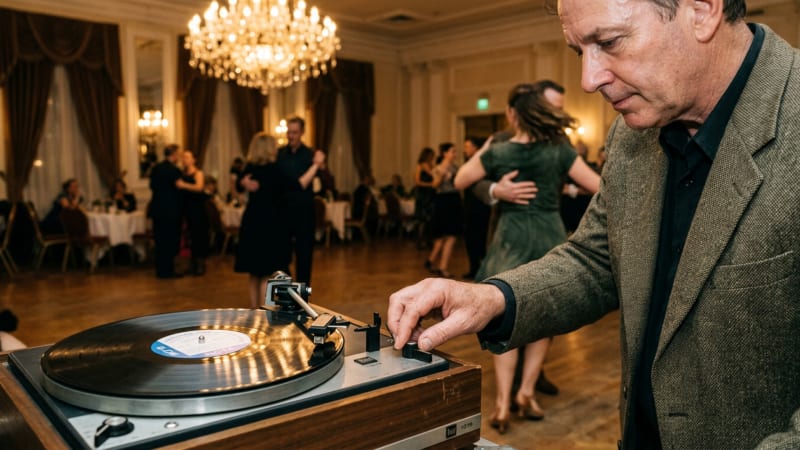
The dance known today as breakdance did not emerge in air-conditioned studios, but directly on the asphalt. In its early phase, the dance was closely linked to local street dance history and was based on so-called top-rocking, dancing while standing. The movements reflected the rhythm of the city: they were proud, direct, and often inspired by everyday gestures or martial arts films. Only over time did dancers shift their steps to the floor. This development, the so-called down-rock, fundamentally changed the dynamics. Young people used the floor as a creative playground where they proved their agility and speed.
The music and the movement influenced each other in a constant interaction. A DJ like Kool Herc observed the crowd closely: when he saw that the dancers reacted particularly wildly to certain drum rolls, he extended exactly that part. The dancers, in turn, adapted their step sequences to the tempo and intensity of the breaks. This close connection shows how inseparably the breakdance origin is linked to the evolution of DJ technique. It was a constant conversation without words, where the beat set the direction and the body provided the answer. Anyone active at a social dance today is essentially experiencing the modern continuation of this spontaneous interaction.
Correct
Wrong
We didn't have money for expensive instruments, so we turned the turntable into our instrument and our body into the expression of our reality.
In the late 1970s and early 1980s, the movement spread unstoppably. What began in the backyards of the Bronx as a local phenomenon developed into a global movement that rewrote the entire history of street dance. The various elements, the DJs, the MCs, the graffiti artists, and the dancers, formed a solid culture. The dance became professional, crews formed and held peaceful competitions, so-called battles. These battles often replaced the violent conflicts of rival gangs on the street: whoever showed the better style and the cleaner steps earned the respect of the community.
Over the decades, the modern history of hip hop dance developed from the raw street styles with all its facets, from popping and locking to today's choreographies in music videos. But the core remains the same: it is about self-expression, a sense of rhythm, and community. To find your way into this world, it helps to develop a good feel for the music. Whoever learns to recognize the beat also understands the movements of the pioneers from back then better. The streets of the Bronx have created a global art form that still connects people all over the world today.
The heartbeat of the culture
The DJ provides the foundation by isolating the breaks, extending them, and setting the rhythm of the street. Without their innovations on the turntables, the dance would never have found its characteristic form and dynamics.
The physical response
Dancers translate the hard beats directly into movement. They react to every accent in the music, use the asphalt as a stage, and reflect the energy and pride of their surroundings in their dance.
Hip Hop dance originated in the early 1970s on the streets of the Bronx in New York City. Young people of African American and Puerto Rican descent shaped the first steps.
DJ Kool Herc is considered the father of Hip Hop because, at a party in 1973, he played the breaks of two identical records alternately for the first time to extend the danceable part. This gave the B-Boys the rhythm they needed for their dance sessions.
In the beginning, it was mainly about top rocks, which are dance steps performed standing up, as well as fast footwork on the floor, known as down rocks. Acrobatic spins were added later.
The music and dance influenced each other. DJs extended the beats because the dancers reacted to them, and the dancers developed new movements to physically represent the complex rhythms of the DJs.
Find the right course and learn the basics of urban movement directly in your city.
Hip HopOranienburg OT Lehnitz · Germany
Hip Hop 6-8 J.Monday · 18:00 · Oct 12
Kulturhaus Friedrich-Wolf
StreetdanceBurgstädt · Germany
Videoclip Teens 11-13 JahreMonday · 16:50 · Oct 26
Burgstädt
Hip HopOranienburg OT Lehnitz · Germany
Hip Hop ab 9 J.Monday · 19:45 · Oct 12
Kulturhaus Friedrich-Wolf
 History of dance music: How rhythms moved the worldDive into the fascinating development of dance music and understand how historical rhythms have shaped the dance styles we enjoy today.
 Dance Music Eras Quiz: Which historical type are you?Find out which era of dance music best suits your personality with our interactive self-test. Take the quiz now!
 7 musical milestones that changed the dance worldDiscover the 7 most influential albums and recordings in history that revolutionized dance styles like Swing, Mambo, and Disco forever.
 The Disco History of Music: Liberation on the Dance FloorThe disco era of the 1970s was much more than just glitter: it was a musical and social revolution that began on the dance floors of the New York underground.
 History of Ballroom Dance: From Salon to SportEmbark on a fascinating journey through time and discover how classic ballroom dances found their elegant form during industrialization and through English pioneers.
 Vintage dance music trends: Why old rhythms are boomingThe global dance scene is celebrating the comeback of historical sounds. Discover how vintage dance music trends are bringing forgotten shellac treasures back to modern dance floors.
 Understanding historical dance music: A guide for dancersLearn how to correctly analyze historical dance music, identify eras, and use ancient sources like Arbeau or Playford to deepen your understanding of dance.