
Find your partner for time travel
On udansa you will find like-minded people who share your passion for rhythm and music history. Search specifically for dance partners in your area and start your historical dance adventure together.



By Bernhard De LucaUpdated
On udansa you will find like-minded people who share your passion for rhythm and music history. Search specifically for dance partners in your area and start your historical dance adventure together.
Historical sounds are much more than dusty melodies. They reveal to us how people used to feel, celebrate, and move, once we learn to correctly read their musical structure.
If you want to understand historical dance music, you have to dare to make the leap from pure movement to music-historical research. Only a look at the original sources reveals why a Baroque minuet in three-quarter time strides along so majestically, while a Renaissance courante possesses a completely different dynamic despite similar notation. Music history for dancers means deciphering the close bond between composer and dance master. Historical composers did not write their music for the concert hall, but directly for the ballroom. The tempo, the accents, and the phrasing were precisely tailored to courtly etiquette and the physical laws of the fashion of the time. When you learn to read these musical codes, your entire understanding of rhythm and movement changes.
To understand and chronologically classify historical dance music, a look at the typical instruments and structures helps. While we hear the rhythmic dominance of the harpsichord and the lute in the Baroque period, orchestral brass sections define the dynamics in the 19th century. A wonderful example of this change is the development of classical ballroom dances. If you want to grasp classical ballroom dances in their depth, you must trace the musical evolution from the courtly processional dance to the bourgeois couple dance. Every era leaves its traces in the notes: the syncopations of early jazz already herald the swing, while the strict beat structure of the Viennese Classical period disciplined the Viennese Waltz. This knowledge protects you from misinterpreting historical pieces with modern listening habits.

Select a specific historical work and get the corresponding dance master treatise. For the Renaissance, the 'Orchesographie' by Thoinot Arbeau (1589) is the best choice, and for English Country Dances, reach for John Playford's 'English Dancing Master' (1651).
Analyze the instrumentation of the piece of music. The presence of a viola da gamba, a lute, or a harpsichord helps you to determine the eras of the dance music and to anchor the sound of the time in your ears.
Examine the musical notation for time signature and rhythmic peculiarities. Pay special attention to syncopations, hemiolas (rhythmic shifts), or typical dotted notes that significantly shape the historical dance character and often deviate from modern rhythms.
Bring musical phrasing into harmony with historical movement patterns. Understanding historical dance music means recognizing how a musical question and answer in the melody corresponds to the courtly spatial paths and bows of the dancers.
Historically accurate
Common mistakes
Preparation
Analysis
Follow-up
A dance master treatise is a historical textbook that describes dance steps and their corresponding music. Famous examples include Arbeau's 'Orchesographie' (1589) or Playford's 'English Dancing Master' (1651). They are the most important source for understanding historical dance music.
Pay attention to the instrumentation and the rhythmic structure. The Baroque era often uses harpsichord and lute in polyphonic structures, while the Renaissance is characterized by recorders, viols, and additive rhythms. You can recognize the 19th century by full orchestral sounds and clear time structures.
Use digital music archives such as the International Music Score Library Project (IMSLP) for historical sheet music. Compare these records with the descriptions in digitized dance treatises from the Bavarian State Library to analyze tempo and rhythm in a historical context.
Find the right course and bring history to life on the dance floor.
Couple danceLimbach-Oberfrohna · Germany
PaartanzkreisFriday · 18:15 · Oct 23
Limbach-Oberfrohna
BallroomMeißen · Germany
Tanzkreis | PROFESSIONALTuesday · 20:15 · Oct 27, 2026 - Jan 5, 2027
“Ein Haus für Vieles” - Saal Tanzkurse
Couple danceLimbach-Oberfrohna · Germany
Silberkurs für PaareSunday · 16:15 · Oct 25 - Nov 15
Limbach-Oberfrohna
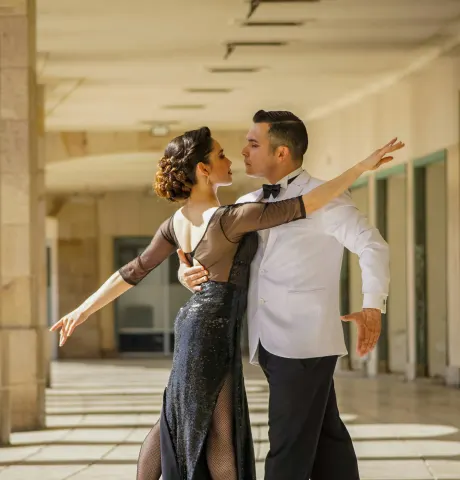 Tango history: From the gutters to the salonsThe history of Tango is a journey of contrasts. Learn how the former dance of the outcasts from the ports of Buenos Aires conquered the noble salons of Europe.
 The history of house music: How beats conquered the clubsDive into the fascinating history of house music. Learn how the heartbeat of modern club culture was born in the Chicago underground of the eighties.
 How swing music history changed dance foreverThe rise of swing music in 1920s and 1930s New York fundamentally revolutionized partner dance. Discover how the Big Bands at the Savoy Ballroom shaped Lindy Hop.
 History of dance music: How rhythms moved the worldDive into the fascinating development of dance music and understand how historical rhythms have shaped the dance styles we enjoy today.
 History of Salsa music: From Cuba to New YorkDive into the fascinating history of Salsa music. Learn how Afro-Cuban rhythms and the New York melting pot of the 1970s triggered a global boom.How swing music history changed dance foreverThe rise of swing music in 1920s and 1930s New York fundamentally revolutionized partner dance. Discover how the Big Bands at the Savoy Ballroom shaped Lindy Hop.Tango history: From the gutters to the salonsThe history of Tango is a journey of contrasts. Learn how the former dance of the outcasts from the ports of Buenos Aires conquered the noble salons of Europe.The history of house music: How beats conquered the clubsDive into the fascinating history of house music. Learn how the heartbeat of modern club culture was born in the Chicago underground of the eighties.
 History of the Viennese Waltz: Rebellion in 3/4 timeFrom a frowned-upon peasant ritual to an imperial status symbol: Learn how the Viennese Waltz revolutionized the dance world in 3/4 time.
 History of Discofox: How the Hustle reached EuropeLearn how Discofox evolved from the New York Hustle and the European Euro-Disco wave of the 70s and 80s into our most popular party classic.