
Find your swing community on udansa
On udansa connect, you will meet like-minded people who share your passion for the golden era and want to conquer the dance floor with you.


By Mary De LucaUpdated
On udansa connect, you will meet like-minded people who share your passion for the golden era and want to conquer the dance floor with you.
In the late 1920s, a musical revolution unfolded in the New York neighborhood of Harlem that would shake the foundations of partner dance. The birth of the history of swing music is inextricably linked to the rise of the great big bands. Bandleaders like Fletcher Henderson and later Duke Ellington began to break up the rigid rhythms of traditional jazz. They replaced the march-like two-four time with a flowing, syncopated four-four time, where the emphasis was on the offbeats. This rhythmic shift created a bouncy, driving feeling, the so-called swing. This new dynamic demanded a completely new way of moving: away from the stiff, upright posture of European ballroom dances, toward a deep, earthy connection to the floor that engaged the entire body.
The epicenter of this movement was the legendary Savoy Ballroom in New York. As one of the few places of the era where racial segregation did not play a role on the dance floor, it provided the perfect breeding ground for musical and dance innovations. Here, the best big bands in the world met in legendary battles, which spurred the musicians on to ever wilder, more driving rhythms. The dancers responded to this musical ecstasy by developing the Lindy Hop. The history of the Lindy Hop shows how the separation of the dance couple in the so-called swingout created a completely new freedom. Suddenly, partner dance was no longer just about performing synchronous steps, but an improvised, rhythmic dialogue that was fueled directly by the energy of the big bands. You can also learn more about the origins of other dance styles in our article on the history of dance music.
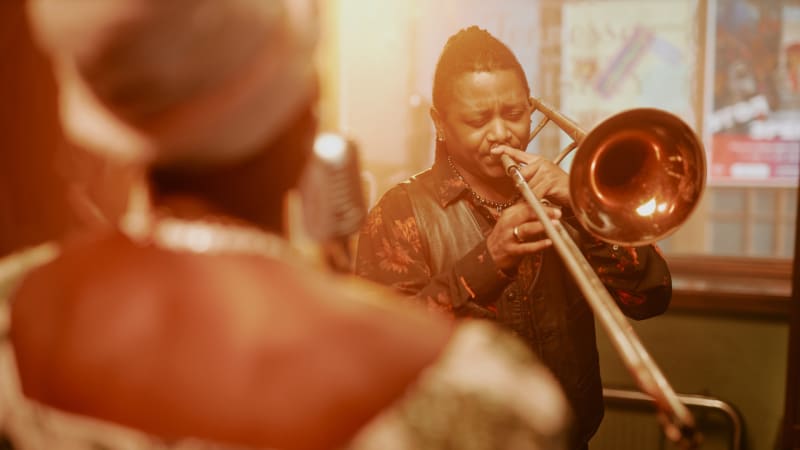
Listen specifically to the hi-hat and the drums of the big bands to feel the bouncy four-four time and the accented offbeats in your body.
Let go of the idea of rigid step patterns and react directly to the musical accents of the brass sections instead.
Use the open posture of the swingout to set your own accents, without losing the connection to the leading or following person.
The term swing describes the rhythmic phenomenon where eighth notes are played unevenly. This creates a bouncy, rolling feeling that automatically sets the body in motion.
Starting in 1926, the Savoy Ballroom in Harlem was the first completely integrated dance hall in New York. The best big bands played here, and dancers invented the Lindy Hop directly to the live music.
The swingout is the key movement where the couple opens up from a closed position and can drift away from each other. For the first time, this allowed for completely free solo elements and athletic acrobatics in the middle of a partner dance.
Find suitable courses and feel the rhythm that has moved generations.
Couple danceLimbach-Oberfrohna · Germany
PaartanzkreisMonday · 19:30 · Oct 12
Limbach-Oberfrohna
Couple danceLimbach-Oberfrohna · Germany
PaartanzkreisFriday · 18:15 · Oct 23
Limbach-Oberfrohna
Couple danceBurgstädt · Germany
Paarkurs - Goldstar TanzkreisSunday · 15:00 · Oct 25
Burgstädt
 History of dance music: How rhythms moved the worldDive into the fascinating development of dance music and understand how historical rhythms have shaped the dance styles we enjoy today.
 Tango history: From the gutters to the salonsThe history of Tango is a journey of contrasts. Learn how the former dance of the outcasts from the ports of Buenos Aires conquered the noble salons of Europe.
 The history of house music: How beats conquered the clubsDive into the fascinating history of house music. Learn how the heartbeat of modern club culture was born in the Chicago underground of the eighties.
 History of the Viennese Waltz: Rebellion in 3/4 timeFrom a frowned-upon peasant ritual to an imperial status symbol: Learn how the Viennese Waltz revolutionized the dance world in 3/4 time.
 History of Discofox: How the Hustle reached EuropeLearn how Discofox evolved from the New York Hustle and the European Euro-Disco wave of the 70s and 80s into our most popular party classic.
 Hip-Hop history: How music and street dance shaped the streetsThe birth of Hip-Hop lies in the dusty streets of the New York Bronx. Learn how DJs and dancers created a worldwide culture together in the 1970s.
 Dance Music Eras Quiz: Which historical type are you?Find out which era of dance music best suits your personality with our interactive self-test. Take the quiz now!