
Find your dance partner for Tango
On udansa, you can find like-minded people in your area who want to explore the fascinating musical world of Argentine Tango with you and practice your sense of rhythm together.


By Bernhard De LucaUpdated
On udansa, you can find like-minded people in your area who want to explore the fascinating musical world of Argentine Tango with you and practice your sense of rhythm together.
Argentine Tango is not a dance that you simply count out. It is an intimate conversation with the music, where listening precisely to the rhythm paves the way for absolute freedom on the dance floor.
Syncopation refers to a rhythmic displacement where the emphasis is shifted from a strong beat to a beat that is normally unstressed. In Argentine Tango, especially in the Milonga, this stylistic device creates the typical driving character that udansa loves.
Anyone visiting a milonga for the first time is often fascinated and confused at the same time. The music of Tango Argentino sounds dramatic, melancholic, and incredibly complex. Unlike standardized competitive dances, there is no rigid, continuous drumbeat dictating the rhythm here. Instead, the bandoneon, violins, and piano drive the action. To be able to hear the tango argentino rhythm, you have to say goodbye to the search for a simple drum kit. The music breathes: it speeds up, slows down in the next moment, and thrives on the dramatic pause. This makes dancing so free, but it also requires active listening.
The foundation is almost always a four-four time signature, but the accents vary greatly. If you want to test your sense of rhythm, you will notice that tango presents you with completely new challenges. To grasp the structure, it helps to pay attention to the bass or the piano. These instruments often mark the heavy walking steps on beats one and three, while the bandoneon layers the melodic arcs on top.

To master the variety at a traditional dance event, you need to be able to distinguish between the three musical faces of Tango Argentino. Besides the classic, often sustained Tango in 4/4 time, you will regularly encounter the Milonga and the Vals on the dance floor. Each of these genres requires a completely different dynamic in your movements, even though the basic dance technique remains the same. When you look at a Tango Argentino vs. Standard Tango comparison, it quickly becomes clear that this musical flexibility is the absolute heart of the Argentine variant.
The Milonga is the cheerful, fast predecessor of the Tango. Here, the rhythm is syncopated and reminiscent of a stumbling, yet extremely precise metronome. The Vals, on the other hand, brings the familiar, swinging feeling of the 3/4 time signature to the floor. Anyone who can distinguish these three worlds by ear no longer just dances their step patterns rigidly, but translates the music directly into fluid movements.
Correct
Wrong
If you understand the tango in your ear, you no longer need complicated step sequences. The music shows your body all by itself when it needs to move and when it needs to pause.
The secret to a harmonious dance lies in how you can structure tango music while you move. Experienced dancers use the structure of the pieces to take breaks or set dynamic accents. A typical tango piece consists of repeating phases, usually organized in eight-bar groups. If you learn to anticipate the end of such a phrase, you can finish your movements precisely with the music.
You do not have to fill every single beat with a step. The tango counts offer you the freedom to choose between the normal walking tempo (on the heavy beats), double time (on the off-beats), and consciously standing still during a pause. This musical interpretation makes the dance come alive. If you are still looking for the right companion for this journey of discovery, a look at the guide will help you to find a dance partner for tango and train your ear together.
Sustained and expressive in four-four time
Classic Tango thrives on melancholy, dramatic delays, and playing with pauses. Here, you determine the tempo through the conscious interpretation of the sustained melodic lines.
Fluid rotations in three-quarter time
Vals brings the dynamics of three-quarter time to the milonga. The steps flow through the room without interruption, carried by the continuous oscillation of the waltz music.
Listen for the bass and the piano. While the bandoneon often plays complex melodic loops, these instruments maintain the steady pulse on beats one and three, which you can use as a guide for your walking.
The Milonga is significantly faster and has a cheerful, almost bouncy character. To recognize the Milonga beat, listen for the typical syncopated rhythm pattern that resembles a stumbling heartbeat.
Yes, the Tango Vals uses the classic three-quarter time. To dance the Tango Vals rhythm, you use the continuous movement of the waltz, but maintain the close embrace and the organic step technique of the tango.
No, in Argentine Tango, standing still during a pause is an active dance element. You do not have to fill every beat with a step, but rather interpret the music through changes in tempo.
Find the right dance school and learn to feel the rhythm of Tango as a couple.
Couple danceLimbach-Oberfrohna · Germany
PaartanzkreisMonday · 19:30 · Oct 12
Limbach-Oberfrohna
Couple danceLimbach-Oberfrohna · Germany
PaartanzkreisFriday · 18:15 · Oct 23
Limbach-Oberfrohna
Couple danceBurgstädt · Germany
Paarkurs - Goldstar TanzkreisSunday · 15:00 · Oct 25
Burgstädt
 Test your sense of rhythm: Do you have the beat in your blood?Are you ready for the dance floor? Take this simple rhythm self-test to find out how good your sense of rhythm really is and how you can improve it.
 Argentine Tango vs. Ballroom Tango: A ComparisonArgentine Tango or Ballroom Tango? Our comparison shows the differences between the improvised world of milongas and the structured elegance of ballroom dance.
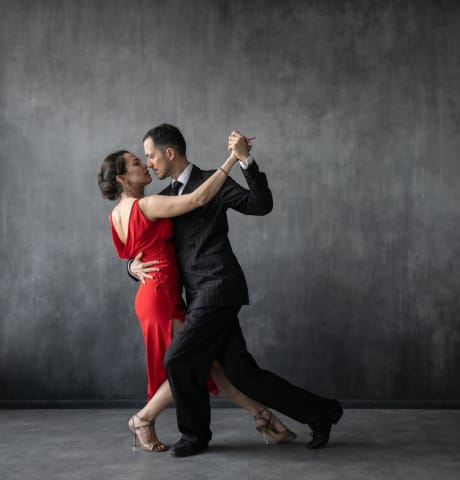 Looking for a Tango dance partnerIn the mood for Tango? Find a suitable dance partner for the next milonga with udansa.
 Recognizing the beat in dance music: How to hit every rhythmA sense of rhythm is not a secret, it is a matter of practice. Learn how to pick out the beat in dance music and move confidently in rhythm.
 Hearing the Cha-Cha-Cha beat: How to master the chasse timingIf you can hear the Cha-Cha-Cha beat correctly, you will dance the chasse on 4-and-1 with absolute ease. This guide shows you how to recognize the syncopated rhythm instantly.
 Salsa On 1 vs. On 2: The rhythmic differenceSalsa On 1 or On 2? This guide explains the rhythmic difference and how to hear the timing for both styles perfectly.
 Understanding West Coast Swing rhythm: 6-count and 8-count timingWest Coast Swing is known for its fluid dynamics and modern music. Our guide explains how to understand the rhythmic structure of 6-counts and 8-counts and feel them in your body.Test your sense of rhythm: Do you have the beat in your blood?Are you ready for the dance floor? Take this simple rhythm self-test to find out how good your sense of rhythm really is and how you can improve it.
 Recognizing the Waltz beat: How to hear the three-quarter timeThe three-quarter time of the Waltz is a challenge for many dancers. With this guide, you will learn to effortlessly hear the one in the beat for both Viennese and Slow Waltz.
 Hearing the Salsa beat: A guide to the Clave rhythmLearn how to decode the fascinating Clave rhythm of Salsa and land your basic step precisely on the beat. The practical guide for a better sense of rhythm.