
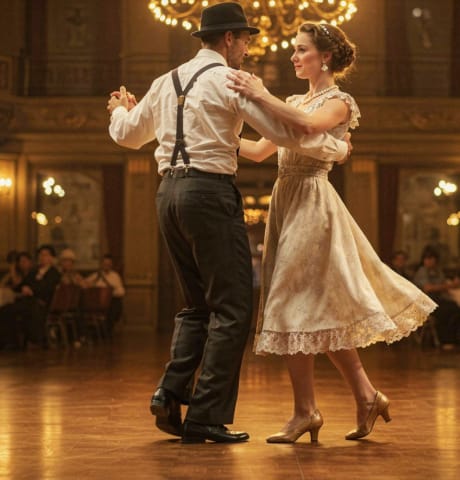
Find your dance partner for the next Waltz
On udansa you will find dance enthusiasts in your area who love the Waltz just as much as you do and want to improve their sense of rhythm on the dance floor together.


By Mary De LucaUpdated
On udansa you will find dance enthusiasts in your area who love the Waltz just as much as you do and want to improve their sense of rhythm on the dance floor together.
The three-quarter time of the Waltz is fascinating due to its elegant, circular flow. However, beginners in particular find it difficult to hear the distinctive one in the flow of the music and to start dancing at the right moment.
Three-quarter time is a musical time signature in which three quarter notes make up a measure. The typical characteristic in partner dance is the strong emphasis on the first beat, followed by two unstressed beats.
Three-quarter time differs fundamentally from the omnipresent four-quarter time of our modern pop music. While we are usually accustomed to a steady four-beat rhythm in everyday life, the Waltz challenges us with a circular movement in three steps. To be able to recognize a Waltz beat, you must train your ear to hear an asymmetrical emphasis. Unlike a march, which stubbornly emphasizes left-right, three-quarter time creates a feeling of swinging, of rising and falling. Once you have understood this difference, you will lose the fear of losing your place when recognizing the beat in dance music.
The biggest hurdle for beginners lies in internalizing the constant repetition of the three. Since the brain automatically searches for even structures, one tends to insert an artificial pause or add a fourth beat at the beginning. The secret lies in the constant flow: three is immediately followed by one again, without delay, without a breather. This rhythmic wheel turns incessantly and forms the stable foundation for every Waltz step.

The key to success lies in identifying the first beat in the measure. This so-called one carries the heaviest weight in the entire rhythmic structure. In musical practice, it is almost always emphasized by a deeper, louder instrument, often the bass or the timpani. In the Viennese Waltz, which is characterized by an immense speed of up to 60 measures per minute, this one acts like a powerful impulse that literally propels the couple across the dance floor.
To precisely grasp the timing in the Viennese Waltz, it helps to focus on the acoustic "boom-ta-ta". The deep "boom" unmistakably marks the one, while the two lighter "ta" beats (usually played by strings or woodwinds) fall on the two and three. When you learn to focus purely on this deep impulse, counting in the rapid flow of the music suddenly becomes playfully easy.
Listen carefully
Typical listening mistakes
If you want to feel the Waltz in your blood, you cannot just count steps, you must learn to internalize the rise and fall of the music.
The Slow Waltz, also known as the English Waltz, challenges your hearing in a completely different way. Since the tempo is drastically reduced here, there is plenty of space between the individual beats. You need to fill this space rhythmically without losing your orientation. If you want to find the one in the Slow Waltz, you must pay attention to the melodic elongation that often extends over the entire measure.
Because the music is so sustained, many couples tend to drag their steps or miss the one. Use the pause of the instruments here: The melody often builds up towards the one and releases exactly on the main beat. If you are preparing for the big performance at a festive ball night, this keen sense of hearing will help you present the elegant, wave-like movement of the dance in sync with the music. The Slow Waltz thrives on this conscious delay, which nevertheless always finds its center punctually on the one.
Fast and spirited in three-quarter time
The Wiener Walzer captivates with its rapid tempo and driving dynamics. The emphasis on the first beat is extremely dominant and leaves the couple hardly any time to think, which requires a quick physical reaction.
Elegant and sustained in the room
Waltz gives the dancer plenty of time to dance out the movement. Here, precisely hearing the one is crucial to not losing the elegant balance between rising and falling.
The one in Waltz is almost always the loudest and deepest beat in the measure. Focus on the bass or the percussion to hear this heavy pulse.
Viennese Waltz is almost twice as fast as Slow Waltz, with about 60 measures per minute compared to about 30 measures per minute for Slow Waltz. However, the basic rhythm remains a three-four time for both dances.
Count out loud in the rhythm 'One - Two - Three', emphasizing the 'One' strongly. As soon as your ear gets used to this three-beat structure, you can continue counting in your head.
Find the right dance course to put your sense of rhythm directly into practice.
Couple danceLimbach-Oberfrohna · Germany
PaartanzkreisMonday · 19:30 · Oct 12
Limbach-Oberfrohna
BallroomMeißen · Germany
Tanzkreis | PROFESSIONALTuesday · 20:15 · Oct 27, 2026 - Jan 5, 2027
“Ein Haus für Vieles” - Saal Tanzkurse
Couple danceLimbach-Oberfrohna · Germany
PaartanzkreisFriday · 18:15 · Oct 23
Limbach-Oberfrohna
 Recognizing the beat in dance music: How to hit every rhythmA sense of rhythm is not a secret, it is a matter of practice. Learn how to pick out the beat in dance music and move confidently in rhythm.
 Ball season: Your guide to glamorous nightsExperience the magic of the ball season with our comprehensive guide. We show you how to prepare perfectly for the dress code, dance steps, and etiquette.Recognizing the beat in dance music: How to hit every rhythmA sense of rhythm is not a secret, it is a matter of practice. Learn how to pick out the beat in dance music and move confidently in rhythm.
 Hearing the Salsa beat: A guide to the Clave rhythmLearn how to decode the fascinating Clave rhythm of Salsa and land your basic step precisely on the beat. The practical guide for a better sense of rhythm.
 Losing the beat while dancing: The 7 most common mistakesLosing the beat is part of learning to dance. Find out which seven typical rhythm mistakes lurk in partner dance and how you can easily correct them.
 Counting the Kizomba rhythm: Understanding the African beatGet to know the rhythmic structure of Kizomba music and learn how to use the batida for your syncopated steps.
 Modern dance music rhythms: Pop hits for partner dancingModern pop and chart hits are taking over the dance floor. In our trend report, learn how to perfectly analyze and dance to current beats in partner dancing.
 Counting the Discofox beat: comparing step systemsThe Discofox beat is a challenge for many dancers. This case study shows how the classic tap-step system differs from the modern three-step system when dancing to fast beats.
 BPM dance music chart: Tempos for all partner dancesOur clear BPM dance music chart shows you the exact speeds of all Ballroom and Latin dances for competitions and social dancing in comparison.