
Find the perfect partner for Discofox
Find motivated dance partners and the best dance courses in your area on udansa to try out your footwork directly on the dance floor.


By Mary De LucaUpdated
Find motivated dance partners and the best dance courses in your area on udansa to try out your footwork directly on the dance floor.
Discofox is the undisputed king of the dance floor, but its rhythmic structure often causes confusion. The secret lies in how the steps are distributed across the beats of the music. The typical discofox speed bpm is between 115 and 130 beats per minute. At this tempo, the chosen step system determines how dynamic and fluid the movement feels. While the classic 3-step rhythm (counted as 1, 2, 3) places each step on a full beat, the much more common variant with the tap step uses a rhythmic division. Here, you dance on counts 1, 2, 3-and, with the tap falling on the "and". Anyone who has trouble keeping time often tends to fall out of the beat. Typical mistakes and how to fix them are shown in the guide Falling out of time while dancing.
In the classic Discofox rhythm with 3 steps, the movements share the space in half a 4/4 bar. The fourth beat remains free without a weight change in the pure three-step system, which is an advantage for very fast songs from 130 BPM. The discofox 4 step beat, on the other hand, which is often used in Hustle or tournament variants, distributes four actual weight changes evenly across the four beats of the bar (1, 2, 3, 4). At high speeds, this requires extremely precise footwork and quick weight shifts. For beginners and relaxed social dancing, the system with the non-weight-bearing tap on 3-and is the most flexible solution, as it offers the perfect compromise between dynamics and rhythm control.

Listen to the heavy, steady bass beat of the music to grasp the basic tempo of the song.
Take the first step on the first loud beat of the measure and shift your weight completely.
Execute the second step on the second beat and keep your body upright and stable.
Place the ball of your free foot without weight on the count of three-and to complete the cycle.
Discofox is counted in a classic 4/4 time signature. The basic step spans three beats (1, 2, 3-and), which causes the step pattern to shift asymmetrically across the musical beats.
The tap is placed on the beat 3-and. It is a non-weight-bearing step that prepares the foot for a quick restart on the next beat 1.
The ideal speed for Discofox is between 115 and 130 BPM. At this tempo, both the basic step and fast turns can be danced in a controlled and harmonious way.
Find the right dance studio to put your sense of rhythm directly into practice.
Couple danceLimbach-Oberfrohna · Germany
PaartanzkreisMonday · 19:30 · Oct 12
Limbach-Oberfrohna
DiscofoxLimbach-Oberfrohna · Germany
Discofox Club - 14-tägigWednesday · 20:30 · Oct 21
Limbach-Oberfrohna
Couple danceLimbach-Oberfrohna · Germany
PaartanzkreisFriday · 18:15 · Oct 23
Limbach-Oberfrohna
 Losing the beat while dancing: The 7 most common mistakesLosing the beat is part of learning to dance. Find out which seven typical rhythm mistakes lurk in partner dance and how you can easily correct them.
 Hearing the Salsa beat: A guide to the Clave rhythmLearn how to decode the fascinating Clave rhythm of Salsa and land your basic step precisely on the beat. The practical guide for a better sense of rhythm.
 Test your sense of rhythm: Do you have the beat in your blood?Are you ready for the dance floor? Take this simple rhythm self-test to find out how good your sense of rhythm really is and how you can improve it.
 Recognizing the beat in dance music: How to hit every rhythmA sense of rhythm is not a secret, it is a matter of practice. Learn how to pick out the beat in dance music and move confidently in rhythm.
 BPM dance music chart: Tempos for all partner dancesOur clear BPM dance music chart shows you the exact speeds of all Ballroom and Latin dances for competitions and social dancing in comparison.
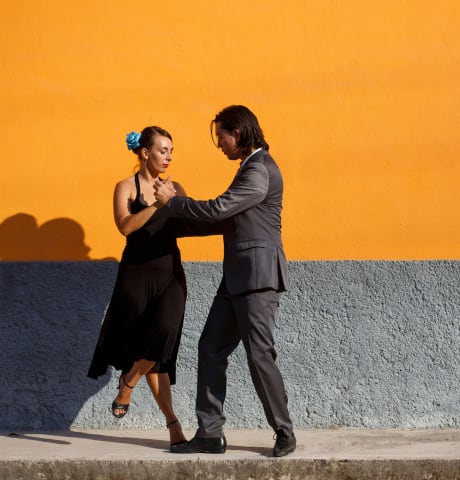 Hear the rhythm of Tango Argentino: Understand beat, Milonga & ValsTango Argentino fascinates with its musical depth. Our guide shows you how to hear the beat of Tango, Milonga, and Vals and adapt your steps perfectly to the music.
 Hearing the Cha-Cha-Cha beat: How to master the chasse timingIf you can hear the Cha-Cha-Cha beat correctly, you will dance the chasse on 4-and-1 with absolute ease. This guide shows you how to recognize the syncopated rhythm instantly.
 Salsa On 1 vs. On 2: The rhythmic differenceSalsa On 1 or On 2? This guide explains the rhythmic difference and how to hear the timing for both styles perfectly.
 Understanding West Coast Swing rhythm: 6-count and 8-count timingWest Coast Swing is known for its fluid dynamics and modern music. Our guide explains how to understand the rhythmic structure of 6-counts and 8-counts and feel them in your body.Test your sense of rhythm: Do you have the beat in your blood?Are you ready for the dance floor? Take this simple rhythm self-test to find out how good your sense of rhythm really is and how you can improve it.