
Find your dance partner at udansa
Here you can find like-minded people in your area and the right courses to put your new knowledge about the correct dance step speed bpm to the test directly on the dance floor.


By Bernhard De LucaUpdated
Here you can find like-minded people in your area and the right courses to put your new knowledge about the correct dance step speed bpm to the test directly on the dance floor.
Whether you are preparing for a tournament or just want to dance in a relaxed way at the next party: the right tempo in your ear determines whether your steps flow harmoniously with the music.
Official association guidelines
All BPM values comply with the official guidelines of the major dance sport associations for the year 2026.
Practical social values
The ranges for the social dance area are based on the experience of professional dance school DJs.
Independent compilation
No dance school or organization has paid for placement on this overview.
Competition: 174-180 BPM | Social: 150-180 BPM
The king of fast turns requires the highest precision. In competitive dancing, 58 to 60 bars per minute (174 to 180 BPM) are prescribed, while for social dancing, it can be a little slower.
Competition: 168-176 BPM | Social: 140-170 BPM
This lively and cheerful dance forms the fast finale of the Latin section. The rapid dance step speed in bpm requires quick kicks and very good balance.
Competition: 200-208 BPM | Social: 180-200 BPM
The sprightliest ballroom dance is bursting with joie de vivre and energy. With its quick chassés and hops, it is the most physically demanding dance on the floor.
Competition: 112-120 BPM | Social: 112-120 BPM
This fiery march dance simulates the torero's entrance into the arena. The music is dramatic, accentuated, and does not forgive rhythm errors.
Competition: 120-128 BPM | Social: 110-124 BPM
This cheeky, flirtatious dance thrives on syncopated steps and direct eye contact. Thanks to popular pop hits, it is an absolute favorite on the dance floor at parties.
Competition: 84-90 BPM | Social: 80-90 BPM
The epitome of romance and elegance. The slow movement gives couples plenty of room for soft, flowing rising and falling movements across the floor.
Competition: 100-108 BPM | Social: 96-104 BPM
The dance of love and passion captivates with its slowness. In the Latin dance tempo table, Rumba is the slowest counted dance, which requires enormous body control.
The speed in partner dance is measured in beats per minute (BPM). Anyone who masters recognizing the beat in dance music will quickly notice: the tempo determines not only the dynamics, but also the character of a dance. While extremely strict guidelines apply in competitive sports to allow for fair judging of the couples, learning ballroom dancing for social events is much more relaxed. DJs at a classic dance party or a ball often adapt the tempo to the skill level of the guests.
In competitive sports, the speed of standard dances is precisely regulated in bpm. A Slow Waltz, for example, must lie precisely within the prescribed range so that the couples can perfectly coordinate their rehearsed, expansive poses with the music. In social dance, however, the Latin dance tempo table is allowed to deviate upwards or downwards. A slightly slower Cha-Cha-Cha gives beginners the necessary time for clean chassés, while a faster Discofox heats up the atmosphere.
A Viennese Waltz is extremely fast at 58 to 60 bars per minute (approx. 174 to 180 BPM). The Slow Waltz, on the other hand, is danced at a leisurely 28 to 30 bars per minute (approx. 84 to 90 BPM).
Ballroom dances cover a wide spectrum from very slow to extremely fast. The range extends from approx. 84 BPM for the Slow Waltz to around 200 BPM for the rapid Quickstep.
In the typical Latin dance tempo table, the Rumba is the slowest at about 100 to 108 BPM. The Jive marks the upper end of the speed scale with a fast 168 to 176 BPM.
Find the right course to put your sense of rhythm into action.
Couple danceLimbach-Oberfrohna · Germany
PaartanzkreisMonday · 19:30 · Oct 12
Limbach-Oberfrohna
BallroomMeißen · Germany
Tanzkreis | PROFESSIONALTuesday · 20:15 · Oct 27, 2026 - Jan 5, 2027
“Ein Haus für Vieles” - Saal Tanzkurse
Couple danceLimbach-Oberfrohna · Germany
PaartanzkreisFriday · 18:15 · Oct 23
Limbach-Oberfrohna
 Test your sense of rhythm: Do you have the beat in your blood?Are you ready for the dance floor? Take this simple rhythm self-test to find out how good your sense of rhythm really is and how you can improve it.
 Recognizing the beat in dance music: How to hit every rhythmA sense of rhythm is not a secret, it is a matter of practice. Learn how to pick out the beat in dance music and move confidently in rhythm.Recognizing the beat in dance music: How to hit every rhythmA sense of rhythm is not a secret, it is a matter of practice. Learn how to pick out the beat in dance music and move confidently in rhythm.
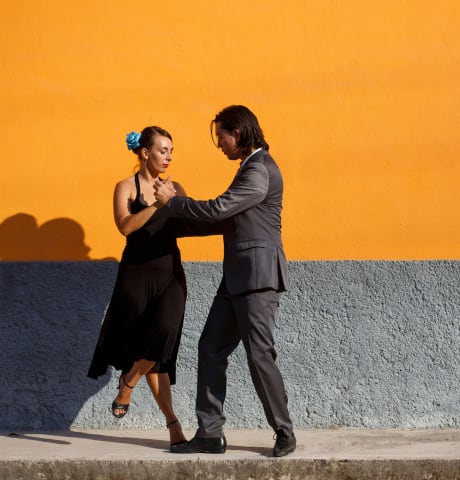 Hear the rhythm of Tango Argentino: Understand beat, Milonga & ValsTango Argentino fascinates with its musical depth. Our guide shows you how to hear the beat of Tango, Milonga, and Vals and adapt your steps perfectly to the music.
 Hearing the Cha-Cha-Cha beat: How to master the chasse timingIf you can hear the Cha-Cha-Cha beat correctly, you will dance the chasse on 4-and-1 with absolute ease. This guide shows you how to recognize the syncopated rhythm instantly.
 Salsa On 1 vs. On 2: The rhythmic differenceSalsa On 1 or On 2? This guide explains the rhythmic difference and how to hear the timing for both styles perfectly.
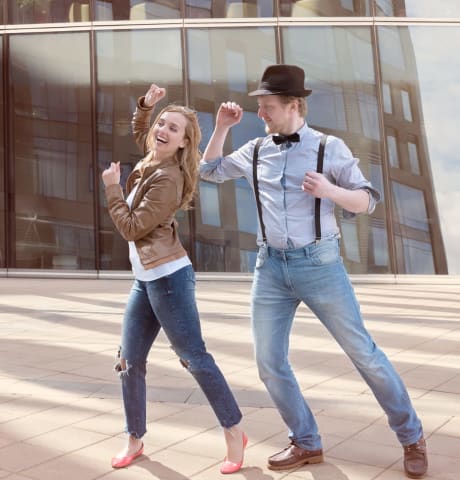 Understanding West Coast Swing rhythm: 6-count and 8-count timingWest Coast Swing is known for its fluid dynamics and modern music. Our guide explains how to understand the rhythmic structure of 6-counts and 8-counts and feel them in your body.Test your sense of rhythm: Do you have the beat in your blood?Are you ready for the dance floor? Take this simple rhythm self-test to find out how good your sense of rhythm really is and how you can improve it.
 Recognizing the Waltz beat: How to hear the three-quarter timeThe three-quarter time of the Waltz is a challenge for many dancers. With this guide, you will learn to effortlessly hear the one in the beat for both Viennese and Slow Waltz.