
Find your partner for the sliding door
On udansa you will find like-minded people who want to learn Discofox and its most beautiful figures with you. Sign up and discover dance courses, events, and dance partners in your area.



By Mary De LucaUpdated
On udansa you will find like-minded people who want to learn Discofox and its most beautiful figures with you. Sign up and discover dance courses, events, and dance partners in your area.
The sliding door brings momentum and elegance to the dance floor. With this guide, you will learn how to master this harmonious position change without stumbling.
The sliding door is one of the absolute classics among Discofox figures. It brings dynamics to your dance flow, as it breaks up the rigid frontal posture and leads the couple into a parallel movement side by side. Unlike the classic promenade from ballroom dancing, where both partners open up in a fan shape and march together in one direction, the sliding door in Discofox remains a genuine, compact change of place. The partners glide closely past each other while the connection via the hands remains intact. Anyone who masters the Discofox technique uses this figure to give the dance an elegant, almost floating appearance.
The appeal of the figure lies in the fluid change between proximity and distance. During the passing movement, a moment of openness is created, which immediately transitions back into the protective basic posture. This makes the sliding door an ideal transitional element to start more complex wraps afterwards. To execute the movement cleanly, controlled body tension is essential. Without this tension, the passing movement becomes sloppy, and the partners lose the shared beat.
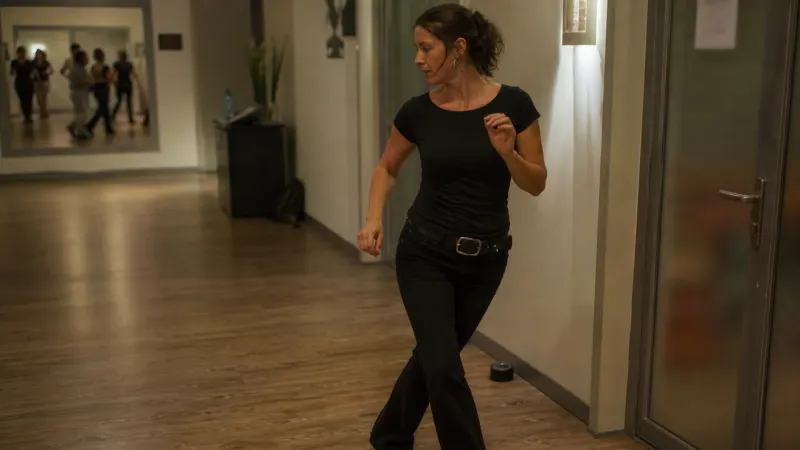
Dance a standard basic step together in a closed position to get in sync with the shared rhythm. This provides security for the transition.
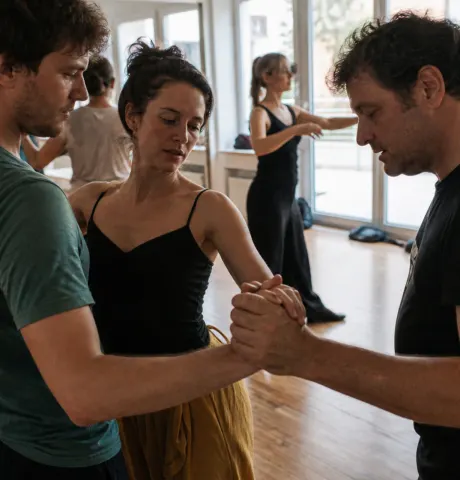
During the "tap" of the basic step, the leader opens the dance hold slightly to the side and releases the right hand from the follower's back. The connection is maintained only through the joined hands.
The leader guides the follower past them with a gentle, lateral impulse. Both partners take two steps forward to reach the other side, gliding closely past one another.
At the end of the position change, both partners turn back towards each other. With the final "tap", the movement is stopped and the balance is realigned.
After the successful change of position, immediately return to the closed facing position and continue the dance with the normal Discofox basic step.
Like this
Don't do this
Preparation
Arrival
During
The main difference lies in the movement sequence. In the promenade, both partners open up into a common walking direction, while the sliding door is a true change of place where the partners glide closely past each other and swap positions.
Leading is primarily done through body tension and the hands. During the basic step, the leader applies a slight pull outward and guides the partner flatly past them without jerking the arms up.
Yes, the sliding door is an excellent entry-level figure. As soon as you can dance the normal basic step confidently in time, the change of place can be learned easily in a few minutes.
Ready for the dance floor? Find the right course now and learn the Schiebetür live.
DiscofoxLimbach-Oberfrohna · Germany
Discofox Club - 14-tägigWednesday · 20:30 · Oct 21
Limbach-Oberfrohna
Couple danceLimbach-Oberfrohna · Germany
PaartanzkreisFriday · 18:15 · Oct 23
Limbach-Oberfrohna
Couple danceLimbach-Oberfrohna · Germany
Silberkurs für PaareSunday · 16:15 · Oct 25 - Nov 15
Limbach-Oberfrohna
 Discofox Wrap Figures: The Guide to Perfect ArmworkDiscover how classic Discofox wrap figures work anatomically and how to dance fluid combinations through proper armwork.
 Discofox technique: The key to posture, leading, and stylingMaster the Discofox technique for an elegant performance on the dance floor. Learn everything about proper posture, subtle leading, and stylish moves.
 Learn the Discofox basic step: step-by-step guideEvery beginning is easy: with our simple step-by-step guide to the Discofox basic step in triple time, you will be dancing confidently on any dance floor in no time.
 Discofox Figures: The Guide to Wraps and TurnsLearn how to add variety to your Discofox with clever wraps and elegant turns. Our guide shows you the essential basics for creating fluid combinations.
 5 easy Discofox moves for a quick startWith these five easy Discofox moves, you will be ready for any dance floor in no time. Learn the simplest turns and position changes for quick success.
 Lady's solo in Discofox: Leading turns correctlyThe lady's solo in Discofox is a real eye-catcher on any dance floor. In this guide, you will learn how to lead effortlessly with subtle hand signals and how the lady can always maintain her balance.Discofox Wrap Figures: The Guide to Perfect ArmworkDiscover how classic Discofox wrap figures work anatomically and how to dance fluid combinations through proper armwork.
 Discofox Brezel: Step-by-Step GuideThe Discofox Brezel is the classic among wrap figures. Learn how to wrap and untangle it perfectly in our step-by-step guide.
 The 10 best Discofox moves for advanced dancersMaster the most spectacular Discofox moves for advanced dancers. Discover complex wraps and dynamic turns for your next appearance on the dance floor.
 Discofox lifts: poses and show effects for the clubDo you want to upgrade your Discofox performance with spectacular poses? Our guide shows you how to present danceable show effects and easy lifts safely in the club.