
Find your partner for clubstyle
On udansa connect, you will find like-minded people in your city who are also into modern beats, fluid movements, and fresh dance styles. Simply sign up and find your perfect dance partner for the next club night.



By Bernhard De LucaUpdated
On udansa connect, you will find like-minded people in your city who are also into modern beats, fluid movements, and fresh dance styles. Simply sign up and find your perfect dance partner for the next club night.
The classic Discofox is the king of the dance floor, but in modern clubs, the traditional rhythm sometimes feels a bit stiff. If you want to dance modern discofox, you break out of the rigid patterns and borrow from related styles. The US-American Hustle, in particular, which is considered the elegant predecessor of Discofox, brings a completely new dynamic to the floor. Instead of rigid up-and-down movements, fluid, linear paths take center stage, giving the dance an urban casualness. Complemented by smooth hip movements and soft body waves from Latin dances, a modern Discofox emerges that fits perfectly with current pop and house tracks.
To successfully implement the club style, leaders and followers change their basic posture. The arm connection becomes more elastic, almost like a rubber band, which enables the typical push-and-pull effect of the Hustle. As a result, modern discofox figures gain space and dynamics. Instead of turning on the spot, dancers use the entire length of the dance lane. The integration of Latin elements also ensures that the upper body works in isolation and the steps are no longer placed clumsily, but rolled softly over the ball of the foot. The result is an extremely adaptable dance style that can be presented effortlessly on crowded club dance floors.

Release your rigid, tight dance posture and build an elastic connection through your hands. Through light pressure and tension, you create the necessary body tension for dynamic changes of direction.
Replace classic circular turns with linear movements along an imaginary line. The leader guides the follower past them and uses the space for expansive Hustle paths.
Let your hips and upper body sway softly to the beat, instead of keeping your body stiff. The movement starts in the knees and flows smoothly through your entire torso.
Use delays in your step pattern to intentionally place accents on highlights in the music. A short freeze or a smooth slide makes the dance immediately club-ready.
Clubstyle differs from classic Discofox primarily through its linearity and elasticity. While the traditional dance is often performed in a circle and with a lot of up-and-down movement, Clubstyle utilizes soft Latin body movements and the expansive, springy lines of Hustle.
Yes, you can dance modern Discofox to almost any pop, R&B, disco, or house music in 4/4 time. Due to the more flexible footwork and fluid movements, this dance style adapts much better to modern club beats than the traditional basic step.
Flat sneakers with a smooth-sliding sole are particularly suitable for Clubstyle. Since the dance is very dynamic and linear due to its Hustle influences, you need secure support combined with high pivotability on the dance or club floor.
Find the right course now and learn the modern club style from professionals.
DiscofoxLimbach-Oberfrohna · Germany
Discofox Club - 14-tägigWednesday · 20:30 · Oct 21
Limbach-Oberfrohna
BallroomMeißen · Germany
Tanzkreis | PROFESSIONALTuesday · 20:15 · Oct 27, 2026 - Jan 5, 2027
“Ein Haus für Vieles” - Saal Tanzkurse
Couple danceLimbach-Oberfrohna · Germany
PaartanzkreisFriday · 18:15 · Oct 23
Limbach-Oberfrohna
 Discofox Wrap Figures: The Guide to Perfect ArmworkDiscover how classic Discofox wrap figures work anatomically and how to dance fluid combinations through proper armwork.
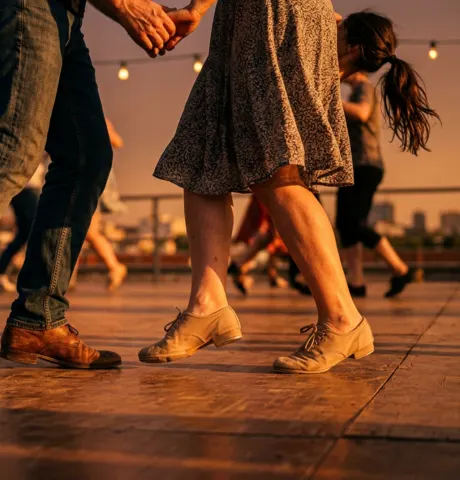 Discofox technique: The key to posture, leading, and stylingMaster the Discofox technique for an elegant performance on the dance floor. Learn everything about proper posture, subtle leading, and stylish moves.
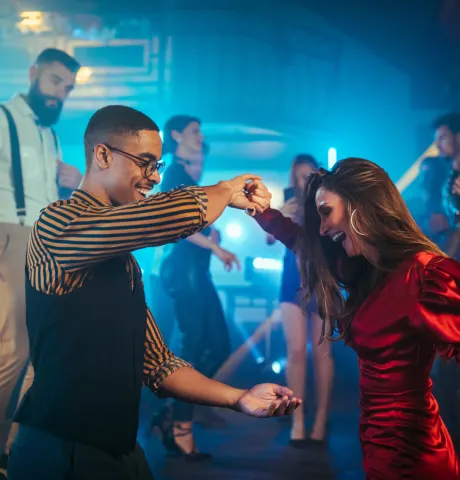 Discofox Figures: The Guide to Wraps and TurnsLearn how to add variety to your Discofox with clever wraps and elegant turns. Our guide shows you the essential basics for creating fluid combinations.Discofox Figures: The Guide to Wraps and TurnsLearn how to add variety to your Discofox with clever wraps and elegant turns. Our guide shows you the essential basics for creating fluid combinations.
 Discofox Figure Trends: New Wraps for the ClubThe Discofox season brings a fresh breeze to the clubs. Learn all about the latest wrap combinations and how to bring them elegantly to the dance floor.
 Discofox Sliding Door: Guide to the position changeThe sliding door is one of the most popular figures in Discofox. With our simple guide, you will master the position change elegantly and in time on any dance floor.
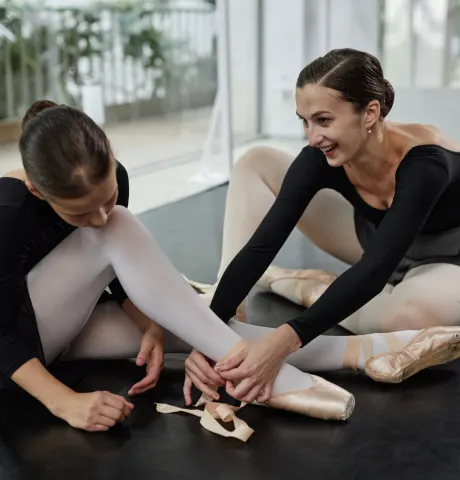 5 easy Discofox moves for a quick startWith these five easy Discofox moves, you will be ready for any dance floor in no time. Learn the simplest turns and position changes for quick success.
 Lady's solo in Discofox: Leading turns correctlyThe lady's solo in Discofox is a real eye-catcher on any dance floor. In this guide, you will learn how to lead effortlessly with subtle hand signals and how the lady can always maintain her balance.Discofox Wrap Figures: The Guide to Perfect ArmworkDiscover how classic Discofox wrap figures work anatomically and how to dance fluid combinations through proper armwork.
 Discofox Brezel: Step-by-Step GuideThe Discofox Brezel is the classic among wrap figures. Learn how to wrap and untangle it perfectly in our step-by-step guide.