Dance technique5 minutes

Discofox at any tempo: adapting steps to the music

By Mary De LucaUpdated

In a nutshell
  • You can adapt to extremely fast songs by significantly shortening your steps and maintaining a compact posture.
  • For very slow songs, you control the movement by consciously dancing with fluid weight shifts.
  • The fundamental rhythm of the basic step remains completely intact regardless of any changes in speed.
  • Stable body tension within the couple prevents the timing from being lost at extreme tempos.

Find your dance partner for every tempo

On udansa connect, you will find like-minded people in your region who love the play with rhythm just as much as you do. Make connections and take your footwork to the next level together with new dance partners.

Find your dance partner for every tempo

Whether it is a driving club beat or a cozy Schlager: only the right adjustment of your step speed makes you a flexible dancer who shines on every dance floor. Learn how to keep control when the tempo goes to extremes with udansa.

DefinitionBPM (Beats per Minute)

BPM stands for beats per minute and indicates the number of quarter notes per minute in a piece of music. In Discofox, this value significantly determines how quickly the sequence of steps must be performed.

How music influences the step pattern

The classic Discofox basic step is based on a fixed rhythm pattern that adapts perfectly to the typical 4/4 time of the music. But what happens when the DJ suddenly plays an extremely fast party hit or the mood shifts to a slow ballad? This is where the art of flexibly regulating your step size and dynamics comes into play, without losing the structure of the dance. To be able to adjust the Discofox speed, both dance partners must develop a fine sense for weight transfer. Anyone who simply tries to move their feet frantically at high speed will quickly lose their balance and contact with their partner.

An important key lies in reduction. With extremely fast songs, less is often more. Instead of expansive steps that take a lot of time, focus on minimal movements directly under your center of gravity. The tap is not executed as a heavy step, but as a feather-light touch of the floor. This maintains the necessary liveliness to remain precisely on the beat even at high speeds. Anyone who wants to consolidate the basics will find the ideal foundation for this fine-tuning in the guide Learn Discofox basic step.

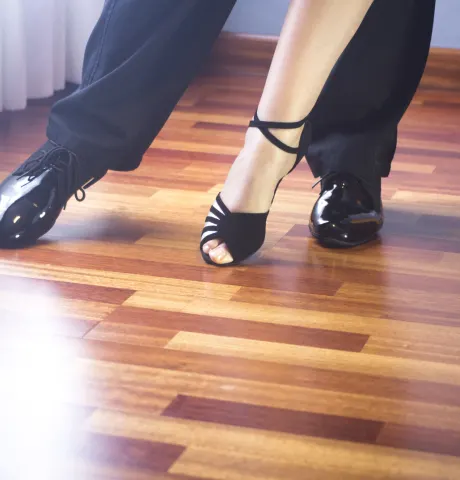
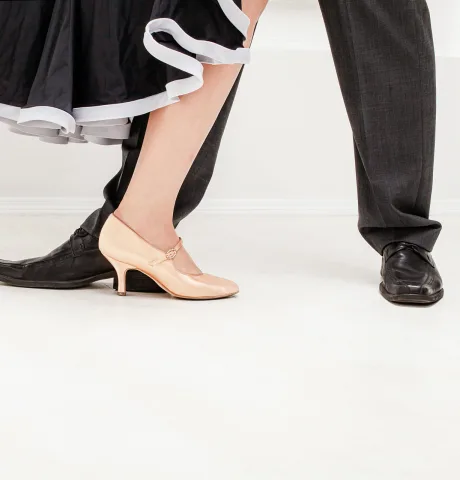
The focus on the feet shows: Only those who adapt their step size to the tempo will maintain perfect balance, even at extreme frequencies.

Compact footwork for fast-paced beats

When the music picks up and the beats per minute (BPM) skyrocket, many dance couples start to feel stressed. The solution for fast-tempo Discofox steps lies in a conscious adjustment of your posture and step length. As soon as the beat gets faster, you should keep your knees slightly bent and shift your center of gravity minimally forward. This shortens your reaction time and makes it possible to keep your steps extremely small. Large steps are the main reason why couples get out of sync during fast songs, as the distance for the foot simply becomes too long.

It also helps to make the arm connection more compact. The shorter the leverage between partners, the more directly and quickly the signals for the next movement are transmitted. In this way, the Discofox BPM step pattern can be kept stable even with fast-paced rhythms. The couple dances as a unit that moves compactly on the spot, instead of getting lost in expansive figures. If you want to learn more about the interaction within a couple, it is worth taking a look at the physical foundations in the article Learn to lead Discofox.

Step adjustment in direct comparison

Correct

  • Make steps extremely small at high tempos
  • Actively dance through the pauses in slow songs
  • Maintain a compact posture and body tension
  • Execute the tap as a feather-light touch

Wrong

  • Take large, sweeping steps to fast beats
  • Stop abruptly during movement when the music is slow
  • Let the arm connection go limp
  • Put your full weight on your foot when tapping

Anyone who masters the art of adjusting their step size to the tempo of the music will never lose their poise on the dance floor, even with the fastest club hits.

Dance instructor

The art of slowing down with slow songs

At the other end of the spectrum are the particularly slow songs. Here, a completely different challenge lurks: anyone who moves too early is unmusical, and anyone who waits easily starts to wobble. For a discofox slow song step sequence, excellent balance and conscious body tension are required. The pauses between the individual beats must be actively danced. Instead of simply stopping the movement, you use the time to shift your weight gently and continuously from one foot to the other. The transition becomes fluid and elegant.

With slow pieces, you can also perform the steps more consciously and softly. The tap is placed with a deliberate delay, which gives the dance a chic, almost floating look. This conscious slowing down requires trust and clear coordination within the couple. Every weight shift must be communicated precisely so that no gaps in the leading occur. You can also learn how important precise timing on the dance floor is in the overarching guide Discofox music and dance practice, which deepens the interplay of rhythm and movement.

Two extremes, one basic step

Fast

Small steps, high frequency

Compact dynamics for high BPM counts

For fast songs, reduce your step size to a minimum. Keep your knees slightly bent, your center of gravity forward, and your arms in a compact, stable connection.

Slow

Danced-out weight transfer

Fluid elegance in calm rhythms

Slow music calls for large, soft movements. The time between beats is used for a controlled weight transfer, ensuring the flow of movement never stops.

Frequently Asked Questions

  1. Small steps save time and energy. By keeping your footwork to a minimum and lowering your center of gravity slightly, you can easily keep up with the fast sequence of steps without running out of breath.

Discofox courses near you

Find the right course on udansa and learn how to adapt to any rhythm with ease.

View all matching courses