
Find your perfect dance partner
Here you can find like-minded people who share your passion and with whom you can conquer the dance floor, no matter which foot you start with.



By Mary De LucaUpdated
Here you can find like-minded people who share your passion and with whom you can conquer the dance floor, no matter which foot you start with.
Left-handed people often have fine coordination in everyday life, but this can cause confusion when dancing. With the right tricks, your dominant side will become your greatest advantage on the dance floor.
Dancing Discofox in mirror image refers to the mental or physical adaptation of step patterns to the dominant side of the body, in order to facilitate coordination for left-handed dancers. The sequence of movements is mirrored in the mind to make optimal use of natural motor skills.
If you start dancing as a left-hander, you often encounter an invisible barrier in your mind. The motor dominance of the left side of your body makes movements that start on the right feel unnatural and stiff at first. In Discofox, the leader traditionally starts with the left foot, which actually suits left-handers. The challenge, however, lies in the weight transfer and the coordination of the entire left side of the body, which instinctively wants to take the lead while the dance posture requires a symmetrical alignment.
To break down this barrier, it helps to mentally mirror the movement sequence. It is not about physically dancing the steps the other way around, but about adjusting your own perception. If you understand how Discofox technique is based on weight transfer and body tension, you can specifically use your strong left side to bring stability to the basic step instead of fighting against your natural predisposition.
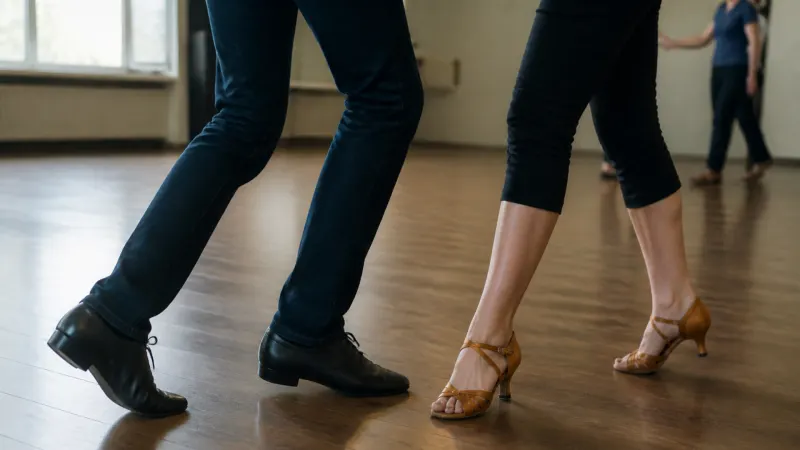
The classic triple-step rhythm of Discofox requires precise weight transfer. For left-handers, there is a strong temptation to shift weight to the left side too early or too forcefully, which disrupts the rhythm. The solution is to consciously use the discofox weight transfer to the left as an anchor. When you take the step to the left, catch your weight softly in the knee instead of falling onto your foot uncontrollably. This gives you the necessary balance for the following tap.
Systematic individual training helps to transfer these sequences into muscle memory. Anyone who wants to learn the Discofox basic step should first practice the steps without a partner and at an extremely slowed-down tempo. Focus exclusively on the feeling in your feet: weight on the left, weight on the right, followed by the unweighted tap. Only when this sequence runs smoothly and without conscious thought is the body ready for coordination as a pair.
Correct
Wrong
As soon as you stop fighting your own handedness and start using your dominant side specifically for stability as a couple, the mental block almost dissolves on its own.
When two people dance together, two movement patterns meet. Left-handed leaders sometimes tend to transmit signals too dominantly through the left arm, which can make the connection rigid. Here, it is important to initiate the leading impulses from the core and not from pure arm strength. The left hand merely maintains contact, while the right arm offers the partner the stable boundary she needs for her turns.
For left-handed followers, the mirror principle applies equally. Since the leader's impulse is usually transmitted via his left hand to your right hand, you must learn to receive these signals sensitively, even though your strong side is on the left. Use your left hand on the partner's shoulder to regulate the distance and build a stable connection. With the right balance, the dance becomes a harmonious dialogue where handedness no longer plays a role.
Using your strong left side in a controlled way
As a leader, you use your strong left side to give precise impulses. Make sure to keep your left arm elastic so that your leading feels inviting rather than restrictive.
Build stability through your left hand
As a follower, you receive signals through your right side, while your left hand on your partner's shoulder provides the necessary stability and the correct distance.
No, the sequence of steps remains identical in a pair, as the leader starts with the left foot anyway. Left-handed people simply need to learn to control their dominant left side more sensitively when leading.
Focus on the tap step while practicing. The tap must not carry any weight, as it serves purely as a change of direction and prepares the transition for the next step with the left foot.
Yes, solo training is highly recommended. By practicing the basic step alone on a straight line, you consolidate the weight transfer without having to focus on a partner.
Find the right course to consolidate your steps at your own pace.
DiscofoxLimbach-Oberfrohna · Germany
Discofox Club - 14-tägigWednesday · 20:30 · Oct 21
Limbach-Oberfrohna
Couple danceLimbach-Oberfrohna · Germany
PaartanzkreisFriday · 18:15 · Oct 23
Limbach-Oberfrohna
Couple danceLimbach-Oberfrohna · Germany
Silberkurs für PaareSunday · 16:15 · Oct 25 - Nov 15
Limbach-Oberfrohna
 Learn the Discofox basic step: step-by-step guideEvery beginning is easy: with our simple step-by-step guide to the Discofox basic step in triple time, you will be dancing confidently on any dance floor in no time.
 Discofox technique: The key to posture, leading, and stylingMaster the Discofox technique for an elegant performance on the dance floor. Learn everything about proper posture, subtle leading, and stylish moves.
 Learn Discofox steps: The easy way to the basic stepThe Discofox basic step is the foundation for every dance night. Learn how to master the rhythm and perform the steps flawlessly on the dance floor.Learn the Discofox basic step: step-by-step guideEvery beginning is easy: with our simple step-by-step guide to the Discofox basic step in triple time, you will be dancing confidently on any dance floor in no time.
 Discofox 3-step or 4-step: A comparisonClassic 3-step or modern 4-step? We compare both discofox systems and help you decide which one is right for you.
 Discofox Level Test: How well do you really dance?How well do you really dance Discofox? Use our interactive level test to find out if you are still working on the basics or are ready for the pro league.
 Mastering the Discofox tap: How to stay on beatThe tap is the rhythmic heart of the Discofox. Learn how to master your weight transfer and avoid common pitfalls here.
 Avoiding Discofox footwork errors: Confident on the dance floorIf you trip while dancing Discofox, you are often looking for the mistake in the wrong place. Learn how to avoid common footwork errors and keep your rhythm here.
 Practice Discofox solo: A guide to footworkLearn the Discofox basic step at home without a partner. Build the perfect foundation with this guide to footwork.