
Find your perfect dance partner
On udansa, you will find like-minded people in your city who also want to polish their footwork, as well as suitable courses for every level.



By Bernhard De LucaUpdated
On udansa, you will find like-minded people in your city who also want to polish their footwork, as well as suitable courses for every level.
If you lose the beat in Discofox, you usually blame your arms or the lead. But the real cause of stumbling almost always lies deeper: in imprecise footwork.
Focus on footwork
All analyzed movement errors relate exclusively to footwork in partner dance.
Practicality
The described approaches have been tested in practice by experienced dance instructors.
Independent selection
No financial contributions were accepted for this systematic compilation.

Mistake 1, dance practice, all levels
Anyone who does not fully shift their weight onto the new foot during a step blocks the free foot for the following step. This immediately leads to uncontrolled stumbling and pulls the couple out of the shared rhythm.
Mistake 2, dance practice, beginners to advanced
Steps that are too wide cost time and energy, which becomes a problem especially at a fast Discofox tempo. Dancers fall behind the music and the harmonious connection within the couple is lost.
Mistake 3, dance practice, beginners
The tap is a step without a weight transfer. If the body weight is incorrectly shifted onto the tapping foot, you are standing on the wrong foot and the next basic step starts incorrectly.
Mistake 4, dance practice, all levels
Anyone who stomps down flat with the entire sole of the foot loses the necessary liveliness. Discofox requires dancing on the balls of your feet to execute quick turns and changes of direction with agility.
Mistake 5, dance practice, beginners
Uncontrolled dragging of the feet across the floor increases friction and quickly leads to tripping on dull surfaces. Feet must be lifted precisely and placed lightly.
Mistake 6, dance practice, all levels
If partners move too far apart during the basic step, the tension is lost. A compact basic step ensures that footwork remains coordinated and collisions are avoided.
Mistake 7, dance practice, all levels
If the rhythm is counted rigidly without listening to the actual music, the couple often dances off-beat. The footwork must flexibly adapt to the speed of the song.
Footwork in Discofox appears playfully light, but it forgives no carelessness regarding weight transfer. If you lose the rhythm in partner dancing, it is almost always due to an incomplete transfer of weight. Many dancers tend to only hint at steps and leave their body weight on both legs. This blocks the next step and inevitably leads to stumbling. Every forward, backward, or sideways movement requires a conscious and complete shift of your center of gravity onto the standing foot.
Another critical point is step size. Steps that are too large tear the dance posture apart and make it impossible to stay on beat during fast songs. If you want to learn Discofox steps, get used to small, controlled movements from the beginning. This saves energy and gives you the necessary balance to maneuver confidently even on crowded dance floors. Focus on keeping your feet flat above the floor and using the ball of the foot as the primary contact point.
To permanently correct errors in footwork, a structured look at your own technique helps. A solid foundation in Discofox technique protects you from internalizing incorrect movement patterns. Use joint training to specifically pay attention to your partner's footwork and give each other feedback. Only those who place their feet precisely create the space for fluid turns and harmonious transitions in dance.
If you keep stumbling, it is usually due to taking steps that are too large or an incomplete weight transfer. Minimize your steps and transfer your body weight completely onto the new standing foot with every step, so that the other foot is completely free for movement.
The tap is purely a touch step without weight. If you perform the tap incorrectly and transfer your body weight onto it, your other foot will be blocked for the next basic step, which will immediately throw you off beat.
Small steps are the key to fast songs. Keep your feet close together, dance primarily on the balls of your feet, and avoid expansive movements to minimize inertia and follow the tempo of the music effortlessly.
Find the right dance course now to take your footwork to the next level.
DiscofoxLimbach-Oberfrohna · Germany
Discofox Club - 14-tägigWednesday · 20:30 · Oct 21
Limbach-Oberfrohna
Couple danceLimbach-Oberfrohna · Germany
PaartanzkreisFriday · 18:15 · Oct 23
Limbach-Oberfrohna
Couple danceLimbach-Oberfrohna · Germany
Silberkurs für PaareSunday · 16:15 · Oct 25 - Nov 15
Limbach-Oberfrohna
 Learn Discofox steps: The easy way to the basic stepThe Discofox basic step is the foundation for every dance night. Learn how to master the rhythm and perform the steps flawlessly on the dance floor.
 Discofox technique: The key to posture, leading, and stylingMaster the Discofox technique for an elegant performance on the dance floor. Learn everything about proper posture, subtle leading, and stylish moves.Learn Discofox steps: The easy way to the basic stepThe Discofox basic step is the foundation for every dance night. Learn how to master the rhythm and perform the steps flawlessly on the dance floor.
 Practice Discofox solo: A guide to footworkLearn the Discofox basic step at home without a partner. Build the perfect foundation with this guide to footwork.
 Dancing Discofox in place: adapting steps for tight spacesLearn how to perfectly adapt your Discofox to tight dance floors. With minimal steps and stable posture, you will maintain full control even in the thickest crowds.
 Discofox at any speed: Adapting steps to the musicLearn how to effortlessly adapt your basic Discofox step to extremely fast or slow songs. With the right technique, you will maintain perfect balance at any tempo.
 Discofox turns: The correct footwork for him and herThe first turn in Discofox brings energy to the dance floor. With this guide to correct footwork, you will turn with stability, harmony, and perfect rhythm.
 Modernizing Discofox steps: New trends for your footworkBring a breath of fresh air to your Discofox. With modern rhythmic variations and syncopations, you can break out of the classic routine and dance with more dynamics.
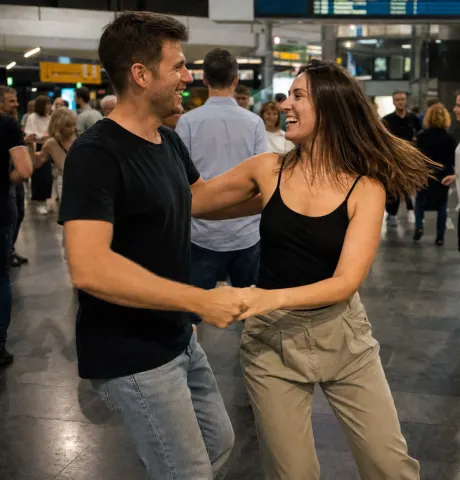 Discofox steps for the club: Ready for the dance floorIf you want to dance Discofox in a club, you will quickly reach your limits on crowded dance floors. With the compact club step, you can perfectly adapt your footwork to the party hustle.