
Find your dance partner on udansa
On udansa, you can find dance enthusiasts in your area who want to conquer the dance floor just like you. Make connections and find the perfect partner for your next Discofox evening.



By Bernhard De LucaUpdated
On udansa, you can find dance enthusiasts in your area who want to conquer the dance floor just like you. Make connections and find the perfect partner for your next Discofox evening.
When the dance floor is full, space quickly becomes tight. With the right technique, you can adapt your steps so that you can dance Discofox confidently and elegantly, even in the smallest of spaces.
Stationary dancing refers to a movement technique in partner dance where the couple barely changes their position on the dance floor and keeps their steps extremely small. This method makes it possible to dance rhythmically and in a controlled manner, even when space is very limited.
The classic Discofox is famous for its dynamics. However, anyone who takes wide steps on a crowded dance floor will quickly reach their limits. If you want to dance Discofox in place, you have to drastically reduce your usual step size. Instead of placing your foot far forward or backward, the movement remains under your own center of gravity. Specifically, this means: the steps become so small that they almost look like walking on the spot.
This adjustment requires conscious control of your footwork. With every step, you place your foot flat and controlled, without throwing your weight around uncontrollably. This allows you to maintain full balance, even when the space around you is extremely limited. Reducing the step size also saves your energy and ensures that you do not lose the beat, even during fast songs.

A common mistake when dancing in a stationary position is the loss of body tension. When the range of motion shrinks, many couples tend to collapse in their upper body. However, especially when dancing Discofox in a stationary position, an upright, stable posture is essential. The connection between the leader and the follower must remain elastic, but compact. The elbows stay close to your own body and do not move outwards.
Through this compact posture, every weight shift is transmitted immediately. Since there is no room for expansive signals, the partner reacts to the finest muscle impulses in the torso. Anyone who masters the Discofox technique for tight spaces uses the push and pull in their hands in an extremely controlled manner. This way, the couple remains stable as a unit without crowding the couples in the immediate vicinity.
Correct
Incorrect
True quality of leading is revealed in tight spaces. Those who dance big only dodge, those who dance small control their body perfectly.
When there is no room for forward and backward steps, rotation offers the perfect alternative. Turning on the spot is the most elegant method to create dynamics without taking up space. Instead of moving your feet linearly, you use your footwork to rotate the couple at minimal angles around their own axis. Each partial turn is executed close to your partner.
The precise execution of the tap is particularly important here. Since the foot does not take any weight during the tap, it serves as the perfect anchor to realign the direction in the smallest of spaces. If you want to learn the Discofox basic step and apply it at parties, you should integrate stationary turning into your training early on. It takes all the stress out of dancing on crowded floors.
Steps along the line
Linear footwork uses targeted forward and backward steps on an imaginary line. It is perfectly suited for open dance floors to demonstrate dynamics and space in the room.
Dancing on a coaster
Stationary footwork shifts the weight almost exclusively under your own body. It is the ideal choice for crowded clubs, as it prevents collisions and ensures maximum stability.
On a crowded dance floor, you should reduce your step size to a minimum. Keep your elbows close to your body and use slight rotations around your own axis instead of moving linearly through the room.
Yes, all wrap figures can be danced in a stationary manner. It is important that the leader guides the partner closely past them and keeps the arm movements compact to avoid hitting other couples.
If you take steps that are too large, you will quickly lose your balance in the crowd and risk collisions. Furthermore, wide footwork makes it difficult to react quickly to tempo changes when space is limited.
Find the right dance school and learn the perfect technique for every dance floor.
DiscofoxLimbach-Oberfrohna · Germany
Discofox Club - 14-tägigWednesday · 20:30 · Oct 21
Limbach-Oberfrohna
Couple danceLimbach-Oberfrohna · Germany
PaartanzkreisFriday · 18:15 · Oct 23
Limbach-Oberfrohna
Couple danceLimbach-Oberfrohna · Germany
Silberkurs für PaareSunday · 16:15 · Oct 25 - Nov 15
Limbach-Oberfrohna
 Learn the Discofox basic step: step-by-step guideEvery beginning is easy: with our simple step-by-step guide to the Discofox basic step in triple time, you will be dancing confidently on any dance floor in no time.
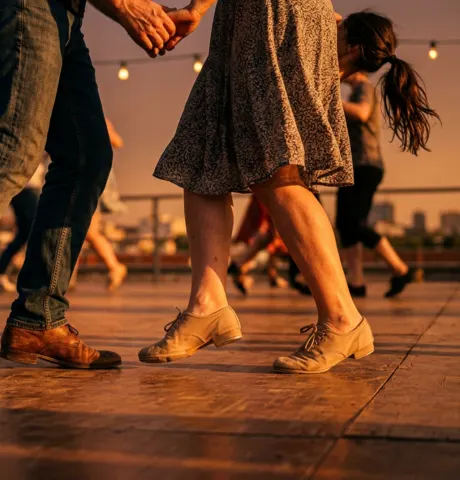 Discofox technique: The key to posture, leading, and stylingMaster the Discofox technique for an elegant performance on the dance floor. Learn everything about proper posture, subtle leading, and stylish moves.
 Learn Discofox steps: The easy way to the basic stepThe Discofox basic step is the foundation for every dance night. Learn how to master the rhythm and perform the steps flawlessly on the dance floor.Learn Discofox steps: The easy way to the basic stepThe Discofox basic step is the foundation for every dance night. Learn how to master the rhythm and perform the steps flawlessly on the dance floor.
 Discofox at any speed: Adapting steps to the musicLearn how to effortlessly adapt your basic Discofox step to extremely fast or slow songs. With the right technique, you will maintain perfect balance at any tempo.
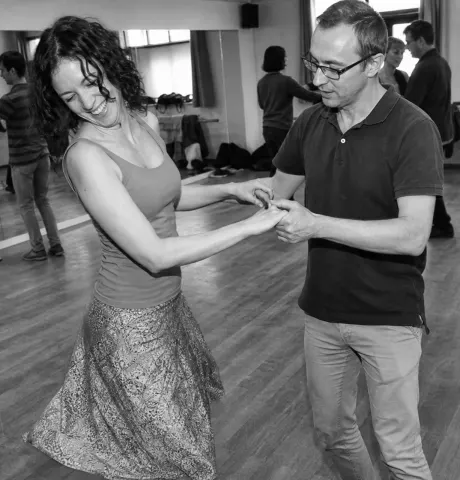 Discofox turns: The correct footwork for him and herThe first turn in Discofox brings energy to the dance floor. With this guide to correct footwork, you will turn with stability, harmony, and perfect rhythm.
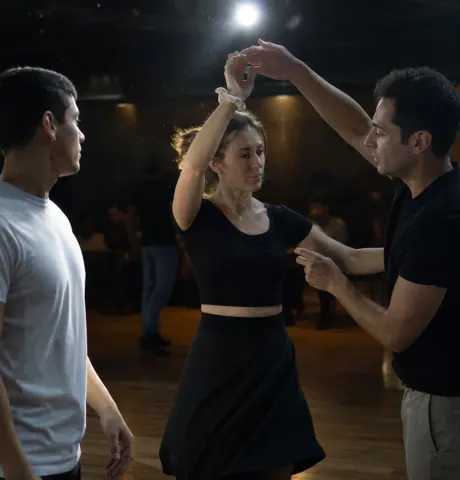 Modernizing Discofox steps: New trends for your footworkBring a breath of fresh air to your Discofox. With modern rhythmic variations and syncopations, you can break out of the classic routine and dance with more dynamics.
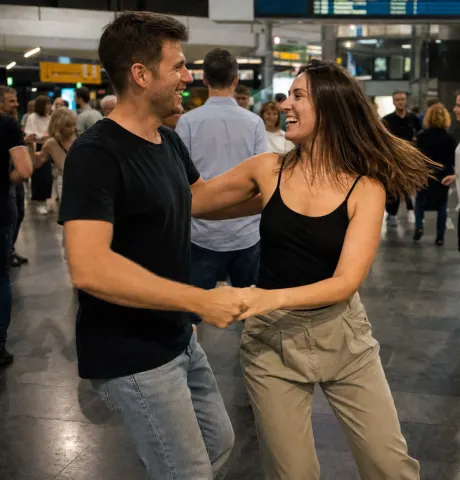 Discofox steps for the club: Ready for the dance floorIf you want to dance Discofox in a club, you will quickly reach your limits on crowded dance floors. With the compact club step, you can perfectly adapt your footwork to the party hustle.
 Discofox for left-handers: tips for steps and coordinationGetting started with Discofox is surprisingly easy for left-handers with the right approach. This guide shows you how to optimally adapt your coordination and weight distribution.Learn the Discofox basic step: step-by-step guideEvery beginning is easy: with our simple step-by-step guide to the Discofox basic step in triple time, you will be dancing confidently on any dance floor in no time.