Film scenes5 minutes

Learn the Zorba the Greek dance: The beach scene in brief

By Mary De LucaUpdated

In brief
  • The short learning version combines relaxed shoulder contact with side steps to the right and left.
  • You dance side by side in the same direction and both start with your right foot.
  • At first, each foot action lasts two counts, then one, with correspondingly smaller steps.
  • This simplified sequence follows the tempo build of the beach scene, not its full choreography.

When you accelerate together, every little delay stands out: one foot lags behind, an arm is already pulling ahead. This interplay is precisely what makes the short sequence an exercise that requires both of you to pay attention.

What you need for the short sequence

  • A second person for the shared sequence
  • A flat, dry floor with clear space on both sides
  • Comfortable clothing and flat shoes that fit securely
  • An audible counting aid or a suitable music recording
  • Light shoulder contact that you can maintain without pain

The tempo buildup makes the learning version recognizable

The beach scene from Alexis Sorbas, also known as Zorba the Greek, cannot be captured by a sequence of steps alone. What stands out above all is how two people side by side move from a calm beginning into increasingly fast movement. Their shoulder contact makes their shared rhythm visible. For your short version, a few sideways movements are enough, danced with plenty of time between them at first and then closer together.

The following exercise is a deliberately simplified learning version, not a faithful Sirtaki choreography. Cross-steps, low positions and jumps are left out. The principle of reducing a film scene to movements that are easy to practice is also clear in the learning version of the Footloose finale.

Distinguish between the music tempo and the density of your steps: to evenly spaced beats, you can first step on every other beat, then on every beat. That alone creates a clear impression of acceleration. A recording that actually gets faster will challenge you further. Introducing both at the same time makes coordination unnecessarily difficult. Knowing how to gradually increase the exertion when dancing is especially helpful for longer repetitions. For this passage, what matters is that your feet carry the rhythm and your arms do not force it.
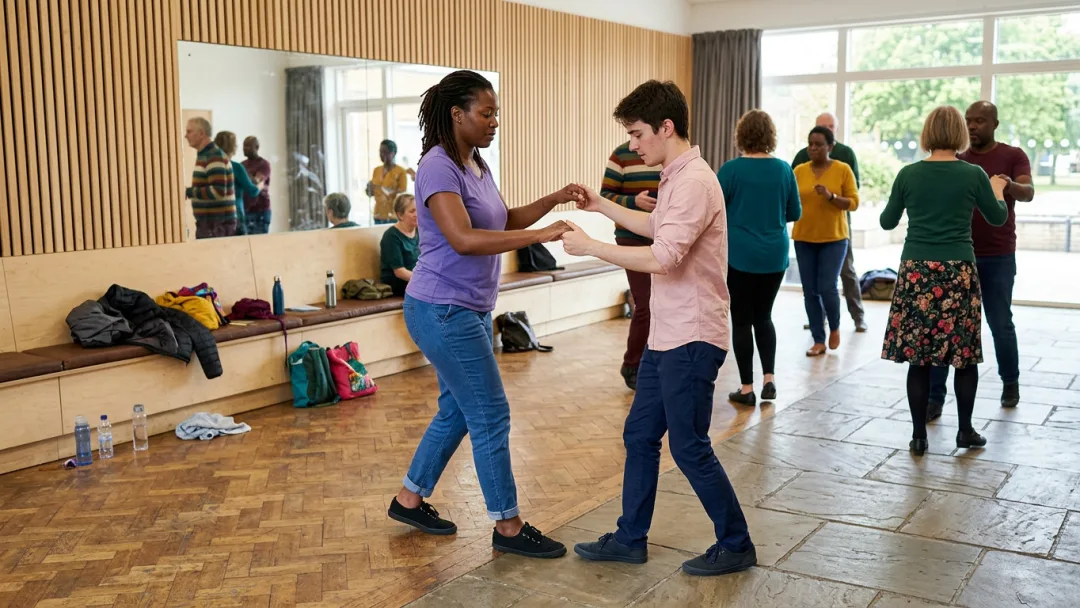
Audible contact between the soles and the floor can reveal during practice whether both feet really land at the same time.

Build the short sequence together

  1. Establish shoulder contact side by side

    Stand facing the same direction and each place one hand lightly on the other person's near shoulder. Keep your outer arms relaxed and your elbows soft, without leaning on each other.

  2. Shift Your Weight to the Left

    Both of you shift your weight onto your left foot, leaving your right foot free. One of you takes charge of counting and signals the start with “Go,” without pushing over the shoulder.

  3. Dance the right half slowly

    Step right to the side on 1, hold 2; close left with weight on 3, hold 4. Step right to the side on 5, hold 6; tap left next to right without weight on 7, hold 8.

  4. Complete the left half

    Step left to the side on 9, hold 10; close with the right foot, putting weight on it, on 11, hold 12. Step left to the side on 13, hold 14; tap the right foot next to the left without weight on 15, hold 16.

  5. Connect both halves smoothly

    First, repeat the entire block of 16 counts twice at an even counting pace. After the right tap, the right foot is free again to begin; the connection is successful if neither of you needs an extra weight change.

  6. Tighten up the footwork

    Dance the same sequence over eight counts: right, close left, right, tap left, left, close right, left, tap right. Give each action one beat, make the side steps smaller, and repeat the quick block twice without adding any jumps.

  7. Hold the final tap together

    Finish the second fast block with the right tap next to the left, and hold there for two beats. Then release shoulder contact; if the music speeds up, end the exercise earlier as soon as your steps get out of sync.

Stay connected without pulling on each other

Like this

  • Keep your hand open and light on their shoulder
  • When closing, take on their full weight
  • When tapping, keep your weight on your supporting foot
  • Shorten the side steps at a faster tempo

Not like this

  • Pinch the shoulder firmly with your fingers
  • Just place the closing foot down and leave it unweighted
  • Unknowingly switch to the tapping foot while tapping
  • Take larger lunging steps at higher speeds

Three checkpoints for your run-through

Before You Start

Positioning

After the slow block

Coordination

After the quick finish

Ending

Frequently Asked Questions

  1. For a connection to the film scene, the well-known music by Mikis Theodorakis from Alexis Sorbas is a good choice. You don't need it for your first practice sessions: counting aloud at an even pace makes the weight changes easier to understand. Start using music for the slow section and finish your short version before the tempo gets ahead of your ability to perform it safely.

Practice the tempo change together

On udansa, you can find dance partners to practice the short beach scene and its tempo change with. In your search, mention that you'd like to try a simplified sequence with side steps.

Practice the tempo change together