
Your entry into the dance world
On udansa connect, you will find like-minded people who share your joy of movement. Discover suitable courses and make contacts in your area to get started together.


By Mary De LucaUpdated
On udansa connect, you will find like-minded people who share your joy of movement. Discover suitable courses and make contacts in your area to get started together.
Jazz Dance combines pure joy of life with rhythmic precision. If you are an adult starting out without any prior knowledge, you will find a wonderfully free solo dance style here that challenges your entire body and completely clears your head.
Jazz Dance Basics refer to the fundamental movement elements of jazz dance, which include controlled body isolations, the gliding jazz walk, and dynamic weight changes. They form the foundation for every choreography in solo dance.
When people think of Jazz Dance, they often immediately picture the glittering world of Broadway, perfectly synchronized ensembles in musicals, or the strict aesthetics of classical ballet. But for starting out as an adult, all of that is secondary. At its core, Jazz Dance is about the joy of living, rhythm, and the freedom to move your own body to the music. This dance style emerged from a fusion of African movement traditions with European influences and is characterized by its enormous dynamism.
In contrast to ballet, which often requires very rigid rules and an extreme outward rotation of the legs, Jazz Dance works with a natural posture. You do not need to be able to do the splits, nor do you need to have started training as a child. A modern Jazz Dance solo course picks you up exactly where you are physically. It is about developing a healthy body awareness, improving your own coordination, and translating the energy of the music directly into movement.

A typical solo jazz dance class always begins with a thorough warm-up. During this, the entire body is mobilized, stretched, and warmed up. A central element that you will learn from the start is what are known as isolations. In these, you move individual body parts, for example just the head, the shoulders, or the pelvis, completely independently of the rest of the body. This trains coordination and lays the foundation for all further movements.
After the warm-up, the first diagonal exercises across the room follow. This is where typical jazz dance basics come into play. These include fluid steps like the "Jazz Walk," where you glide smoothly through the room with slightly bent knees, or the "Chassé," an elegant step-together-step. Simple turns and controlled weight shifts are also built up step by step. At the end of a class, you will usually dance a short, exciting choreography where you can try out what you have learned directly to the music.
Correct
Wrong
In Jazz Dance, it is not about perfection like in ballet, but about feeling the music with every fiber of your body and letting that energy out.
The biggest advantage when adults learn Jazz Dance is the immediate applicability without pressure. You do not have to learn complicated partner dance rules, and you are not dependent on a partner leading you or following your steps. You focus entirely on yourself, your balance, and your rhythm. This clears your mind and offers an ideal balance to a stressful everyday life.
If you are wondering whether this dynamic style suits you, it is worth taking a look at our guide Which dance style suits me? The great guide for beginners. If you are specifically looking for a way to really let off steam and build your endurance at the same time, the article Dancing as a fitness sport: The best styles for your endurance is also an excellent source of inspiration. Jazz Dance combines the best of both worlds: It is a demanding full-body workout and a highly emotional art form at the same time.
Traditional roots and rhythm
Here, the focus is on rhythmic precision, earthy movements, and classic isolations. The music ranges from traditional jazz to fast swing rhythms.
Current hits and free expression
This style blends jazz foundations with elements of pop, funk, and contemporary. You dance to current chart hits, which makes getting started especially intuitive.
No, absolute beginners do not need any prior experience. The courses for adults are structured so that all steps, isolations, and stretching exercises are developed together from scratch.
Comfortable sportswear that allows you to move well is ideal. On your feet, you can start with either non-slip socks, gymnastics slippers, or special, flexible jazz shoes with a split sole.
Definitely. Since you move completely without a partner in Jazz Dance, the courses are specifically designed for solo dancers and offer a wonderful opportunity to connect directly within the group.
Jazz Dance is an excellent full-body workout. It engages the deep muscles, improves spinal mobility through isolations, and strengthens endurance through jumps and steps.
Find the right course now and start your dance adventure without a partner.
Modern DanceBerlin · Germany
Modern Jazz Dance ErwachseneThursday · 20:50 · Oct 15
Hebammenpraxis Storchennest
 Which dance style suits me? The ultimate guide for beginnersYou want to start dancing but don't know which style suits you best? Our comprehensive guide gives you the perfect orientation for your start on the dance floor.
 Dance as fitness: The best styles for your staminaDo you want to improve your stamina and are looking for a motivating alternative to the gym? Discover how you can easily burn calories with the right dance styles.
 Learn to dance solo: The best dance styles for individualsWant to dance but don't have a partner? No problem! Discover the exciting world of solo dance styles and find the perfect fit for you.
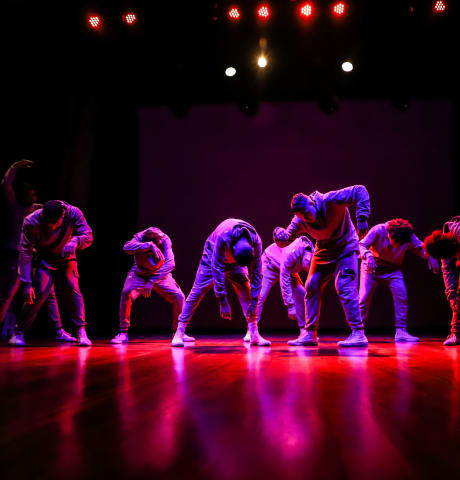 Which solo dance style suits you? Take the testFind out which solo dance style suits you best with our test. Whether it is Streetdance, Contemporary, or Solo-Latin, get started without a partner!
 Learn Tap Dance for Beginners: Rhythm in Your SoulTap dance fascinates through the combination of movement and music. Find out here how you can master the entry into this rhythmic hobby without any prior knowledge or a partner.
 Dancehall & Afro-Beats: Solo Rhythms for BeginnersDiscover how to train your body awareness and coordination with Dancehall and Afro-Beats without a partner. The perfect start for solo dancers!
 Learn K-Pop choreography as a beginner: How to nail your coverK-Pop choreographies often seem extremely complex and intimidating. With the right approach and the right online tools, you can easily master the dance steps at home, even as a beginner.
 Solo social media dance trends: Today's viral movesLearn how viral social media dance trends emerge and how you can master today's hottest solo moves step by step.
 Going to a dance class alone: How to overcome your fearAre you nervous about attending a dance class alone? We debunk the biggest myths and show you how easy it is to get started without a partner.