Streetdance4 minutes

Train your streetdance expression: More presence in freestyle

By Bernhard De LucaUpdated

In a nutshell
  • The emotional expression in street dance enhances the impact of your movements and makes your freestyle authentic.
  • Rigid facial expressions usually result from focusing too much on pure footwork technique, which blocks your charisma.
  • Through targeted training with focus points and conscious breathing, you can systematically improve your presence on the dance floor.
  • Your facial expressions should dynamically follow the music, instead of remaining in a constantly static expression.

A strong freestyle thrives on the energy you radiate. Learn how to relax your facial expressions and noticeably increase your presence on the dance floor.

DefinitionStreetdance solo performance

Streetdance solo performance refers to the ability to tell a story and captivate the audience's attention through a combination of physical movement, facial expressions, and stage presence.

Why expression makes the difference

When you are standing in a circle improvising, you usually focus entirely on your feet, your arms, and the rhythm. However, the true magic happens a little further up. The charisma in freestyle Hip Hop determines whether a move looks technically clean or absolutely captivating. If you want to train your street dance expression, you have to view your body as a whole. Your face is not an uninvolved spectator, but the center of your connection to the audience.

Often, the fear of others' judgment blocks us. We focus so strongly on flawless execution that our facial expressions freeze or we radiate a strained concentration. True presence on the dance floor, however, only emerges when you not only hear the music, but reflect it in your facial features. This has nothing to do with put-on acting, but with honest, unfiltered emotion that underscores your movements.
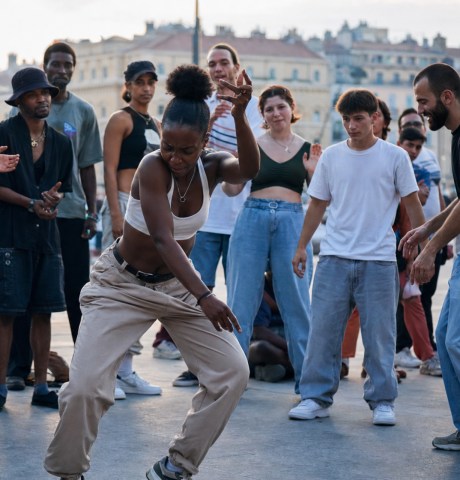
The right focus directs energy outward: if you lift your gaze and let the music show on your face, you will dominate the dance floor.

Understanding facial expressions as a mirror of the music

A common misconception is that you have to smile constantly or look particularly grim for a good performance in solo street dance. An artificial, permanent grin quickly seems out of place in freestyle, while a permanently gloomy look stifles the dynamics of the dance. Facial expressions while dancing should instead breathe and change, just as the beat does. They are the visual amplifier of your dance style.

To train this flexibility, consciously playing with contrasts during training helps. For example, if you use the bounce musicality in Hip-Hop, you can try to accompany the hard accents with a focused, sharp look, while the softer intervals allow for a relaxed release of your facial features. This way, your charisma becomes dynamic and remains exciting for the audience.

Control your presence on the dance floor

That is how

  • Lift your gaze and consciously work with the space
  • Adapt your facial expressions to the dynamics of the music
  • Relax your jaw and breathe evenly
  • Accept mistakes as part of the performance

Don't do this

  • Staring fixedly at the floor
  • Wearing a mask-like, permanent grin
  • Holding your breath during difficult steps
  • Letting small mistakes unsettle you

A dancer without facial expression is like a book without letters. Technique gets you on the floor, but your expression makes people stay.

Streetdance coach, Hamburg

Practical methods for more presence in training

Presence cannot be forced, but it can be deliberately provoked. A proven method in solo training is dancing with focal points. Instead of analyzing yourself in the mirror, fixate on an imaginary point in the room or make eye contact with imaginary spectators. This forces you to lift your head and send your energy outward, instead of keeping it trapped within yourself.

Furthermore, it helps to use your breath consciously. Anyone who holds their breath tenses their jaw muscles and appears blocked. A flowing, deep breath relaxes the facial features and automatically ensures a more natural expression. The next time you are in the studio, shift your attention away from the steps for a few minutes and instead feel how your face feels while you move.

Two ways of performance compared

Freestyle

Creating a real connection

The art of spontaneous emotion

You fully immerse yourself in the rhythm, react spontaneously to tempo changes, and show your genuine emotions on your face. This feels approachable, vibrant, and immediately captivates the audience.

Show

Avoid artificial poses

The danger of masquerade

You reel off learned movement patterns and put on a rehearsed, rigid face. Without a connection to the moment, the performance seems staged and loses its urban energy.

Frequently Asked Questions

  1. Concentration often makes your facial muscles freeze. Try to consciously keep your jaw relaxed during training and exhale regularly to release tension in your face.

Streetdance courses near you

Find the right dance school and work on your style.

View all matching courses

Find your crew and presence

On udansa you will find like-minded people who share your passion for urban styles. Discover street dance courses and workshops near you to take your performance to the next level.

Find your crew and presence