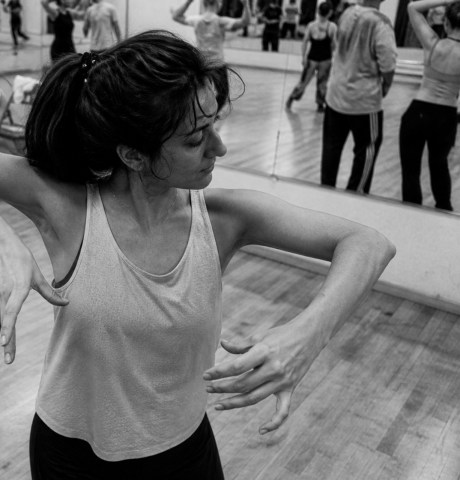
Street dance technique5 minutes

House Dance Basics: Jacking and Lofting explained clearly

In a nutshell
  • Jacking is the wave-like basic groove of the upper body in House Dance, which starts in the pelvis and flows through the spine.
  • Lofting refers to a soft technique where the dancer fluidly and elegantly lowers their center of gravity and incorporates the floor.
  • The combination of fast steps and these two techniques gives House Dance its typical dynamics.
  • Regular training of isolations helps beginners to move the upper body independently of the fast footwork.

House Dance is pure energy and freedom on the dance floor. Learn how to find your own groove with the right techniques and feel the music throughout your entire body.

DefinitionJacking and Lofting

Jacking and Lofting are the two fundamental movement concepts in House Dance. While Jacking describes the rhythmic, wave-like groove of the upper body, Lofting stands for fluid, soft movements and transitions towards the floor.

Jacking as the pulsating engine of the body

Anyone starting to learn House dance will quickly notice that this style is fundamentally different from other street dance directions. While Hip-Hop often relies on a deep, earthy bounce, House is characterized by an almost weightless, fluid dynamic. The key to this feeling lies in what is known as jacking. It is the permanent, wave-like groove of the upper body that drives the entire dance. Without jacking, even the fastest steps seem sterile and unmusical. It connects the music directly to your body's center.

With jacking, the movement starts in the pelvis, travels like a wave up through the spine, and ends in a slight nodding motion of the head. It is important that this movement is not forced mechanically, but rather emerges organically from the rhythm of the music. To develop a feel for these House dance basics, it helps to first focus entirely on the beat without any footwork. As soon as the wave in the upper body flows on its own, it becomes much easier to coordinate the typical steps with your feet, as your body is already in the flow.

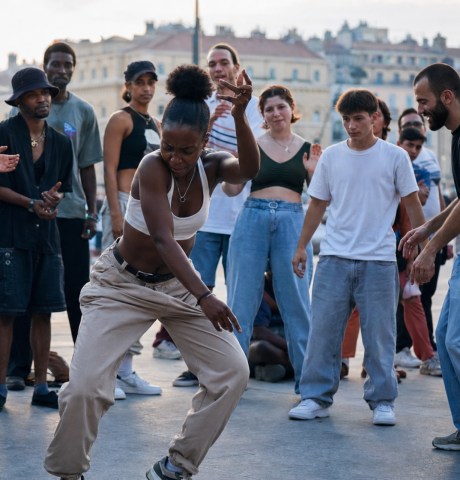
Lofting for weightless elegance on the floor

In contrast to the rhythmically pulsating jacking, there is lofting. This technique brings a completely new dimension to dance: elegance, softness, and the use of the floor. With lofting, the center of gravity shifts downwards. The movements become more fluid, almost cat-like. It is about using the space three-dimensionally by gently bending your knees, leaning your upper body far forward, or sliding in a controlled manner towards the floor. Lofting is the art of creating visual weightlessness despite the fast beats.

The biggest challenge with this lofting technique is to make the transition between fast standing and deep sliding seamless. There must be no abrupt stopping. The movement continues to flow continuously, while the arms often draw wide, circular paths to maintain balance. Anyone who masters this technique breaks up the rigid vertical axis of dancing and brings a fascinating dynamic to their freestyle. It is the perfect tool to visually express melodic passages in the music.

The path to the perfect house groove

Training correctly

  • Start the wave in your hips
  • Keep your upper body completely relaxed
  • Practice fluid transitions to the floor
  • Adapt your footwork to the groove

Common mistakes

  • Forcing the movement in your head
  • Tensing your upper body stiffly
  • Stopping abruptly on the floor
  • Executing steps rigidly without groove

House Dance is not just about running through steps, it is the feeling of breathing in the music with your whole body and releasing it back out in the groove.

Street dance instructor, Cologne

The fusion of fast feet and soft waves

The true magic in House Dance emerges when you let the different elements merge with each other. Fast, rhythmic House Dance steps like the Loose Leg or the Cross Step form the foundation. When you combine these steps with the constant pulsing of jacking and sprinkle in a soft lofting element at the right moment, a dynamic contrast is created that makes your dance come alive. It is the constant play between tension and relaxation, between fast feet and a completely relaxed upper body.

To train these transitions, you should not only practice fixed step combinations, but also play with the music in a targeted way. Try to emphasize the hard beats with fast steps and use the gentle melodic arcs for wide lofting phases. A good sense of rhythm is essential for this. If you want to sharpen your perception of music, taking a look at other styles can help you, for example learning how to understand Hip-Hop beats. This trains your ear for subtle nuances in the beat, which you can then visualize in House Dance with your movements.

Two techniques in dynamic interplay

Jacking

Energy and rhythm

The rhythmic pulse while standing

The permanent, wave-like groove in the upper body. It reacts directly to the driving beat of house music and forms the rhythmic foundation for every step sequence.

Lofting

Flow and weightlessness

Elegant movement on the floor

Soft, fluid movement towards the floor. It uses space in three dimensions and focuses primarily on elegance, balance, and long, gliding transitions.

Frequently Asked Questions

  1. Jacking is the wave-like basic groove in the upper body, while lofting is a soft technique for low, flowing movements on the floor. Jacking emphasizes the rhythm, lofting the melody.

Streetdance courses near you

Find the right course on udansa now and learn the basics from experienced instructors.

View all matching courses

Find your dance partner for House Dance

On udansa you will find like-minded people who want to feel the rhythm with you. Search for dance partners and courses in your area and bring your groove to the floor together!

Find your dance partner for House Dance

Read more