


Find your Hip-Hop crew online
On udansa you will find like-minded people who share your passion for urban rhythms, as well as suitable studios for your training. Experience the music together and take your sense of rhythm to the next level.

By Mary De LucaUpdated
On udansa you will find like-minded people who share your passion for urban rhythms, as well as suitable studios for your training. Experience the music together and take your sense of rhythm to the next level.
The secret behind the unmistakable groove of urban music lies in its inner structure. Anyone who can isolate the individual elements of a beat will effortlessly find the rhythm and understand the music on a completely new level.
To understand Hip-Hop beats, it helps to take a look at Hip-Hop history and music. The rhythmic structure of modern urban beats is almost always based on a classic four-four time signature, which gains its dynamics through the characteristic arrangement of drum elements. Music theory in Hip-Hop is shaped less by classical sheet music and more by loops, samples, and the interplay of two main components: the deep kick drum and the whipping snare. While the kick lays the foundation, the snare provides the rhythmic anchor point that every dancer and listener uses for orientation. By consciously shifting these elements, syncopations are created that give the groove its typical friction.
The classic Boom Bap rhythm of the nineties illustrates this principle perfectly. The name itself imitates the sound: "Boom" stands for the deep kick on the one and the three, while "Bap" describes the sharp snare on the two and the four. Once you have internalized this basic pattern, you can effortlessly decode even complex, modern productions, as they are almost always built on this rhythmic DNA.
Fade out the vocals and the melody completely. Focus exclusively on the rhythmic structure in the background to reveal the supporting instruments.
Look for the bright, whipping sound that often sounds like a clap. This snare drum almost always hits precisely on the two and the four of the beat.
Count out loud at a steady pace: One, Two, Three, Four. The one is the heaviest beat, the snare helps you with the two and the four for orientation.
Pay attention to the small beats that lie between the numbers. These syncopations fill the pauses and give the beat its typical, rolling character.
Find the right dance school and learn to move perfectly to the beat.
StreetdanceBurgstädt · Germany
Videoclip Teens 11-13 JahreMonday · 16:50 · Nov 9
Burgstädt
StreetdanceBurgstädt · Germany
Videoclip Teens ab 16 JahreMonday · 17:50 · Nov 9
Burgstädt
StreetdanceLimbach-Oberfrohna · Germany
Videoclip Teens 11-13 JahreTuesday · 18:35 · Nov 10
Limbach-Oberfrohna
How it works
Don't do this
Preparation
Analysis
The Hip-Hop beat is counted in a classic four-four time signature. You count evenly from one to four, where the one marks the beginning of the bar and the snare usually hits on two and four.
The kick drum produces the deep, dull bass hit that you often feel in your stomach. The snare, on the other hand, is a bright, whipping sound that resembles a clap and forms the rhythmic center.
A syncopation is a conscious shift in rhythm where a beat occurs unexpectedly between the main counts. This breaks up the monotony and gives the beat its bouncy character.
 Hip-Hop history and music: The roots of urban beats
 Oldschool vs. Trap: How music eras change dance rhythm
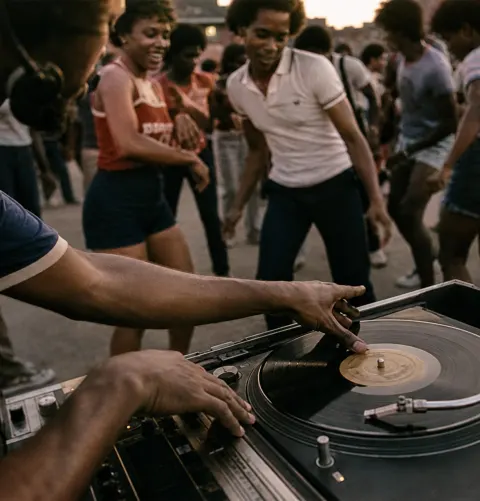 The Art of Sampling: How Breakbeats Changed Dance
 What kind of Hip-Hop fan are you? Take the sound test
 From Funk to Soul: The musical roots of street dance
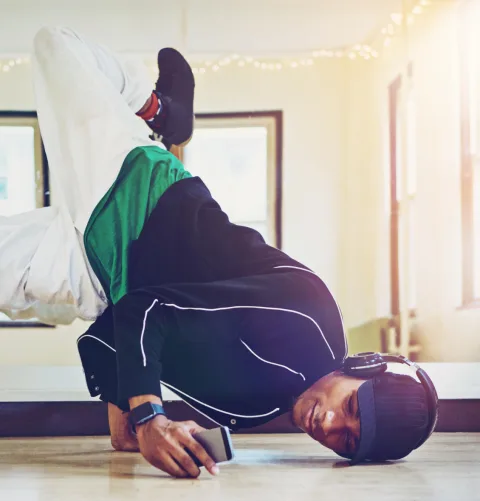 Classic Hip Hop albums in dance history
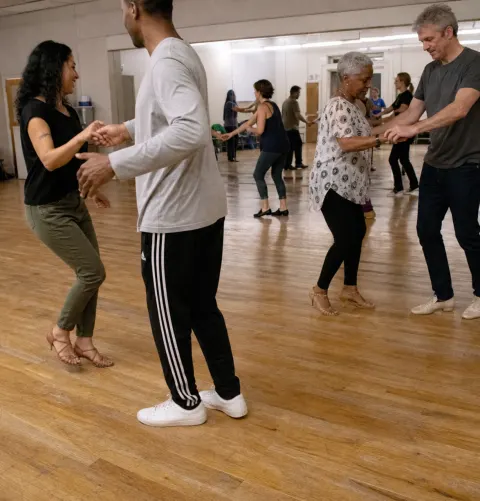 Bounce and Musicality in Hip-Hop: The Invisible Connection