

Find your rhythm in partner dance
On udansa you will find like-minded people who share your passion for Caribbean culture, as well as the right courses in your area.

Behind the sensual movements and infectious rhythms of Bachata lies a dramatic history full of resistance. Once banned as the music of the poor, the dance has developed into a global phenomenon.
Bachata refers to both a musical genre and the corresponding partner dance, which originated in the Dominican Republic in the 1960s. The term originally stood for informal, lively neighborhood parties.
The roots of Bachata lie deep in the rural Dominican Republic of the 1960s. After the end of the decades-long Trujillo dictatorship, people in the countryside and in the poorer neighborhoods of the cities were looking for an outlet for their worries, longings, and love stories. A raw, acoustic music emerged, which was strongly influenced by Cuban Bolero and Puerto Rican Jíbaro singing. Played with acoustic guitars, maracas, and a bongó, this music expressed the pain of everyday life. The origin of Bachata is inextricably linked to the dive bars, brothels, and backyards of the working class, where the music served as an accompaniment for the informal partner dance that developed organically to the rhythms.
Anyone who wanted to learn to dance Bachata back then did not do so in a dance school, but directly in social life. However, the country's high society looked down on this culture with deep contempt. For the upper class, the music was vulgar, the lyrics too direct, and the dance, in which the couples moved closely entwined, simply indecent. This social stigmatization decisively shaped the first decades of the musical genre and pushed it to the fringes of legality for a long time.
For decades, Bachata was practically banned on Dominican radio and television. Radio stations refused to play the songs, and record stores often only sold the recordings under the counter. The term Bachata itself was originally not a name for a music genre, but a derogatory word for an informal, loud backyard party of the poor population. However, censorship could not stop its spread. On the contrary: the cassette culture of the 1970s and 1980s ensured that the music remained omnipresent on the streets and in rural regions.
It was only when musicians began to replace the acoustic guitar with the electric guitar that the sound changed. The sound became brighter, more modern, and more danceable. With the economic boom and growing tourism in the Dominican Republic in the late 1980s, international visitors also came into contact with the music. The final breakthrough came in 1990 with the artist Juan Luis Guerra and his album Bachata Rosa, which sold millions worldwide and made the musical genre socially acceptable. Suddenly, the former bar sound was a proud cultural asset.
When dancing, consciously listen to the classic tracks from the 1970s and 1980s. This trains your ear for the traditional rhythm and the true emotional roots of the dance.
Bachata is the voice of the Dominican soul, born from the pain of exclusion and now infecting the whole world with its joy of life.
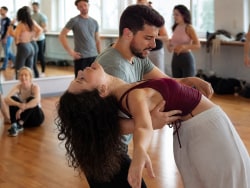
With the international success of the music, the dance also adapted. While in the Dominican Republic the focus was on close social interaction, the rhythmic play of footwork, and celebrating together, the dance evolved further abroad. European and North American dancers fused the movements with elements from other styles. New trends emerged, such as Bachata Sensual, which dominate dance schools worldwide today. This dance evolution shows how a local partner dance became a global phenomenon.
Today, Bachata is celebrated at festivals from Tokyo to Berlin to New York. Anyone dancing at a Latin party in Munich or in the clubs of Berlin today feels the unbroken energy of this style. UNESCO officially declared Bachata an Intangible Cultural Heritage of Humanity in 2019. This completes the circle from the frowned-upon music of the outcasts to a globally celebrated dance symbol for Caribbean joie de vivre.
The traditional roots in the Caribbean
In the Dominican Republic, the dance emerged as an improvised partner dance on the street and in bars. The focus is on the grounded connection to the floor, the fast footwork, and celebrating together to the rhythm of the music.
The global evolution in the club
Modern fusions have developed on dance floors worldwide. Through the influence of Western dance techniques, fluid body waves, complex turns, and a new dynamic have been integrated, which shape the dance in the club.
The music genre originated in the early 1960s in the Dominican Republic. It developed after the end of the Trujillo dictatorship from the Cuban Bolero and other Caribbean influences.
Find the right course and learn the fascinating rhythms of the Caribbean yourself.
 Learn to dance Bachata: Your path into the world of BachataLearning to dance Bachata made easy. Discover the simple basic step, the different styles, and how to shine at social parties.
 Latin Parties in Munich: The city's best Caribbean nightsReady for hot rhythms by the Isar? We show you where to make the night come alive in Munich with Salsa, Bachata, and Merengue.
 Bachata styles and history comparedDiscover the fascinating history of Bachata and learn the differences between the traditional Dominican style and modern variations like Bachata Sensual.
 Bachata styles: Dominicana, Sensual, and Moderna comparedDiscover how Bachata Dominicana, Sensual, and Moderna differ in movement, music, and connection, and find the style that perfectly suits you.