Getting started with classes5 minutes

Quickstep without jumping: This is enough for class and the ball

By Bernhard De LucaUpdated

In short
  • You can dance Quickstep in a beginner class and at a ball without hops or jump figures.
  • Gliding beginner figures are enough if you confidently master the rhythm, weight changes, and moving together along the floor.
  • Without jumping, Quickstep stays lively, with short, quick steps and a flowing movement pattern.
  • Optional hops require controlled takeoffs, safe landings, and more precise timing together.

A fast dance can seem challenging even before you’ve taken your first step. If you’re also thinking about jumps, getting started can feel unnecessarily out of reach.

DefinitionFlight phase

Flight phase describes the moment in a movement when both feet are simultaneously off the ground. It distinguishes an actual jump from simply lifting one foot during a step.

Gliding figures are a complete introduction

Quickstep without jumping is not a makeshift substitute for the real dance. Its repertoire of figures includes movements that do not require an airborne phase. In a beginner course, these figures form the foundation of the lessons: you learn to combine steps of different durations while moving with your dance partner. A quarter turn or a gliding chassé does not need an extra hop to serve its purpose.

For a complete introduction, what matters is that your steps fit together, not that your feet leave the floor at the same time. The fast music already demands your attention. The short steps need to land at the right time while you stay connected as a couple. Jumps would add another task that simply isn't necessary.

There is no general requirement to perform jumping figures at a ball, either. A manageable gliding repertoire can be enough for an entire dance, as long as you can repeat it confidently and adapt it to the space available. Connections matter more than constantly learning new individual figures. You'll encounter this principle when connecting Foxtrott figures, too, even though the specific transitions are different in Quickstep.
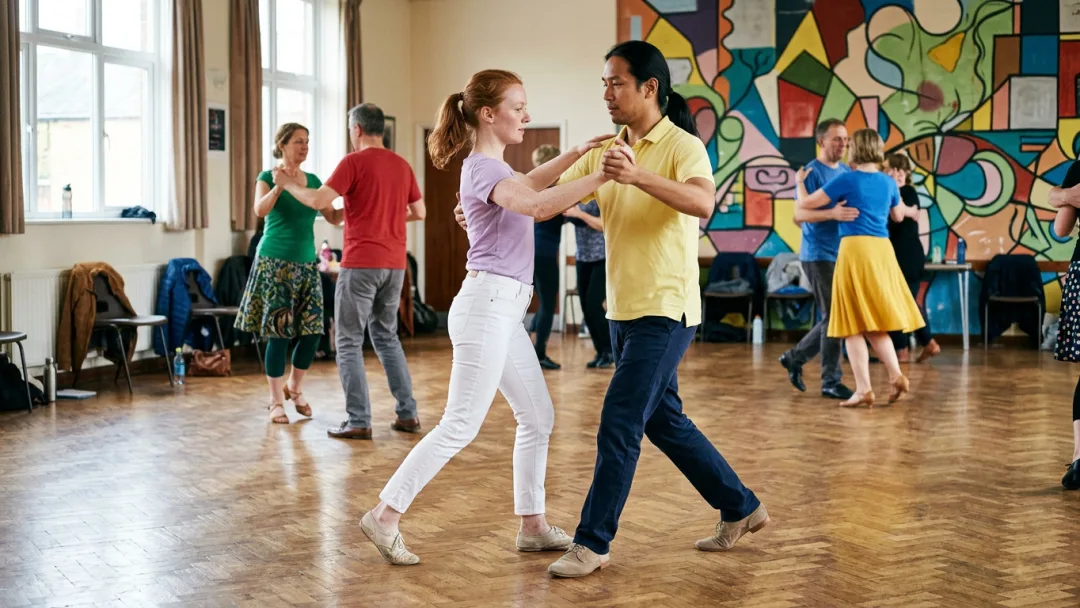
A still upper body can allow plenty of movement below without it turning into a jump.

Upward movement is not a hop

The word “hop” is used imprecisely in everyday speech. Sometimes it means an actual jump, sometimes just a springy or light-looking movement. As you start your course, the distinction is useful: A mobile body and a lifted free foot do not mean that you are jumping. The general rise and fall in Standard ballroom dance is a technique topic in its own right, not an invitation to add extra moments in the air.

Conversely, “gliding” does not mean dragging both soles across the floor. Your weight shifts from one foot to the other, and your free foot needs to be able to move. Here, the term describes a continuous flow of movement. If you stiffen your knees and hold your feet to the floor for fear of hopping, you make the short, quick steps harder for yourself.

Nor do you need to visibly emphasize every quick step with an upward movement. A step’s short duration is not an instruction to jump. You can dance quickly and close to the floor without becoming stiff. This keeps the real task clear: You keep moving in time with the music rather than adding extra upward impulses between the steps as prescribed.

How to recognize low-to-the-ground dancing

Like this

  • Lift the free foot for the next step
  • Shift your weight fully onto the new supporting foot
  • Dance quick steps with an appropriate stride length
  • Stay on the same path of movement without pulling on each other's arms

Don't do it like this

  • Keep both feet planted out of fear of jumping
  • Stop between the steps
  • Emphasize every quick step by jumping up
  • Pull your dance partner through the sequence with your arms

A dance figure doesn't become suitable for beginners just because you leave out its jump, but because its movement sequence works without one.

udansa dance guide editorial team

Optional hops change the task for the couple

When hops are added later, it is not enough to simply dance the same sequence with a little more energy. Taking off and landing bring additional demands: your body has to generate the impulse, absorb the landing and then continue in a controlled way. During a flight phase, you cannot adjust your support on the floor afterward. That is why this movement needs its own preparation, not just more courage.

This affects both dancers as a couple. Different timing or movement ranges can make your connection feel unsteady. Your arms should not have to compensate for that. A secure gliding sequence shows that you can coordinate rhythm and pathways; it does not yet prove that you can also manage jumping movements together. To understand the physical demands, it helps to distinguish between exertion and targeted training in building muscle through dance.

These additional demands do not mean you have to catch up on hops at some point. You can also improve your dancing with more precise transitions, more reliable weight changes and smoother movement together. This is a solid path forward for classes and social dances. If you later decide you want to learn flight phases, you are adding a new movement challenge, not filling a gap in your existing Quickstep.

Two Ways to Enjoy Movement

Gliding

Travel through the music

Expression through traveling and short steps

Gliding figures give you room to dance to the music with steps of different durations. You can travel together and let the movement flow without adding an airborne phase. Even a small repertoire offers plenty of opportunities to focus and express yourselves.

Hopping

Consciously accentuate the movement

Expression with added airtime

Optional hops can add a playful accent to a suitable sequence. To do this, both dancers coordinate their takeoff, landing, and continued movement with each other. Anyone who wants to learn this movement style later can expand their repertoire without replacing the gliding figures.

Frequently Asked Questions

  1. No, leaving out hops does not make Quickstep Foxtrot. The distinction between the dances depends not only on jumps, but also on the rhythm and the structure of the figures, among other things. So you can dance Quickstep close to the floor without simply dancing another dance faster.

Ballroom dance classes to get started with Quickstep

In a ballroom dance class, you'll learn to move together across the floor with gliding Quickstep figures.

See all matching classes

Find someone to glide along with

On udansa connect, you'll find dance partners for your first steps in Quickstep. Describe how you'd like to practice and solidify a small repertoire of gliding steps together.

Find someone to glide along with