Grow together at the limits
On udansa connect, you will find like-minded people who are working on their athleticism just like you. Exchange ideas, share your training successes, and find the perfect crew for your next session.

By Mary De LucaUpdated
On udansa connect, you will find like-minded people who are working on their athleticism just like you. Exchange ideas, share your training successes, and find the perfect crew for your next session.
Getting started in the world of acrobatic spins requires much more than just courage. This self-test will tell you immediately if your body is ready for the extreme demands of power moves.
The dream of the perfect windmill or your first spectacular handstand fascinates almost everyone who starts breaking. But before you throw yourself onto the dance floor with momentum, it is time for an honest assessment of your physical prerequisites. Power moves are not ordinary dance steps, they are highly demanding, acrobatic feats. They require an extreme level of strength, flexibility, and coordinative body control.
Anyone who starts these dynamic rotations without the necessary foundation risks not only frustrating failed attempts, but also exposes themselves to a high risk of injury. Your wrists, elbows, and shoulders carry your entire body weight during almost every movement, while your core must tame the centrifugal forces as an iron link. A targeted fitness test for power moves helps you assess your current form in black and white.
To prepare yourself optimally, you should work specifically on your foundation. A solid start is often achieved through preparatory exercises that train your stability. Take a look at our guide to master the learning handstands for adults, or learn more about the 7 most important essentials for your acrobatics training to be safely positioned from the start.
Your body already has excellent physical prerequisites. You possess the necessary strength and stability in your shoulders and core to begin training your first power moves, like the windmill, without injury. Use this head start and begin with controlled, clean techniques.
Your basics are solid, but you lack the necessary stability in your key joints. Before you venture into dynamic turns, you should strengthen your wrists and specifically build up shoulder strength. Focus on specific hold exercises in a handstand over the next few weeks.
Your body is currently not yet prepared for the extreme strain of power moves. The risk of injury to your wrists and shoulders is too high at the moment. Focus first on general strength building and stabilizing your core before you train acrobatics.
| Criterion | Type A (Ready to go) | Type B (Rising star) | Type C (Beginner) |
|---|---|---|---|
| Shoulder stability | Very high, handstand secure | Medium, handstand shaky | Low, hardly any holding strength |
| Core strength | Excellent, firm center | Satisfactory, slight weaknesses | Needs improvement, no holding |
| Injury risk | Low with clean technique | Increased without additional training | Very high, build strength first |
| Next step | Learn first power moves | Targeted shoulder strengthening | Full-body strength training |
The information serves as a general guide for injury-free training with udansa.
Find the right course to take your athleticism to the next level under professional guidance.
StreetdanceBurgstädt · Germany
Videoclip Teens 11-13 JahreMonday · 16:50 · Nov 9
Burgstädt
Modern Dance for kidsBerlin · Germany
Modern Dance & Akrobatik ab 10 J.Wednesday · 17:00 · Nov 11
Flow Motion Studio Wedding
StreetdanceBurgstädt · Germany
Videoclip Teens ab 16 JahreMonday · 17:50 · Nov 9
Burgstädt
After you have evaluated your results, it is time for concrete implementation in your daily training routine. Your test result shows you exactly which screws you need to turn before you dare to try complex rotations. Strength without the necessary flexibility leads to unclean movements, while pure mobility without the appropriate muscle strength leaves your joints unprotected.
Set yourself realistic intermediate goals and do not rush anything. If your core strength still shows weaknesses, integrate specific holding exercises into your warm-up. If you lack shoulder stability, controlled push-ups and handstand holds against the wall are your best friends. A structured approach protects you from overexertion and ensures that your joints can permanently withstand the enormous forces of spins.
For in-depth training that stabilizes your center, we recommend our guide on activating the Contemporary dance center. These principles of deep muscle training can be excellently transferred to the requirements in breaking.
For your first power moves, you should be able to hold a handstand against the wall for at least 30 seconds steadily. In addition, 10 clean push-ups and one minute in a forearm plank are good benchmarks for the necessary basic strength.
Yes, without sufficient mobility in the hips and shoulder girdle, your body will block itself during rotations. Insufficient flexibility also drastically increases the effort required and leads to injuries more quickly.
If you lack the strength, you should first focus on targeted strength training for your core and shoulders. At the same time, you can practice simple floor elements and footwork to develop a feel for contact with the floor.
 Power Moves in Breakdance: Athletic Training for Spins
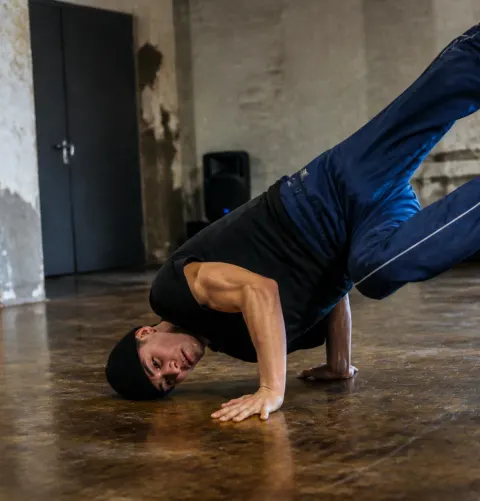 Learn the Halo in breakdance: technique and guide
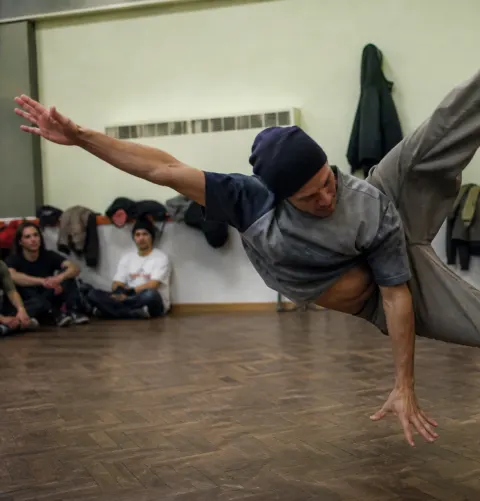 The physics of power moves: Understanding balance and rotation
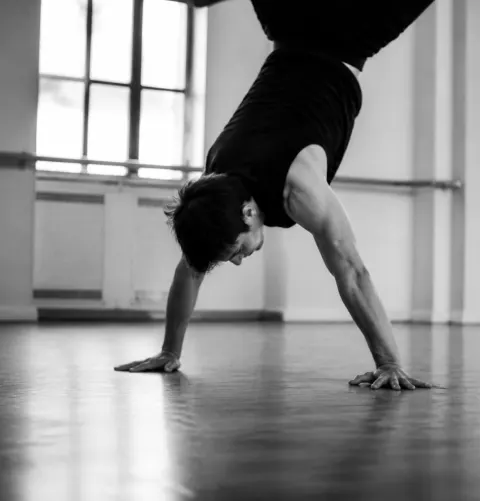 Learning the handstand in breakdance: The foundation for power moves
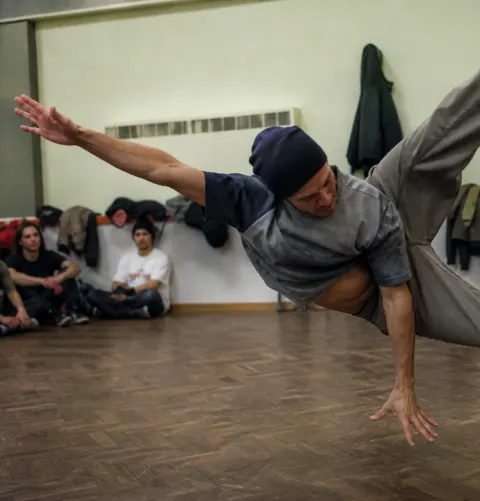 The 5 essential protectors for power move training
 Mastering the Airflare: Your Guide to the Ultimate Power Move
 Mastering Power Move Combos: Fluid Transitions in Dance