

Find your dance style in the studio
Whether you are looking for the clear structure of Modern Dance or want to try your hand at free-form Contemporary Dance: on udansa you will find the right courses and like-minded people in your area.


The path to the dance floor does not have to lead through rigid ballet rules. Anyone who understands the subtle differences between Modern and Contemporary will find the course that truly suits their own body awareness much faster.
Modern Dance is a form of stage dance that emerged at the beginning of the 20th century, established as a counter-movement to classical ballet. The style emphasizes gravity, breath, and individual emotional expression through systematically developed movement concepts.
If you are an adult interested in stage dance, you will quickly come across two terms that are often mentioned in the same breath: Modern Dance and Contemporary Dance. Although both styles are closely related, they historically and practically denote different approaches. The essential difference between Modern and Contemporary Dance lies in their time of origin and the philosophy associated with it. Modern Dance emerged at the beginning of the 20th century as a conscious rebellion against the strict, artificial corset of classical ballet. The pioneers wanted to return to nature, to gravity, and to genuine emotional expression. If you attend a course in Modern Dance and Contemporary for adults today, you will notice that, despite all its freedom, Modern Dance has developed its own very clear structures and fixed movement principles over the decades.

In contrast, Contemporary Dance, often referred to as zeitgenössischer Tanz in German, is younger and formulated even more openly. It developed from the middle of the 20th century onwards and is not understood as a fixed school, but rather as a dynamic melting pot. An important characteristic of Contemporary Dance is its radical boundlessness: here, elements from Modern Dance, classical ballet, but also from street dance, martial arts, yoga, and pure everyday movement flow together. While Modern Dance wanted to revolutionize dance, Contemporary Dance breaks with the question of what dance is allowed to be in the first place. For adult beginners who are looking for an easy introduction to Contemporary Dance, this style offers a wonderful platform to get to know your own body without any rigid templates.
If you have to choose between styles, take a trial class in both directions. Pay attention to whether you enjoy the structured learning of fixed sequences or the free exploration of movements more.
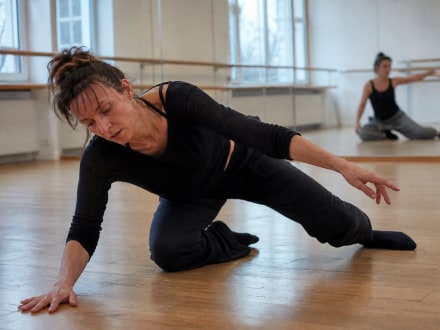
In contemporary dance, we do not look for the perfect pose, but for the most honest connection between feeling and movement in the current moment.
For practice in the dance studio, this means: In modern dance classes, you can usually expect clearly defined movement sequences that focus on the interplay of falling and catching, as well as work with the upper body. The movements often appear grounded, powerful, and graphically clear. In contemporary classes, on the other hand, the focus is on exploring movement qualities. You work a lot with the flow of movement, the alternation between tension and relaxation, and often with free improvisation. Both directions are excellent dance styles for adult beginners, as they do not require a perfect ballet body, but rather value individual expression. Which path suits you better depends on whether you feel more secure in a clear structure or are looking for the absolute freedom of contemporary dance.
Clarity and firm principles in Modern Dance
This style works with clear, historically developed principles. The movements are often powerful, grounded, and follow a tangible, rhythmic structure that gives the body support and orientation.
Boundless variety of movement in Contemporary
There are no fixed movement catalogs here. The style draws from everywhere, emphasizes fluid transitions, playing with the floor, and leaves plenty of room for your own interpretation and improvisation.
Modern Dance emerged as a historical countermovement to ballet and uses fixed, systematic movement schools. Contemporary Dance is the further development that combines all dance styles, martial arts, and everyday movements completely freely.
Find the right studio and start your first dance class easily.
 Modern and Contemporary Dance for Adults: Getting StartedThe ideal introduction to the world of contemporary dance for adults. Discover how you can express your creativity and improve your fitness in the studio, even without prior experience.
 Learning Contemporary Dance as an adult: Your easy startStarting with Contemporary Dance is possible for adults of any age. Find out how a typical dance class works and how you can start without any prior experience.