
Dancing together into marital bliss
On udansa, you can easily find the right dance school or a private workshop to practice your Slow Waltz stress-free. Use our platform to prepare optimally for your big moment.


By Mary De LucaUpdated
On udansa, you can easily find the right dance school or a private workshop to practice your Slow Waltz stress-free. Use our platform to prepare optimally for your big moment.
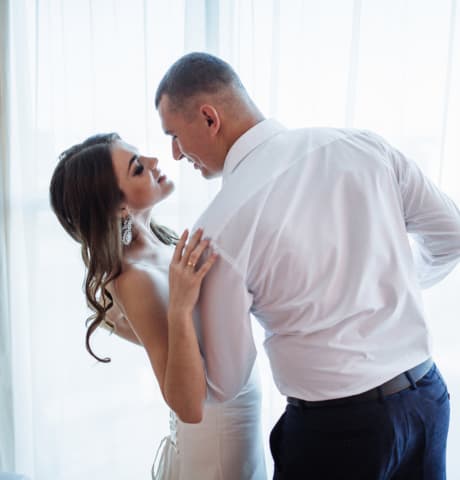
The Waltz is the perfect choice for bridal couples looking for a stylish and stress-free opening dance. With gentle wave movements and clear structures, this classic ensures a magical moment on the dance floor.
The Slow Waltz is a ballroom dance in 3/4 time, characterized by slow, flowing movements and a distinctive rise and fall of the body.
The Slow Waltz, also known in international dance sport as the English Waltz, is considered the gold standard for the opening dance. With its harmonious three-quarter time and flowing, wave-like movements, it radiates an incomparable elegance. In contrast to the fast Viennese Waltz, which makes many couples dizzy due to its high tempo and constant turns, the slow version allows for relaxed and controlled gliding across the dance floor.
Anyone comparing the Slow or Viennese Waltz for the wedding dance will quickly realize that the English Waltz leaves significantly more room for conscious accents and soulful glances. For the perfect start, you should determine your wedding dance schedule early on to internalize the steps without any time pressure.

The Waltz basic step for the wedding dance is based on a simple box that is danced across the floor. The movement follows the classic rhythm: step, step, close. On the count of one, you take a sweeping forward step, on two a side step, and on three you close your feet. For the follower, the whole thing applies in reverse. This basic geometric shape ensures stability and gives you the necessary confidence for your performance.
A common mistake is to keep the knees stiff. The typical elegance only emerges through the gentle rising and falling (Rise and Fall). On one, you bend your knees softly, on two you rise onto the balls of your feet, hold the height on three, and gently lower yourself again at the end of three. To hit the beat reliably, take a look at our guide on determining the beat for your wedding dance.
Correct
Mistakes
The Slow Waltz is much more forgiving of small uncertainties than the fast Viennese Waltz. The calm in the beat gives the couple the opportunity to truly enjoy the moment.
As soon as the box step is second nature, you can enhance your wedding dance with simple turns and elegant figures. The right turn is the classic way to move elegantly across the floor. Here, the basic box is rotated slightly to the right, so that you complete a full turn after two basic steps. If you want a little show element, incorporate a simple promenade, where the couple opens up slightly and walks forward side by side.
When practicing the figures for the Slow Waltz as a wedding dance, make sure not to overload the choreography. Less is often more. Two cleanly executed figures look far more elegant to the wedding guests than a hectic sequence of complicated wrap figures that throw you off beat. Instead, focus on a proud posture and eye contact with each other.
Safety and spatial awareness in the room
Here, the focus is on forward movement and gently propelling the couple. The leader determines the direction in the room and ensures a stable frame that the partner can orient themselves to at any time.
Lightness and elegance in the flow of music
The following person reacts to the impulses in the partner's upper body. Through active stretching and maintaining one's own body tension, the typical, weightless floating feeling of the Slow Waltz is created.
The Waltz is danced in three-four time. The tempo is typically a very calm 28 to 30 bars per minute, which makes it significantly slower and more relaxed than the Viennese Waltz.
Yes, for absolute beginners, 4 to 6 weeks of preparation time are usually sufficient. Since the steps are logically structured, the basic step and a simple turn can be learned quickly and confidently.
The natural turn, the reverse turn, and the promenade are the most popular figures. They break up the basic step, are easy to learn, and look very elegant to wedding guests.
Find the right dance course now to prepare your waltz perfectly.
Couple danceLimbach-Oberfrohna · Germany
PaartanzkreisFriday · 18:15 · Oct 23
Limbach-Oberfrohna
BallroomMeißen · Germany
Tanzkreis | PROFESSIONALTuesday · 20:15 · Oct 27, 2026 - Jan 5, 2027
“Ein Haus für Vieles” - Saal Tanzkurse
Couple danceBurgstädt · Germany
Paarkurs - Goldstar TanzkreisSunday · 15:00 · Oct 25
Burgstädt
 Slow Waltz vs. Viennese Waltz for your wedding danceSlow Waltz or Viennese Waltz? We explain the crucial differences in tempo, technique, and style so your wedding dance becomes an unforgettable moment.
 Wedding Dance Timeline: When to Start Practicing?When is the perfect time to start practicing for your wedding dance? Our detailed timeline shows you the stress-free path to your first dance.
 Finding the beat for your wedding dance: It is that easyDo you want to find the beat of your wedding song to choose the right dance style? With our simple guide, you will learn step by step how to determine the beat and BPM of your song.
 Wedding Dance Choreography: How to master your first danceYour first dance should be your personal highlight. With the right choreography and the perfect steps, you will dance into your wedding night feeling completely relaxed.
 Modernizing Foxtrot and Quickstep for your wedding danceClassic ballroom dances don't have to be stiff. Use this guide to modernize Foxtrot and Quickstep for your perfect, contemporary wedding dance.
 Tango for your wedding dance: Bring drama and elegance to the floorA Tango as your wedding dance brings pure drama and elegance to your celebration. Learn how to master the essential steps and enchant your guests.
 Modern West Coast Swing and Hip-Hop for your wedding danceUrban dance styles are revolutionizing the first dance. Discover how West Coast Swing and Hip-Hop bring a fresh, modern vibe to your wedding celebration.Slow Waltz vs. Viennese Waltz for your wedding danceSlow Waltz or Viennese Waltz? We explain the crucial differences in tempo, technique, and style so your wedding dance becomes an unforgettable moment.
 Create your own wedding dance choreography: A guideYou can easily create your own wedding dance, even without any prior experience. This guide shows you how to structure an impressive choreography.
 Mistakes in wedding dance choreography: The 7 biggest pitfallsPlanning your opening dance can lead to typical training pitfalls. Learn about the seven most common choreographic mistakes couples make and how you can avoid them.