
Together to your dream dance
On udansa you will find experienced dance instructors, flexible crash courses, and like-minded people in your region who will accompany you on the way to the perfect opening dance.


By Bernhard De LucaUpdated
On udansa you will find experienced dance instructors, flexible crash courses, and like-minded people in your region who will accompany you on the way to the perfect opening dance.
Your opening dance should be the emotional highlight of your celebration. However, when designing the steps, classic errors in thinking often creep in, which cause frustration in the practice room.
Practical relevance
The listed points are based on the real practical experiences of wedding choreographers.
Scope of content
Only choreographic and dance-related aspects of the training are taken into account by udansa.
Independence
No dance studio or service provider has paid for a placement on this list.

Step selection in training
Many couples want too much at once and incorporate spectacular figures that they cannot maintain cleanly under stress. Less is more: A simple, elegantly danced basic step looks much better than a shaky lift.
Music and beat analysis
When steps are designed without precisely analyzing the beat of the song, the couple often dances out of rhythm. This leads to frantic movement and massively disrupts the overall visual impression of the opening dance.
Presence on the dance floor
Anyone who stares rigidly at the floor while practicing loses the connection to their partner and appears distant to the guests. Eye contact and an upright posture are crucial for an emotional impact.
Adapting to the dance floor
Often, a fixed route through the room is rehearsed. If the dance floor on the wedding day is smaller than expected or tables are in the way, the entire choreography falls apart. Flexibility in your paths is a must.
Dress rehearsal in your outfit
Long dresses restrict leg movement, and slippery soles affect your balance. If you only train in sneakers and sweatpants, you might be in for a nasty surprise during your opening dance. Read our tips on dancing in a wedding dress for more information.
Dramaturgy of dance
A five-minute song drags on for the audience like chewing gum if the figures are constantly repeated. A good wedding dance choreography should be compact and get to the point after three minutes at the latest.
Interaction while dancing
If one partner forces the lead or tries to correct the other's mistakes while dancing, the harmony suffers. Trust and mutual adjustment during small mistakes make for a successful performance.
Knowing the typical pitfalls when designing and rehearsing saves valuable nerves during training. A common mistake is planning the choreography purely in your head or in everyday clothes, without taking the dynamics of the room and the limitations of formal wear into account. If you develop a feel for the rhythm early on, you can determine the beat for your wedding dance and prevent losing your orientation at the crucial moment.
Set realistic milestones when practicing. Instead of memorizing a complex sequence of professional turns, you should focus on a clean execution of the basic steps and a harmonious connection. If the foundation is stable and the transitions between the parts of the song are fluid, the entire dance will appear natural and confident, even if a small step goes wrong on the big day.
Overloaded step sequences quickly overwhelm beginners and lead to visible tension. Focus instead on a few, cleanly executed basic steps and a harmonious presence.
Without a firm sense of rhythm, the dance looks restless and asynchronous. Learn to hear the basic beat of your song reliably before you build your steps on top of it.
Expansive poses and wide paths are often impossible to implement on a crowded or small dance floor. Plan your movements to be flexible and compact.
Find the right dance class to learn your choreography stress-free.
Couple danceLimbach-Oberfrohna · Germany
PaartanzkreisMonday · 19:30 · Oct 12
Limbach-Oberfrohna
Couple danceLimbach-Oberfrohna · Germany
PaartanzkreisFriday · 18:15 · Oct 23
Limbach-Oberfrohna
Couple danceBurgstädt · Germany
Paarkurs - Goldstar TanzkreisSunday · 15:00 · Oct 25
Burgstädt
 Slow Waltz vs. Viennese Waltz for your wedding danceSlow Waltz or Viennese Waltz? We explain the crucial differences in tempo, technique, and style so your wedding dance becomes an unforgettable moment.
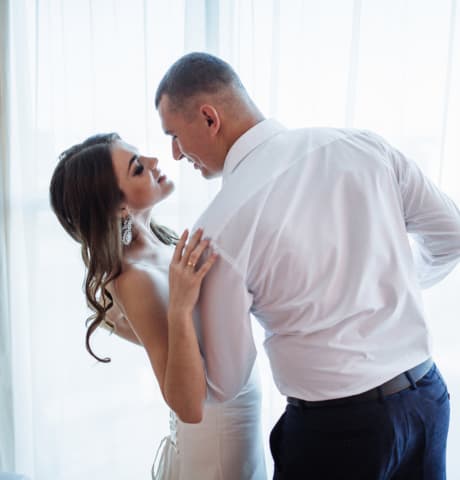 Create your own wedding dance choreography: A guideYou can easily create your own wedding dance, even without any prior experience. This guide shows you how to structure an impressive choreography.
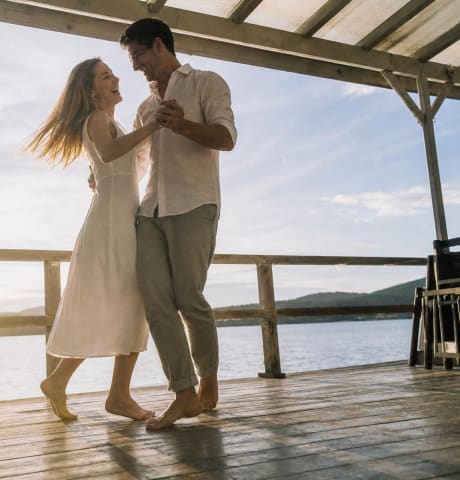 Wedding Dance Choreography: How to master your first danceYour first dance should be your personal highlight. With the right choreography and the perfect steps, you will dance into your wedding night feeling completely relaxed.
 Crazy Wedding Dance: How to Pull Off the Perfect SurpriseThe crazy wedding dance breaks with tradition: Learn how to master the transition from a classic Waltz to an upbeat party mix.
 Salsa and Bachata for your wedding dance: Choreography tipsAre you dreaming of a wedding dance full of rhythm and joy? Our guide shows you how to perfectly incorporate Salsa and Bachata into your first dance.
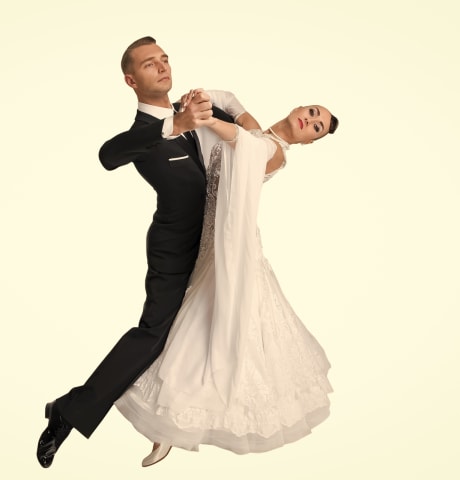 Learning lifts for your wedding dance: Shine with confidenceAre you dreaming of a spectacular opening dance? Learn in our guide how to integrate lifts and poses into your choreography safely and elegantly.
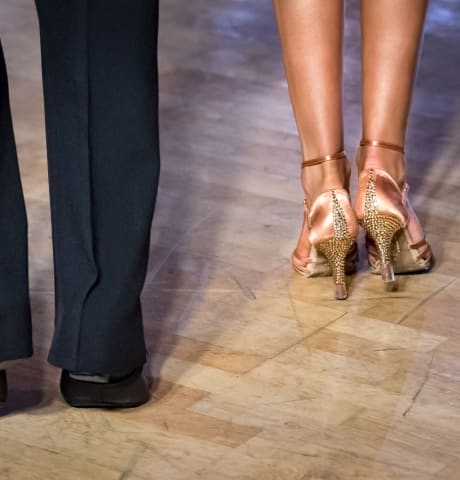 Learn Discofox for your wedding: The guide for your first danceDiscover why Discofox is the perfect, uncomplicated wedding dance for your big day. With simple steps and modern music, you will create the best atmosphere.
 Unique wedding dance: 6 alternative dance stylesForget the classic waltz. We show you six unique dance styles, from Argentine Tango to Lindy Hop, for an unconventional and unforgettable first dance.
 Slow Waltz for your wedding dance: figures and stepsThe Slow Waltz is the classic choice for a wedding dance. Learn how the basic step works and which simple figures will help you shine on the dance floor.