
Dancing into marital bliss together
Whether it is a classic waltz or a modern wedding dance: on udansa you will find the right dance courses in your region as well as like-minded people who share your passion for movement.


By Mary De LucaUpdated
Whether it is a classic waltz or a modern wedding dance: on udansa you will find the right dance courses in your region as well as like-minded people who share your passion for movement.
The moment of the first dance is magical, but opulent fabrics, hoop skirts, and long trains can turn your wedding dance into a sporting challenge. With the right technique and preparation, you will dance weightlessly through your big moment with udansa.
A petticoat is a separate garment worn under a wedding dress to add volume to the skirt or to make walking and dancing easier through spacers like hoops.
A majestic appearance in an opulent dress with a hoop skirt is the dream of many brides. When dancing in a wedding dress, the hoop skirt develops a unique dynamic that you should be aware of. The most important rule for dancing with a hoop skirt is: keep your distance, but stay connected. The elastic rings of the hoop skirt create a natural barrier between you and your partner. Do not try to overcome this barrier with force or flatten the dress. The groom must adjust his dance steps slightly and must not get too close.
To elegantly master wedding dance choreography and dance styles, you should modify your dance posture slightly. Leading is done less through close body contact and more through the arms and hands. When you move backwards, use your toes to gently kick the bottom ring of the hoop skirt forward. This prevents you from stepping on your own hem. A well-fitting hoop skirt swings beautifully during turns and adds a majestic touch to your dance.

A long, flowing train looks breathtaking in photos, but it is a tripping hazard when dancing without preparation. For a smooth experience, you should plan the pinning up of the wedding dress for dancing in good time. Modern wedding dresses usually have a train attachment: Either the train is fastened to small, invisible buttons or loops on the buttocks, or it is carried via a wrist loop. The latter requires some practice, as the bride's left hand then carries the weight of the fabric and restricts the dance posture.
If you decide on a dynamic dance, making the wedding dress dance-ready is the best option. An experienced tailor can prepare the train so that it can be pinned up completely and sits flush with the rest of the skirt. This way, you have full freedom of movement for your legs and do not run the risk of your partner or guests stepping on the delicate fabric. If you still want to dance the wedding dance with a train on the floor, plan exclusively forward steps for the bride and wide, circular movements.
Correct
Mistakes
The biggest hurdle for the wedding dance is not the choreography, but the unfamiliar volume of the dress. Anyone who simulates this beforehand will dance completely free on the evening.
Not every wedding dress is wide and flared. Figure-hugging cuts like the mermaid line (fit and flare) or slim sheath dresses present couples with completely different challenges. Here, freedom of movement for the legs is severely restricted, which makes large lunges or expansive turns almost impossible. For the wedding dance sequence on your wedding day, this means: adapt your steps to the silhouette of the dress. Small, precise steps and a focus on upper body movements, gentle turns, and soulful eye contact often look much more elegant than forced step changes.
The groom plays a key role with tight dresses. He must lead with extreme sensitivity and must not push the bride into positions that exceed her stride length. Use the preparation time in the wedding dance guide to get a feel for the shifted center of gravity. If the dress is extremely tight, it is worth considering choosing a lighter second dress for the later party part of the evening so that you can conquer the dance floor carefree.
Hoop skirt and princess cut
Wide dresses with a hoop skirt or layers of tulle need space to swing. The partner keeps their distance, leads gently via the hands, and the bride kicks the hem slightly when stepping backwards.
Mermaid and sheath dress
Slim-fit dresses limit your stride. Here, it is all about small, precise steps, elegant arm movements, and a very sensitive, close leading of your partner.
Yes, dancing in a hoop skirt is often even easier than with many heavy layers of tulle, as the hoop keeps the fabric away from your legs and gives you freedom of movement. You just need to make sure that your partner keeps enough distance.
The best way to bustle the wedding dress is to attach the train to the buttons provided on the back. Alternatively, you can use a wrist loop, although this restricts the freedom of movement of your left arm.
When dancing, the groom should consciously maintain a slightly larger distance so as not to step on the hem of the dress. He leads more attentively through the arms and flexibly adapts his step size to the bride's freedom of movement.
Prepare for your big performance in your wedding dress together in an optimal dance course.
Couple danceLimbach-Oberfrohna · Germany
PaartanzkreisMonday · 19:30 · Oct 12
Limbach-Oberfrohna
BallroomMeißen · Germany
Tanzkreis | PROFESSIONALTuesday · 20:15 · Oct 27, 2026 - Jan 5, 2027
“Ein Haus für Vieles” - Saal Tanzkurse
Couple danceLimbach-Oberfrohna · Germany
PaartanzkreisFriday · 18:15 · Oct 23
Limbach-Oberfrohna
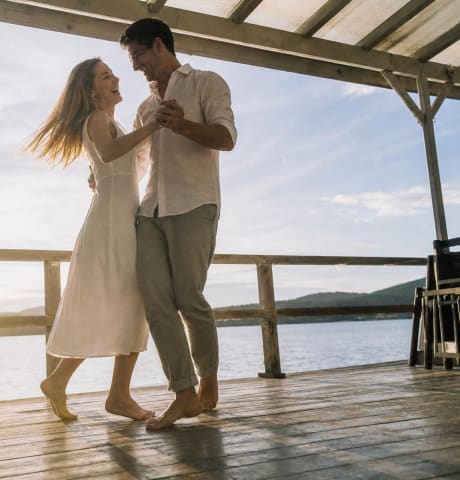 Wedding Dance Choreography: How to master your first danceYour first dance should be your personal highlight. With the right choreography and the perfect steps, you will dance into your wedding night feeling completely relaxed.
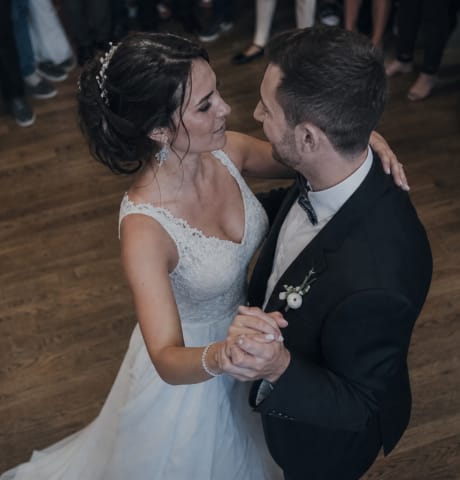 Wedding Dance Guide: How to Perfect Your First DanceYour wedding dance is approaching and the excitement is building. With our guide, you will master the flow, handle your wedding dress with ease, and dance your way into marital bliss, completely relaxed.
 Wedding Dance: The ultimate guide for your first danceThe first dance is the emotional highlight of your wedding celebration. Our guide shows you how to prepare for your big moment without any stress or pressure to be perfect.Wedding Dance Guide: How to Perfect Your First DanceYour wedding dance is approaching and the excitement is building. With our guide, you will master the flow, handle your wedding dress with ease, and dance your way into marital bliss, completely relaxed.
 Avoiding mistakes during your wedding dance: How to save the momentSmall slip-ups during your opening dance are not the end of the world. With the right tips, you can react calmly and turn your wedding dance into an unforgettable moment.
 Wedding dance jitters: How to stay relaxedAre your knees shaking before the big performance? With our proven instant tips, you can overcome your wedding dance jitters and enjoy your special moment.
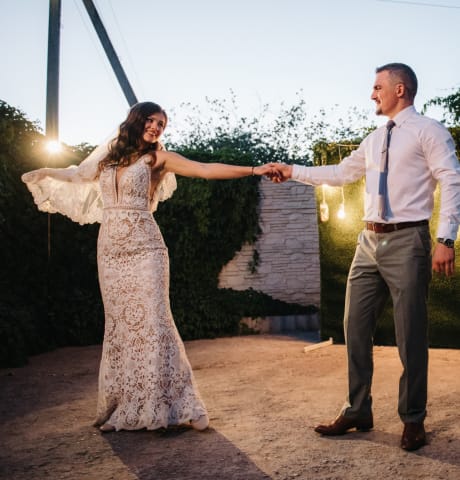 Opening the dance floor: How to get your guests movingThe first dance is done, but how do you get the party started? With the right etiquette and a clear plan, you can get your guests on the dance floor in no time.
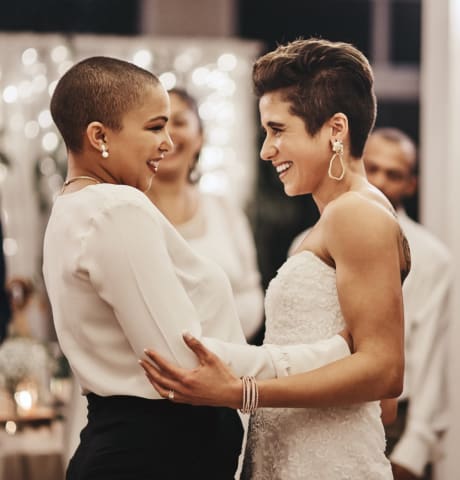 Which wedding dance suits you? Take our quizClassic Waltz, modern mashup, or an exciting flashmob? Our quiz reveals which opening dance perfectly matches your personality.
 Coordinating your wedding dance with the DJ and band: What mattersYour opening dance should be unforgettable. Use our guide to coordinate with your DJ and band to perfectly align the hosting, sound, and timing.
 Wedding Dance Trends: Fresh Ideas for Your PerformanceWant to make your wedding dance modern and unique? We show you the most exciting trends, from creative mashups to spectacular lighting effects.