Wedding preparation5 minutes

Preparing your wedding dance: Your stress-free timeline

By Bernhard De LucaUpdated

In a nutshell
  • A relaxed wedding dance schedule starts at least three to six months before the wedding date.
  • Regular, short practice in everyday life anchors the dance steps in muscle memory far more effectively than a hectic last-minute crash course.
  • The choice between a classic dance school and an online course depends primarily on your need for personal feedback and scheduling flexibility.
  • Private lessons shortly before the date offer an excellent opportunity for individual fine-tuning and provide additional confidence.

Preparing your wedding dance together

On udansa, you will find like-minded people, experienced dance instructors, and the right dance school in your region to approach your wedding preparations in a relaxed way. Start your dance journey together now and find the perfect course for your big day.

Preparing your wedding dance together

The preparation time for the opening dance is an emotional rollercoaster for many couples. With the right perspective and smart time management, however, the shared journey to the dance becomes an oasis of relaxation amidst the hustle and bustle of wedding planning.

DefinitionWedding dance crash course

A wedding dance crash course is a compact dance course, which usually takes place over a single weekend and teaches the absolute basics of the most popular wedding dances. It primarily serves for quick orientation or a short-notice refresher of existing prior knowledge.

Why preparation time is often underestimated

Many couples underestimate how much mental energy learning new movement sequences consumes under time pressure. Those who want to prepare their wedding dance are often confronted with a flood of to-do lists. However, dancing is not a logistical item like ordering the wedding cake. It requires motor learning, which needs time to mature. Anyone who only seeks out a wedding dance dance school four weeks before the celebration almost always ends up in a spiral of stress. The brain needs rest periods between training sessions to store movement patterns in long-term memory. Starting early removes the pressure and transforms practicing from an annoying chore into a bonding couple experience in the stressful everyday life of wedding planning.

A typical mistake is the belief that an intensive wedding dance crash course on the weekend before the wedding will solve all problems. Such compact courses are excellent for refreshing forgotten basic skills or learning the absolute basics. However, they cannot build solid dancing confidence if you have never danced together before. Musical coordination and an intuitive understanding of your partner grow through regular repetition over several months. Those who set up a structured schedule early on create space for mistakes, laughter, and genuine dancing development.

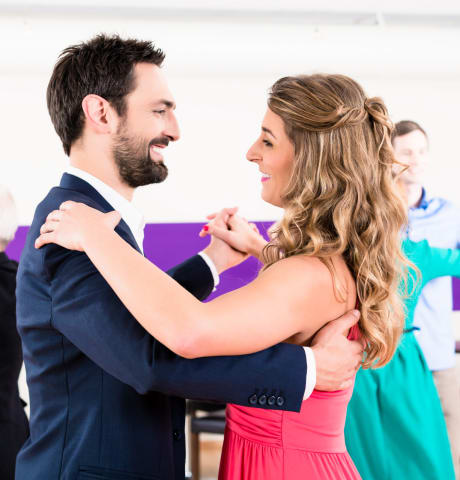
Concentration and a smile on your lips: if you start practicing early, you will dance completely carefree on the big day.

Dance school versus online course in direct comparison

When choosing a learning method, couples today face a fundamental decision. Learning the classic way on-site in a dance school offers the invaluable advantage of direct feedback. An experienced dance instructor sees immediately if your posture is blocked or your footwork is off, and can correct it before mistakes become ingrained. For couples who are unsure, we recommend taking a look at guides like finding a dance course for beginners beforehand to overcome the first hurdles.

In contrast, a wedding dance online course promises maximum flexibility in terms of time. You can practice in your own living room whenever it fits into your schedule, and repeat difficult passages as often as you like. However, the corrective eye from the outside is missing here. Those who opt for the digital version should be particularly disciplined and give each other constructive, loving feedback. Often, a combination is also ideal: work out the basics in a relaxed way at home and book one or two private lessons at a local dance school for the finishing touches to optimize your posture.

The path to a relaxed opening dance

Correct

  • Start planning at least three months before the celebration
  • Incorporate short, regular practice sessions into your daily routine
  • Take mistakes during practice with humor and composure
  • Book targeted private lessons for support if needed

Wrong

  • Panicking and searching for courses only a few weeks before the date
  • Training for hours at a time only once a month
  • Trying to force perfection and flawless choreography
  • Attempting to learn difficult figures without guidance

The biggest mistake with a wedding dance is trying to put on a perfect show. Guests do not want to see professionals, but a happy couple enjoying the moment.

Dance instructor, Hamburg

How regular practice permanently reduces stress

For dancing together to be a success, practice must be firmly integrated into everyday life. It is of little use to have a two-hour marathon session once a month. Short, regular units of ten to fifteen minutes, about two to three times a week, are much more effective. Turn your living room into a dance floor and use everyday moments to let the steps sink in. It is not about perfection, but about blind trust in each other.

If you would like to develop a feel for moving together before your first real lesson, you can get inspired by general beginner tips. A helpful guide for your very first step onto the dance floor is, for example, the article First dance lesson: What to wear and bring along?. If you internalize what you have learned without the pressure to perform, you will gain the necessary composure for the big moment. After all, on your wedding day, it is not the flawless choreography that counts, but the charisma and the joy that you share as a couple.

Two ways to the perfect opening dance

In-person

Learning at a dance school

The classic way in the dance studio

Learning on-site offers direct corrections from professionals and a fixed weekly appointment in your calendar. Ideal for couples who value commitment and the atmosphere of a real dance floor.

Digital

Learn via online course

Flexible training in your living room

The digital version allows you to practice in your own living room with a flexible schedule. Perfect for busy couples who want to train without spectators and at their own pace.

Frequently Asked Questions

  1. Ideally, you should start dancing three to six months before your wedding date. This timeframe leaves enough buffer for stress-free breaks, vacations, and cementing the learned steps into your muscle memory.

Wedding dance courses near you

Find the right dance school now to prepare for your opening dance stress-free.

View all suitable courses

Everything to prepare for your wedding dance: Your stress-free timeline