
Dancing together makes life more colorful
On udansa you will find like-minded people, the right music, and the best offers to make your dance preparation a real pleasure.


By Bernhard De LucaUpdated
On udansa you will find like-minded people, the right music, and the best offers to make your dance preparation a real pleasure.
Your own four walls are the ideal place to prepare for your big performance without any pressure. With the right approach, practicing in your living room becomes a relaxed time for couples filled with anticipation.
Your own living room offers the perfect, protected setting to try out your first dance steps without any audience. If you want to practice your wedding dance at home, you not only save time on travel, but you can also train completely stress-free at your own pace. The most important thing is that you do not put any pressure on yourselves. It is not about absolute perfection like in a tournament dance, but about your shared moment as a couple. If you approach preparing your wedding dance in a relaxed way, training in the living room will even become a lovely bit of couple time in the often stressful everyday life of wedding planning.
To make your practice a success, you should turn your living room into a small dance floor beforehand. Push the coffee table aside, provide warm, pleasant lighting, and have your music ready. Use these private sessions to fully engage with each other. If a step goes wrong, laugh about it together: it is precisely this ease that will give you the necessary radiance on the big day. A conscious start helps you leave everyday life behind and focus entirely on the rhythm.

Push furniture aside to create a clear space of at least three by three meters. A non-slip floor ensures that you stand securely and can focus entirely on the steps.
Start by walking through the basic step of your dance without any music. Count the beats out loud until the movement feels natural and fluid for both partners.
Turn on the music and try to dance the learned step at the right tempo. Adjust your steps to the beat, without thinking about posture or arm movements yet.
Now take the classic dance position and connect the steps with each other. Make sure that the lead signals are transmitted gently and clearly.
As soon as the basics are stable, you can incorporate simple turns or small changes in direction. End every session with a positive feeling and a successful sequence.
How it works
Better avoid this
Preparation
In the meantime
Follow-up
For starters, two to three short sessions of twenty minutes each per week are often enough. Consistency is more important when learning than hours of training at a time, as this helps the movement patterns anchor better in your muscle memory.
Yes, that is absolutely possible. Focus on simple basic steps and good posture instead of forcing complicated figures. A simple but harmoniously danced Waltz often looks much more elegant to guests than an overloaded choreography.
The best surface is a smooth but not slippery floor like parquet, laminate, or thin vinyl flooring. If you have a thick carpet, you should temporarily roll it up for training if possible to avoid tripping hazards.
Refine your steps with professional support for your big day.
Couple danceLimbach-Oberfrohna · Germany
PaartanzkreisMonday · 19:30 · Oct 12
Limbach-Oberfrohna
Couple danceLimbach-Oberfrohna · Germany
PaartanzkreisFriday · 18:15 · Oct 23
Limbach-Oberfrohna
Couple danceBurgstädt · Germany
Paarkurs - Goldstar TanzkreisSunday · 15:00 · Oct 25
Burgstädt
 Wedding Dance: The ultimate guide for your first danceThe first dance is the emotional highlight of your wedding celebration. Our guide shows you how to prepare for your big moment without any stress or pressure to be perfect.
 Preparing your wedding dance: Your stress-free timelineYour opening dance should be the highlight of your wedding celebration. With our stress-free timeline and helpful preparation tips, you will learn to dance in a relaxed way without any pressure.Preparing your wedding dance: Your stress-free timelineYour opening dance should be the highlight of your wedding celebration. With our stress-free timeline and helpful preparation tips, you will learn to dance in a relaxed way without any pressure.
 Wedding Dance Trends & Learning Methods: How to Learn TodayDiscover the most modern methods couples use today to prepare for their wedding dance. From flexible hybrid models to fast express crash courses, there is something for every schedule.
 Learn your wedding dance without arguments: Stress-free preparationYour wedding dance should be an unforgettable moment full of harmony. Learn how to master the preparation without any relationship stress or frustration.
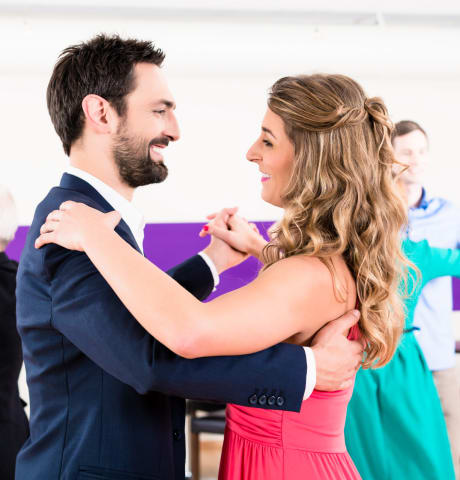 Last-minute wedding dance crash course: Is it doable?Running out of time before the wedding? A last-minute crash course saves your opening dance by teaching you the most important basics at express speed.
 The 7 biggest mistakes when planning your wedding danceAvoid unnecessary stress before your big performance. We show you the typical mistakes when planning your wedding dance and how you can easily avoid them.
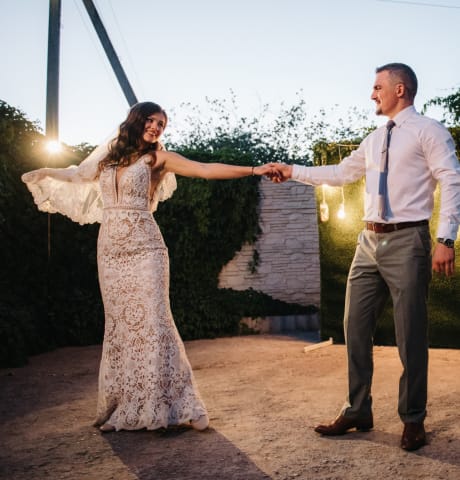 Planning your wedding dance with limitations: How to keep it stress-freeYour wedding dance should be a joy, not a source of stress. Learn how to plan a safe and beautiful first dance, even with physical limitations or during pregnancy.
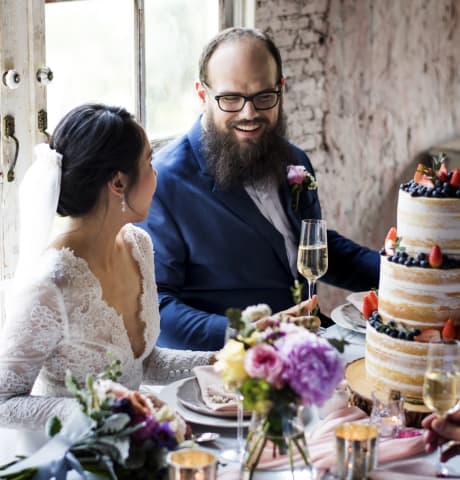 Planning your wedding dance: Coordinating with DJs and plannersProper preparation for your wedding dance with your DJ and planner ensures your first dance goes smoothly. Learn what matters most when coordinating.