

Zumba is even more fun together
On udansa connect you will find like-minded people who share your passion for energetic workouts, as well as suitable courses in your area. Grab your sports shoes and get started together with others!

By Mary De LucaUpdated

On udansa connect you will find like-minded people who share your passion for energetic workouts, as well as suitable courses in your area. Grab your sports shoes and get started together with others!
No more nagging pain after your workout. With the right adjustments to your steps, you train highly effectively, protect your joints, and get the full energy out of every Latin American choreography.
Relevance for joint health
All analyzed movement errors are proven to lead to strain on the musculoskeletal system.
Direct solvability in training
For every identified error, an immediately implementable anatomical correction is provided.
Practical relevance in everyday classes
The selection is based on the most frequently observed incorrect postures in real fitness classes.
Free from paid placement
This analysis was created independently and without sponsorship from fitness chains.
Regarding: Turns and changes of direction
If you keep your foot flat on the floor during quick changes of direction, you risk painful shear forces in the knee. Lift your heel slightly and turn exclusively on the ball of your foot to allow the joint to rotate freely.
Applies to: side steps and lunges
During fast side steps and lunges, the knees often buckle inward. Make sure that your kneecap always points in exactly the same direction as your toe to keep the ligament tissue stable.
Applies to: Hip rolls and shimmies
Latin rhythms tempt you to tilt your pelvis extremely far back. Without active abdominal tension, this arched back leads to compression of the lumbar spine: therefore, consciously engage your core.
Applies to: Jumps and bounce steps
If you land flat-footed after jumps without cushioning, you send hard shockwaves directly into your knees and hips. Instead, always roll softly from the ball of your foot through the midfoot and keep your knees slightly bent.
Applies to: Basic posture throughout the entire course
A rounded back and slumped shoulders restrict your breathing and strain your neck. Actively lift your sternum and gently pull your shoulder blades back and down to stabilize your spine.
When you give your all during a workout, it is easy to forget your posture in the rush of the music. Yet, this is exactly where the danger lies for your knees, hips, and spine. Dynamic, Latin American movements challenge your entire musculoskeletal system, which is why proper technique is the absolute foundation for pain-free training. If you regularly feel a pulling sensation in your lower back after class or your knee joints start to rebel, it is usually due to unconscious compensatory movements. A typical trigger is staying firmly planted on your whole foot during quick changes of direction, which directs rotational force straight into the knee. A collapsed arch or a permanent swayback also put unnecessary strain on your joints. To enjoy Zumba Fitness as an effective workout for body and mind in the long term and without limitations, it helps to consciously question your own movement patterns. Often, small corrections such as the proven method of lifting your heels during turns or consciously engaging your abdominal muscles are enough to immediately and noticeably relieve your joints and maximize the effectiveness of your training.
Zumba knee pain is usually caused by pivoting on a non-slip floor with your foot planted flat. This causes the foot to lock while the thigh continues to rotate, which creates extreme shear forces in the knee joint.
You can recognize poor posture during Zumba by a drooping head, rounded shoulders, or an extreme swayback during hip movements. If your knees collapse inward during squats, this is also a sign of poor posture.
To avoid injuries during Zumba, you should warm up thoroughly before every class, pay attention to the correct alignment of your joints, and wear shoes with a special pivot point on the sole.
Find the right course now and learn the moves from professional instructors.
ZumbaLimbach-Oberfrohna
ZUMBA® Fitness Clubrunning since Aug 18
Limbach-Oberfrohna
 Zumba Fitness: The effective workout for body and mindZumba Fitness is the perfect workout for anyone who loves to move and wants to improve their health at the same time. Find out how to get perfectly equipped here.
 Zumba during pregnancy: Training safely with a baby bumpZumba during pregnancy keeps you fit and boosts your mood. With the right low-impact adjustments, the workout remains perfectly safe for you and your baby.
 Zumba coordination training: More balance in everyday lifeA strong sense of balance and quick reactions are the best foundation for a safe everyday life. Learn how to train your coordination effectively and playfully with udansa and Zumba.
 Zumba Fitness Trends 2026: Wearables and New StylesFind out how smart wearables and the latest functional styles are revolutionizing Zumba training in 2026. The ultimate trend report for your workout.
 Zumba wear: The perfect outfit for your workoutThe right style for maximum energy: Learn how the perfect Zumba wear gives you maximum freedom of movement and keeps you comfortably cool.
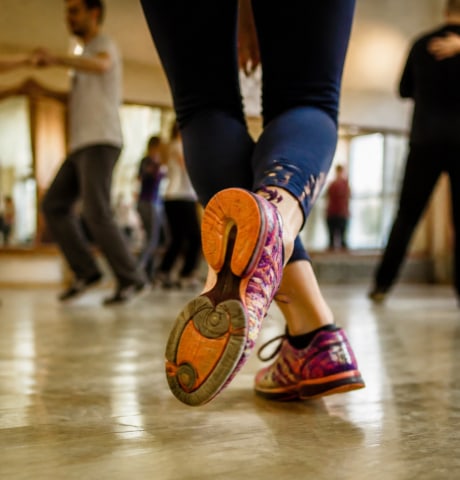 Zumba shoes: How to find the perfect gripThe right grip is key to safety and fun when doing Zumba. This guide shows you what to look for in a sole to protect your joints during quick turns.
 Zumba Gear: The 7 Essential Fitness ItemsReady for your next workout? With these seven essential items in your gym bag, you are perfectly prepared for every sweaty Zumba class.