Queer Dancing5 minutes

Queer dancing in Berlin: courses and dance schools without gender roles

By Mary De LucaUpdated

In a nutshell
  • Queer dancing in Berlin means partner dance without traditional gender-based role assignments.
  • Gender-sensitive dance courses teach leading and following independently of roles or teach both roles in rotation.
  • You can recognize good offers by gender-neutral course descriptions, respectful interaction, and open registration options for couples as well as individuals.
  • Current courses and open dance evenings in Berlin can be selected directly in the course filter according to suitable focus areas.

Partner dance works perfectly well without dusty gender roles. Gender-sensitive dance schools and queer dance classes focus on mindfulness, switching roles, and the shared experience on the dance floor.

DefinitionEqual Play

Equal Play refers to a dance concept in partner dance, where leading and following switch situationally and fluidly between both people while dancing. The model breaks down fixed roles and promotes mutual understanding of technique and balance.

Why partner dance without rigid gender roles is liberating

Classic partner dance instruction was structured for decades according to a rigid pattern: the gentleman leads with the left, the lady follows with the right. Anyone wanting to dance queer in Berlin consciously looks for spaces that break with this convention. Gender-sensitive dance instruction completely dissolves the connection between biological sex and dance role. Each person decides for themselves whether they give the impulse, pick up the movement, or learn both.

For the queer community, this means not only a formal opening but a protected space on the dance floor. No one has to justify who they dance with or in which role. Studios with such a philosophy pay attention to non-discriminatory language, refrain from gender-specific dress codes, and create an atmosphere in which queer, trans, and non-binary people can meet without the pressure to explain themselves. A look at trial classes and first experiences in open dance groups also shows how important such a culture of belonging is.

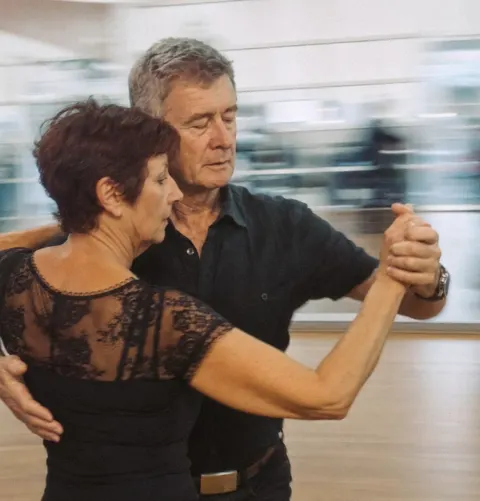
Leading and following are based on clear body language and subtle weight shifts, completely independent of gender.

Same-Sex and Equal Play in direct comparison

If you are looking for a suitable teaching format, you will encounter terms like Same-Sex dance and Equal Play. Same-Sex formats historically emerged as a protected space for same-sex couples. They focus on two women or two men learning ballroom or Latin dances together, but often retain fixed roles during a song. This creates visibility and security, but often still relies on a division into fixed leaders and followers.

The Equal Play concept goes a step further: here, the dancers switch roles in the middle of a piece, often seamlessly through fluid transitions in hand contact or through eye contact. A modern queer dance school in Berlin usually integrates this approach directly into the lessons. As a result, both people understand the mechanics of the figures from both perspectives. Those who master both sides dance more attentively, react more sensitively to weight shifts, and experience the dance as a genuine dialogue instead of a one-sided instruction.

Gender-neutral dancing on the floor

Recommended

  • Learn roles according to personal preference or both
  • Look for transparent language and open studio values
  • Mindfully address body signals and boundaries within the dance couple
  • Try out fluid role switching at your own pace

Avoid

  • Assigning fixed dance roles based on gender without asking
  • Demanding traditional dress codes without necessity
  • Trying to force a lack of leading through the use of physical strength
  • Viewing role switching as a fixed duty instead of an enrichment

Partner dance only truly comes to life when leading and following are not tied to gender, but are understood as an attentive dialogue between two people.

Dance instructor for partner dance

How to identify non-discriminatory dance courses

When looking for the right course, it is worth taking a close look at the course descriptions and the instructors' mission statement. Reputable providers for a same-sex dance course in Berlin or queer dance offerings state their teaching language transparently. In the course description, it will then be clearly stated, for example, that registration and participation are possible regardless of the partner's gender. Individuals are also generally welcome, as many courses work with rotating roles.

Also pay attention to how the studio handles changing rooms and sanitary facilities and whether the instructors have experience with sensitive teaching methods. A trial session helps you determine whether the interaction in the room is based on genuine respect. In addition, it is worth taking a look at open evenings: places like Clärchens Ballhaus in Mitte or the traditional Ballhaus Berlin offer regular dance evenings where you can try out what you have learned in a relaxed setting. You can filter specific dates and available course places in Berlin directly via the course search on this page.

Concepts for queer partner dance

Focus

Same-sex dancing

Visibility for same-sex couples

Two women or two men dance a traditional dance program together. The distribution of roles between leading and following usually remains fixed during the dance, but it offers a familiar, safe framework.

Dynamics

Equal Play Dancing

Fluid role swapping on equal terms

The roles of leading and following are swapped situationally, often in the middle of a song. Both partners learn the technique for both roles and shape the dynamic as complete equals.

Frequently Asked Questions

  1. No, in most courses you can also sign up alone. Many queer courses work with regular partner changes or connect individuals before the course begins.

Queer and gender-sensitive dance classes in Berlin

Choose from classes that teach leading and following free from gender roles.

Dance the way that suits you

Find dance partners, courses, and open dance nights on udansa, where leading and following are practiced free from gender roles.

Dance the way that suits you