Find your dance partner for Latin dances
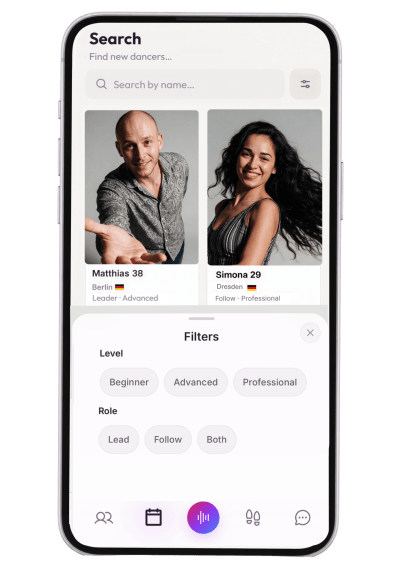
Whether you are looking for the right course or someone for the dance floor: on udansa you will meet like-minded people who share your passion for Rumba, Cha-Cha-Cha, and more.

Getting started with Latin American dances opens the door to a world full of rhythm and expressiveness. With the right step patterns in your repertoire, you will transform dry theory into pure joy on the dance floor with udansa.
Latin dance steps describe the standardized footwork and floor patterns of the dances Cha-Cha, Rumba, Jive, and Paso Doble in ballroom dancing. These step patterns form the foundation for all advanced figures and turns in partner dancing.
Anyone taking their first steps in a dance school will quickly encounter the World Dance Program (WTP). This system structures the most important social dances in such a way that you can move confidently on any dance floor in the world. In the Latin American dances, the WTP focuses primarily on four styles: the lively Cha-Cha-Cha, the romantic Rumba, the energetic Jive, and the proud Paso Doble. They all bring their own unique dynamic, yet they are based on clear, recurring movement patterns.
You start with standardized basic steps, which serve as the foundation for all subsequent Latin American dances in the World Dance Program. Instead of getting bogged down in complicated theory, you will quickly learn in practice how these steps are put together. Each figure builds logically on the basic step. Once you have understood the principle, you can effortlessly transfer the learned patterns to other dances, as many step sequences are similar.
The transition from the simple back-and-forth of the basic step to actual figures is the moment when dynamics emerge in ballroom dancing. In Cha-Cha-Cha, the side chassé step is the defining element upon which turns like the promenade or the lady's solo are built. Rumba uses almost the same geometric spatial layout, but stretches the steps differently in time, which leads to figures like the "fan" or the "Alemana". Here, the close relationship between the dances becomes particularly clear.
Those who want to learn ballroom dances, on the other hand, get used to a permanently closed hold. Latin dances break this symmetry: figures thrive on the constant change between open and closed dance holds. In Jive, for example, you use elastic kick steps and fast place changes to create visual highlights. Paso Doble, in turn, stages the entry into the arena with march-like forward steps, where the couple moves across the floor as one unit.
Use slow music when practicing at home. Once you have mastered the sequence of steps at half speed without errors, coordination at normal speed will be much easier for you.
The magic of Latin American dances does not lie in the number of figures, but in the clarity with which every single step is taken.
A common misconception among beginners is the belief that you have to memorize countless moves to look good. In dance school practice, the opposite is true: confidence on the dance floor comes from mastering a few, but cleanly executed, basic elements. If you know the basic steps by heart, you can react flexibly to your partner's movements and string moves together fluidly without losing your rhythm.
Especially with fast dances like Jive or Cha-Cha-Cha, a solid foundation protects against rushing. Instead of giving up after a failed turn, experienced couples simply return to the basic step for one or two bars to regroup. This composure distinguishes the advanced social dancer from the stressed beginner and ensures that the joy of movement remains the focus.
Lively and compact on the spot
Cha-Cha-Cha thrives on fast, precise weight shifts in a small space. The steps are placed flat to ensure you do not lose the typical liveliness and direct contact with the floor.
Fluid paths in space
In Rumba, steps are placed softly and with control. The movement flows through the entire body, giving the steps enormous dynamics and tension despite the slow tempo.
The Cha-Cha-Cha basic step consists of a rock step (forward and backward) and a quick side step, the chassé. The chassé connects the changes of direction and provides the typical, rhythmic character of the dance.
Find the right dance course now and learn the steps directly on the dance floor.
Sunday · 14:30-16:00 · Nov 15, 2026 - Jan 17, 2027
Limbach-Oberfrohna
Sunday · 14:30-16:00 · Sep 6 - Nov 8
Limbach-Oberfrohna
Sunday · 14:30-16:00 · Nov 15 - Nov 29
Limbach-Oberfrohna
 Learn Latin dances in the world dance programLearn everything about the Latin dances in the world dance program. We show you the differences between Cha Cha, Rumba, Jive, and Paso Doble for your perfect start.
 Learning Ballroom Dances: Your Guide to the Dance FloorThe comprehensive guide for your entry into the world of ballroom dances. Learn everything about the world dance program, the right technique, and how to get started even without a partner.