Latin technique6 minutes

The New York step guide for Cha-Cha and Rumba

By Mary De LucaUpdated

In short
  • The New Yorker is an open promenade figure, which is danced with identical footwork in Cha-Cha-Cha and Rumba.
  • The movement is based on a rock step forward, where the couple opens outwards by 90 degrees.
  • In Rumba, the step occurs on counts two, three, and four, while in Cha-Cha-Cha, the quick chassé follows on four-and-one.
  • A full rotation of the hips and feet is crucial for stable balance and an elegant look.

The New Yorker adds shine and breadth to your Latin dances. Learn how to look perfect in Rumba and Cha-Cha-Cha with the right footwork and the appropriate timing.

DefinitionNew Yorker

The New Yorker is a classic figure in Latin dances, where the dance couple turns from a closed facing position into an open promenade position. This movement is also known as a promenade opening.

How the open promenade breaks up the dance posture

The New York dance figure guide shows that this movement is one of the most versatile elements in partner dance. Known as the Promenade opening Latin, it breaks up the closed dance posture and elegantly opens the couple to the audience or to the side of the room. Instead of standing directly opposite each other, the leader and follower turn a quarter turn outward and look in the same direction. The key: The connection remains via a single hand, while the other arm is stretched freely into the room. This open position creates enormous dynamics and makes the figure a real eye-catcher on every dance floor.

Both in the lively Cha-Cha-Cha and in the sensual Rumba, the figure forms a creative highlight. Although the musical styles and the basic characters of the two dances differ drastically, the basic geometric pattern of the steps remains identical. Once you have internalized the footwork, you can effortlessly apply it in both worlds. It is this combination of technical clarity and expressive opening that makes the New York an indispensable classic in the world dance program.
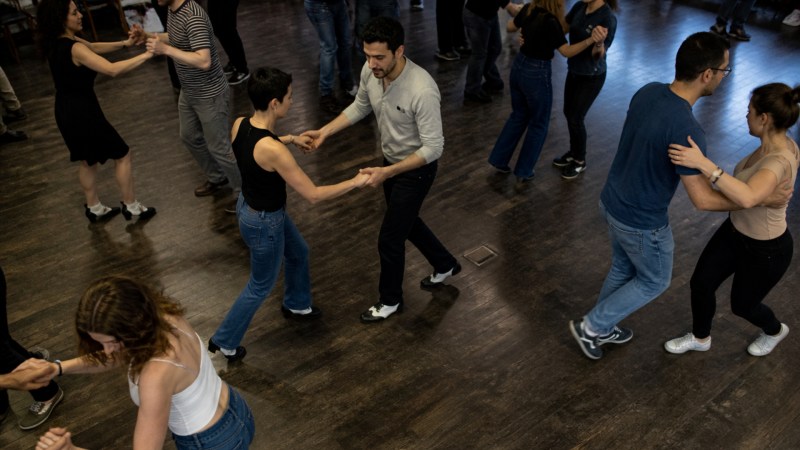
The perfect moment of opening: Only one hand maintains the connection, while the gaze and energy are directed outward.

Step sequence and exact timing in comparison

To execute the figure cleanly, a precise understanding of weight transfer is crucial. When performing the Rumba New Yorker steps, the free foot crosses in front of the standing leg with a clear forward step. The leader usually crosses with the right foot to the left, while the follower crosses with the left foot to the right. It is important that the weight is actually fully transferred to the front foot, while the back leg remains fully extended and the heel lifts slightly off the floor. After this forward step, the weight rocks back onto the rear foot before the couple turns back into the basic position.

The timing differs between the two dances due to the connecting steps. In Rumba, the New Yorker is danced on counts two, three, and four, with count one used for the slow transition. In the Cha Cha Cha New Yorker, however, the rock on two and three is followed by the typical, fast chassé on four-and-one. If you want to refine your technique, you can read our guide Latin American dances: 7 common technique mistakes to learn how to avoid typical misunderstandings regarding weight transfer in order to bring more stability into your turns.

The direct technique check for clean execution

Correct

  • Turn your feet and pelvis completely 90 degrees to the side
  • Shift your weight entirely onto the foot during the forward step
  • Actively stretch the back leg during the rock step
  • Direct your gaze proudly in the direction of the opening

Wrong

  • Only twist your upper body and keep your hips facing forward
  • Stay on your back foot and only tap
  • Bend your back knee uncontrollably or let it sink
  • Look at the floor or at your partner instead of into the room

Only when the hip completes the rotation does the New Yorker gain its proud Latin American flair and the necessary stability for the next step.

Dance instructor, Düsseldorf

Avoiding common mistakes during turns

The most common mistake when learning the New Yorker is an incomplete rotation of the pelvis. Dancers often tend to turn only their upper body to the side, while the hips remain rigidly facing forward. This leads to an unnatural twisting of the spine and robs the figure of its typical, flowing elegance. For a clean execution, the pelvis, knees, and foot must rotate as a unit by exactly 90 degrees. Only through this complete alignment does the proud, Latin American body tension emerge that makes the New Yorker look so majestic.

Another aspect is balance during the rock step. The front foot must be placed flat to give the body a stable foundation. Anyone who leans too far forward or keeps their weight on the ball of the foot easily loses their balance during the subsequent rock back. If you are already confident in the basic steps and want to test your level, you will find an excellent opportunity to put your precision in turns and weight shifts to the test in the Latin dance technique test.

Two dances, one movement: The New Yorker in a character comparison

Cha-Cha-Cha

The dynamic variation

Lively and rhythmically emphasized

In Cha-Cha-Cha, the New Yorker is characterized by lively energy. After the quick chassé, the forward step is executed sharply and precisely, which gives the dance its cheeky and rhythmic character.

Rumba

The elegant stretch

Sensual and controlled extension

In Rumba, the figure is celebrated in a soft and fluid way. The slow music allows you to savor the weight shift down to the last detail and elegantly stretch the movement out.

Frequently Asked Questions

  1. In Rumba, the New Yorker is danced on counts two, three, and four. The step forward occurs on two, the rock back on three, and the step to the side on four, which flows into count one.

Latin courses near you

Find the right dance course to try out your Latin technique in real life.

View all matching courses

Find your partner for the dance floor

On udansa you can find like-minded people to keep the beat with you, and the right dance courses in your area to take your steps to the next level.

Find your partner for the dance floor