


It is easier to spin together
Whether you are looking for like-minded people to practice with or need the perfect dance course for your next turn: on udansa you can quickly and easily find the right dance community in your area.

By Bernhard De LucaUpdated
Whether you are looking for like-minded people to practice with or need the perfect dance course for your next turn: on udansa you can quickly and easily find the right dance community in your area.
The spot turn adds dynamics and elegance to your Latin dances. With the right technique, you can turn stably on the spot without losing your balance or falling out of time.
The spot turn is one of the absolute classics among solo turns in Latin dance. It is danced in both the lively Cha-Cha-Cha and the sensual Rumba, with the footwork and direction of rotation being identical in both dances. The essential difference lies in the music and the resulting timing. While you have plenty of time in Rumba to enjoy the movement, the Cha-Cha-Cha requires fast, precise footwork to stay on beat. Once you have internalized the difference in rhythm between Cha-Cha-Cha and Rumba, you will quickly understand how it affects the dynamics of the turn.
A clean execution of the spot turn is characterized by the fact that you turn on the spot without traveling across the room. The secret lies in the precise weight transfer onto the balls of your feet and the targeted use of your focal point. Once you master this solo turn, you will gain enormous balance and be able to move much more freely on the dance floor. It is worth practicing this stationary turn regularly on your own to stabilize your axis before performing it as a couple. The principle is similar to individual training in other styles, such as how you use practicing Bachata alone for improved body control.
Put your full weight on your standing leg and fix your gaze on a steady point directly in front of you at eye level. Build up slight core tension in your stomach and shoulders to stabilize your axis.
Place your free foot at a right angle across the standing leg, landing on the ball of the foot. Shift your weight completely onto this front foot, while keeping your gaze directed forward.
Now turn 180 degrees on the balls of both feet, so that your back is facing the original focal point. Your weight remains on the foot you placed forward in the previous step.
Continue turning another 180 degrees in the same direction while shifting your weight back onto the other foot. Whip your head around quickly so that your gaze immediately catches the original focal point again.
Complete the movement with a controlled side step. In Rumba, this is a single, elongated step, while in Cha-Cha-Cha, you dance the side chassé here to return to the basic position.
Find the right dance course now to take your turns to the next level.
Couple danceBurgstädt · Germany
Paarkurs - Boogie & Rock'n'Roll - ClubTuesday · 19:00 · running since Nov 10
Burgstädt
BallroomMeissen · Germany
Tanzkreis | PROFESSIONALThursday · 19:20 · Jan 7 - Mar 25, 2027
"Atelier Federleicht" - Saal Tanzkurse
Couple danceBurgstädt · Germany
Bronzekurs für PaareTuesday · 20:00 · Nov 10 - Nov 24
Burgstädt
Correct
Wrong
Preparation
Arrival
During
The spot turn in Cha-Cha-Cha is danced on the counts 2, 3 and 4-and-1. The first step and the turn occur on 2 and 3, while the final side chassé on 4-and-1 completes the movement.
In Rumba, you dance the spot turn on the counts 2, 3 and 4. You take the first step on 2, turn and shift your weight on 3, and finish the turn with a side step on the elongated 4.
To avoid dizziness during the spot turn, use the technique of spotting. Keep your eyes on a fixed point in front of you for as long as possible, turn your body, and bring your head around quickly at the last moment.
 Latin dances: Steps and figures at a glance
 Cha-Cha-Cha Basic Step: Step-by-Step Guide
 Learn the Rumba basic step: A simple guide
 Jive Basic Step: The precise sequence for beginners
 Paso Doble Basic Step: Learn the marching steps correctly
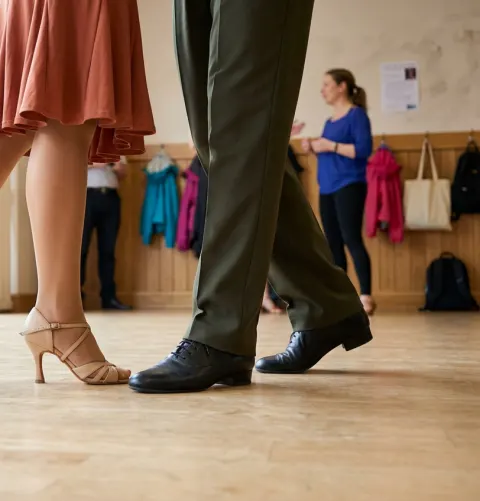 Rumba Fan Figure: Sequence and Leading in Detail
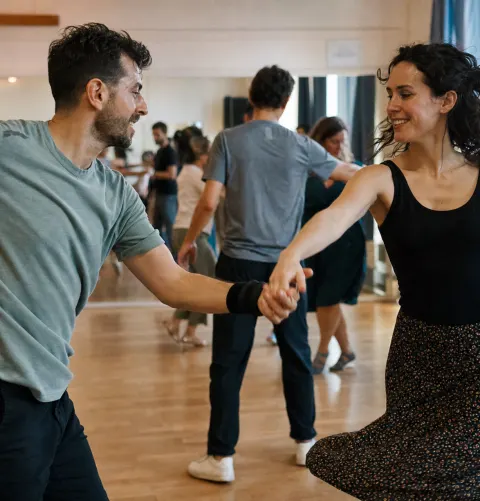 Jive Windmill: Step-by-step guide for couples