Find your dance partner for the Rumba
On udansa, you will find like-minded people in your area who want to try out the fan and other figures with you in a dance class or at the next social.

By Bernhard De LucaUpdated
On udansa, you will find like-minded people in your area who want to try out the fan and other figures with you in a dance class or at the next social.
The fan is the gateway to the open figures of Rumba. It transforms the classic, close partner connection into an elegant game of distance, leading, and balance on the dance floor.
The Rumba Fan figure is a classic element of the world dance program, where the couple moves from a closed hold into an open, right-angled position. One partner remains in the center, while the other dances a wide arc to the outside.
The Rumba fan figure, often referred to as the fan in the German-speaking world, is one of the most elegant and well-known elements you will learn in the world dance program. It breaks up the closed dance hold and opens the couple into an asymmetric, parallel position. While the leader acts firmly in place, the follower describes a wide arc that visually resembles the unfolding of a fan. In almost all choreographies, this figure serves as an important link to transition from a close embrace into open footwork patterns like the hockey stick figure or the Alemana turn.
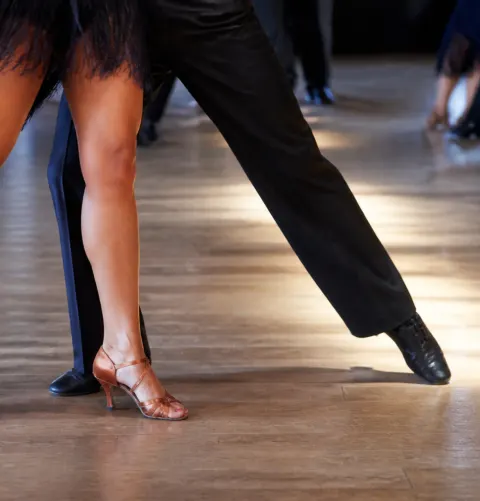
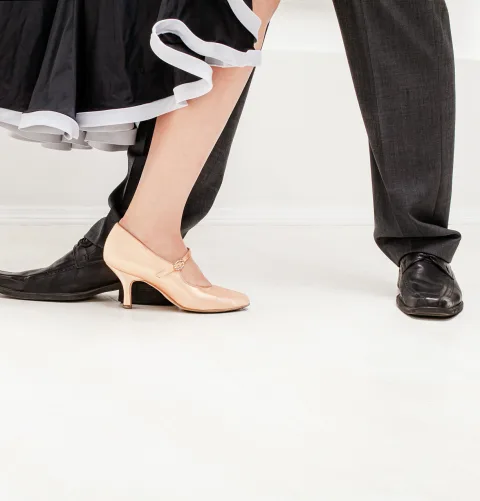
What makes this figure special is the play with distance and proximity. Although the partners are only holding one hand at the end of the sequence and are standing almost two meters apart, the dance tension in the upper body remains fully intact. To achieve this elegant look, precise footwork in Latin American dances is essential. Only when the steps are placed exactly on the line does the balance remain stable.
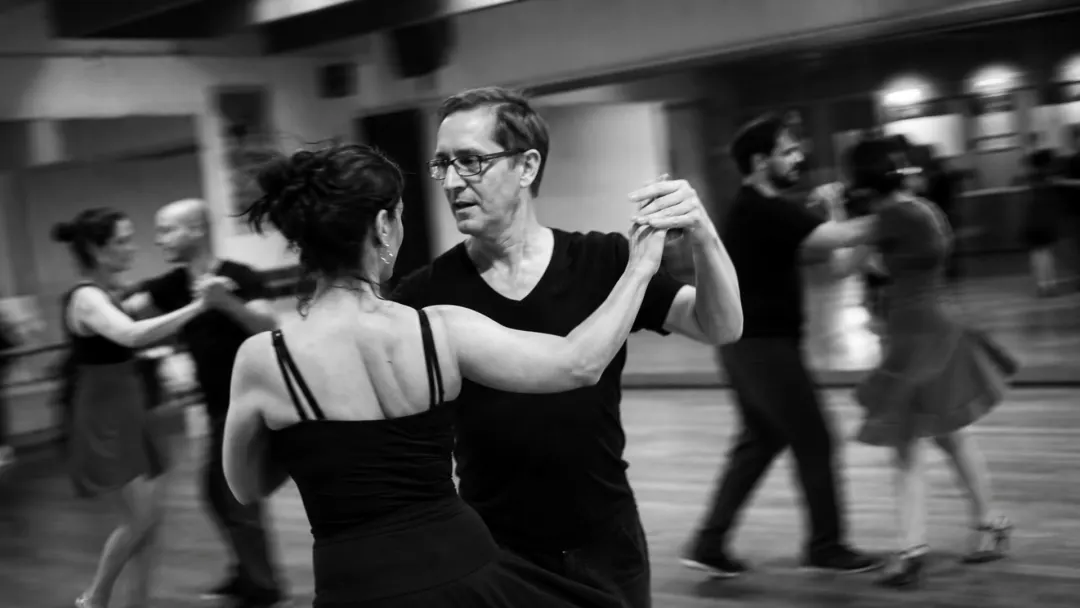
The exact sequence spans six beats in the typical Rumba rhythm (Slow, Quick, Quick). The entry usually occurs from a basic step movement. On the counts 4-1-2-3, the leader first guides the follower into a forward movement and then initiates a controlled quarter turn to the left. In doing so, the follower takes a step backward on 2, shifts weight to the right leg on 3, and turns 90 degrees to the left on 4-1 to reach the fan position.
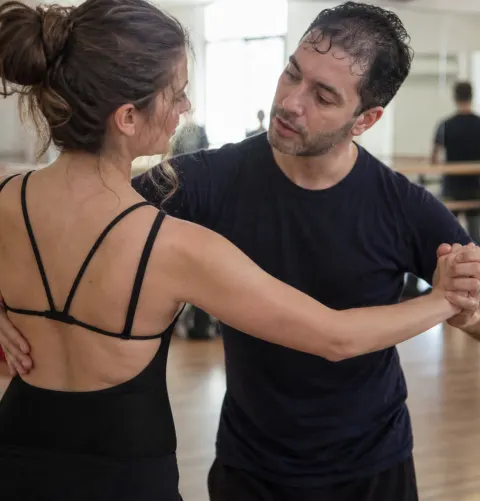
At the end of the movement, the partners are at a right angle to each other. The leader faces the line of dance, while the follower is oriented to the left. The connection now exists only through the leader's left hand and the follower's right hand. It is important for the Rumba fan lead that the arm is never fully extended. A slight bend in the elbow ensures that impulses are transmitted elastically and the connection remains soft.
How to master the fan
Common mistakes
Sign up today and learn the fan in the right course.
Couple danceBurgstädt · Germany
Paarkurs - Boogie & Rock'n'Roll - ClubTuesday · 19:00 · running since Nov 10
Burgstädt
BallroomMeissen · Germany
Tanzkreis | PROFESSIONALThursday · 19:20 · Jan 7 - Mar 25, 2027
"Atelier Federleicht" - Saal Tanzkurse
Couple danceBurgstädt · Germany
Bronzekurs für PaareTuesday · 20:00 · Nov 10 - Nov 24
Burgstädt
The fan does not live from the strength of the arms, but from the shared body tension in the space. Whoever pulls here, destroys the elegance of the Rumba.
For the Rumba fan figure to look light and effortless, both partners must develop a clear understanding of weight transfer. A common mistake is pulling or pushing on the partner's arm prematurely. Leading the fan is done primarily through the center of the body and not through the muscle power of the arms. The leader offers a stable palm as an anchor point, which the follower can use for orientation and to push off.
Anyone implementing the Rumba fan figure explanation in a dance class should pay particular attention to the timing. Since Rumba is accented on the second beat of the measure, the first step of the turn must be placed exactly on count 2. If you rush here, you lose synchronicity with the music. If you want to prepare for your next dance badge exam, clean separation of the axes and a steady stance in the end position of the fan are important criteria for the judges.
The calm center of movement
The leader remains stably anchored in the space, provides clear directional impulses from the center of the body, and keeps the left hand ready as an elastic anchor point for the partner.
The dynamics on the line
The follower uses the leader's momentum, takes precise steps on the line, and maintains body tension down to the fingertips to balance the distance.
The fan is danced over six beats. It usually begins on the count 4-1 of the preparatory step, followed by the actual steps on 2, 3, 4-1 of the Rumba rhythm, until the final position is reached.
No, the arms should never be completely locked. A slight bend in the elbow is necessary to transmit elastic lead impulses and to prevent an abrupt tug on the shoulder.
The transition is best achieved via a so-called hand-to-hand element or directly from a half basic step. The leader guides the partner to their left side and backwards to prepare the fan.
The most well-known following figure is the Hockey Stick. The Alemana turn or simple forward walking in an open position can also be excellently connected to the fan.
 Latin dances: Steps and figures at a glance
 Jive Windmill: Step-by-step guide for couples
 The Promenade in Paso Doble: Steps and Posture
 Latin Dance Steps Test: Determine Your Level
 New Yorker dance figure guide for Cha-Cha-Cha and Rumba
 Latin Dances: Modern Figure Trends for the Dance Floor
 Learn the Spot Turn: Mastering the Latin pivot