Latin American dances4 minutes

The promenade in Paso Doble: step sequence and posture

By Bernhard De LucaUpdated

In a nutshell
  • The promenade in Paso Doble is a sideways movement in an open position, where both partners move in the same direction.
  • The step sequence is based on four precise marching steps, which are placed exactly on the beats of the music.
  • The change of direction at the end of the promenade is initiated by a controlled right turn of the leader.
  • A constantly high body tension in the upper body is absolutely necessary to maintain balance during the transition.

The promenade in Paso Doble combines marching forward energy with proud elegance. Learn here how to master the step sequence and perfectly coordinate the change of direction as a couple.

DefinitionPromenade position

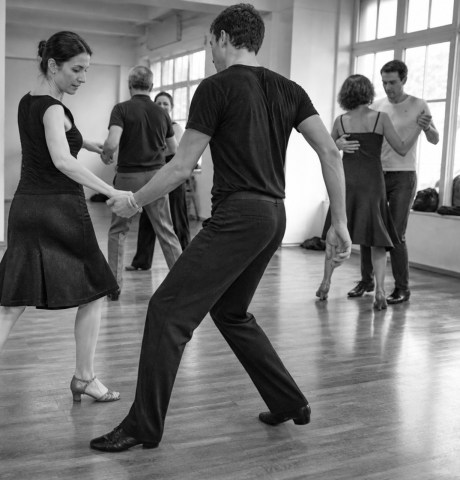
The promenade position describes a v-shaped opening of the dance couple, where both partners move forward in the same direction while their hips remain in contact on the closed side.

Pride and marching tempo on the dance floor

The Paso Doble differs fundamentally from other Latin American dances. While soft hip movements dominate in Salsa or Cha-Cha-Cha, this dance is a proud, crisp march. The promenade is one of the most distinctive figures for bringing this energy onto the dance floor. In a proud, upright posture, both partners move side by side in the same direction without losing the intense contact and tension between the pair. Anyone who masters this figure brings the typical dynamics of the Spanish bullfight directly onto the dance floor.

The basis is a clear structure that closely follows the classic dance direction in the ballroom. In contrast to competition dances, where highly complex choreographies are often required, the promenade in the world dance program focuses on a clear, understandable pattern. The challenge lies in controlling the forward movement so that it stops in a controlled manner and transitions fluidly into a new element.

The proud posture in Paso Doble requires a wide lifting of the chest while keeping the shoulders low.

The exact step sequence of the promenade in detail

To execute the promenade cleanly, both partners must coordinate their steps precisely. The step sequence begins from a closed facing position. The leader initiates the movement by opening their upper body slightly. This creates the space that both need for the forward step. The movement occurs over four beats in the typical Paso Doble rhythm, with each step placed exactly on a beat of the energetic marching music.

The leader begins with the left foot forward in promenade position, while the follower moves in mirror symmetry with the right foot. After the joint forward step, a passing step follows, during which the couple maintains the marching dynamic. It is important here that the toes point slightly outward and the knees remain minimally bent to maintain the typical, grounded stability of the Paso Doble. The arm connection remains stable throughout the entire sequence and elastically absorbs the forward momentum.

The path to a proud promenade

Correct

  • Lift your chest proudly
  • Place your steps precisely on the beat
  • Keep your arm frame stable and under tension

Wrong

  • Slumping down
  • Dragging your feet sloppily
  • Letting your arms hang limply

In Paso Doble, the promenade is not a stroll, but a demonstration of absolute presence and shared strength on the dance floor.

Dance instructor, Düsseldorf

How to master the change of direction as a couple

The most exciting moment of the promenade is the end, where the couple must change direction to transition back into the Paso Doble basic step or another figure. This change of direction is usually initiated via a controlled right turn. The leader gently blocks the follower's forward movement with an impulse in the right arm and turns their own upper body to the right. This redirects the forward momentum into a rotational movement.

The follower reacts to this weight shift and places the final step so that the couple faces each other again. Only through this harmonious coordination is it prevented that the couple loses balance or stops awkwardly. Body tension must not be lost at this moment of the turn. Only with a firm core and clear leading can the abrupt transition from marching into the turn be mastered elegantly and proudly by udansa.

Two roles for a perfect promenade

Leading

The leader as a signal provider

Setting the impulse and direction

As a leader, you open the promenade through a targeted, slight opening of your upper body. You determine the marching tempo and initiate the subsequent change of direction through a clear impulse in the arm frame.

Following

The follower as a counterpart

Maintain tension and react

As a follower, you maintain stable body tension and follow the forward movement without overtaking the leader. You react sensitively to the stop impulse and complete the turn harmoniously.

Frequently Asked Questions

  1. The leader initiates the promenade by slightly opening their left shoulder and left arm. This signals to the follower that the closed dance position is transitioning into a v-shaped forward movement.

Paso Doble courses near you

Find the right dance course now and learn the promenade from experienced instructors.

See all matching courses

Find your partner for Paso

On udansa connect, you meet other dance enthusiasts in your area who want to practice Paso Doble with you or try out new moves in a dance class.

Find your partner for Paso