Dance connections6 minutes

Going dancing alone in Düsseldorf: Find your people on the first night

By Bernhard De LucaUpdated

In brief
  • For your dance night in Düsseldorf, you need an option that explicitly welcomes guests coming on their own.
  • Announced partner changes make it easier to get started, but they don't guarantee you a dance partner throughout the evening.
  • Joining a group before the open dancing gives you a concrete first point of contact.
  • At the edge of the dance floor, you can approach guests who aren't dancing with a brief invitation to dance for one song.

Arriving alone can feel especially awkward among couples who already know each other. A manageable goal takes the pressure off: You don’t have to learn lots of names or stay until the last song on your first visit.

What you need for your evening

  • A dance evening open to individual guests
  • Basic knowledge of the announced dance style, or a beginner-friendly introduction
  • Comfortable clothing and shoes suitable for the floor
  • A small bag for water and personal belongings
  • Your own transport there and back

Coming alone and dancing with others are two separate questions

If you attend a dance evening in Düsseldorf without a companion, admission and finding someone to dance with are two different things. A single ticket initially only gives you access. It says nothing about whether guests mostly stay with their regular partners or pair up with new people during the evening. An announced partner rotation is a format, not a promise that you’ll have a personal dance partner.

During a guided introduction, the instructor can announce partner changes and reorganize the group. In free dancing, by contrast, partners change through invitations between songs. So if someone is dancing with someone else right now, that doesn’t mean they’re already committed to dance with them for the next song. Conversely, no one has to switch partners just because you came alone.

The word “dance” also doesn’t automatically mean there’s an opportunity to join in. In 1998, tanzhaus nrw moved into a former tram depot in Düsseldorf, bringing together a stage and an academy there. That history doesn’t explain how you can take part in an event today. For your visit, what matters is an explicitly described opportunity to join in.

For Swing, the guide can also help you find a party that suits your own dancing. A later regular dance practice partnership in Düsseldorf, on the other hand, is a different decision from accepting an invitation for a single song.
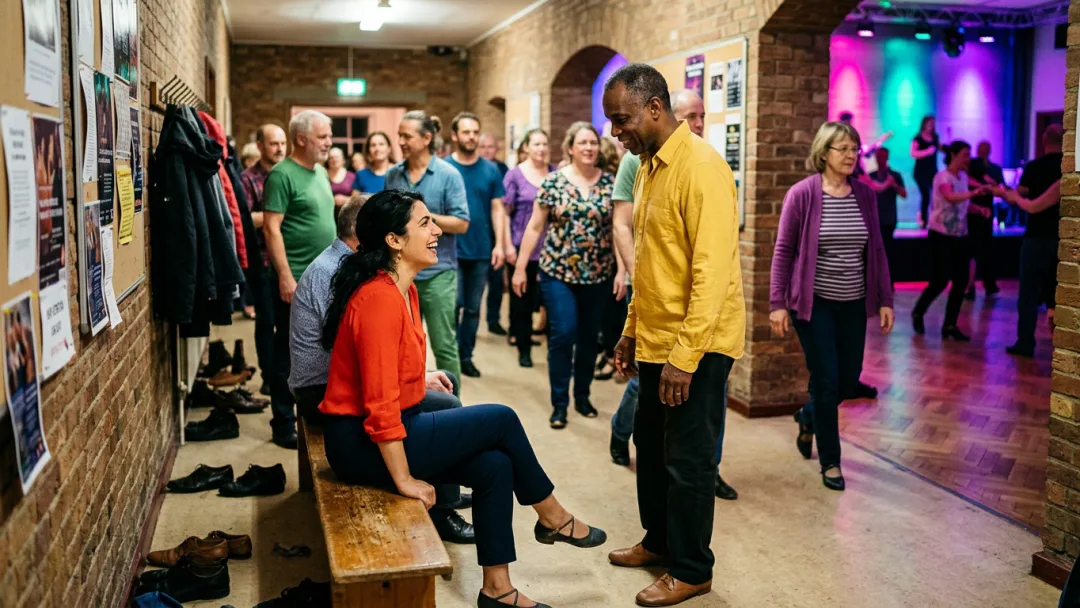
A short break to change shoes gives you time to settle in before you hit the dance floor.

From idea to dancing in seven steps

  1. Review the participation details

    Read through the information for the selected event on udansa about solo attendees, partner changes, and joining together. If a key detail is missing, ask the organizer about these three points in one go; “open party” alone does not answer them.

  2. Set a small goal for the evening

    Plan to share a first dance and a short conversation, rather than aiming for a certain number of new contacts. Also decide which dance role you can offer: that way, when you invite someone to dance, you won't have to think about your skills and expectations at the same time.

  3. Arrive for the group welcome

    Come at the announced start time of an open introductory session, if that’s part of the evening. Greet the person at reception and say: “I’m here alone for the first time today.” This makes your request clear without implying that you need someone to accompany you.

  4. Take an active part in the rotation

    Join the group for the guided introduction and follow the announced partner changes for as long as you’d like to participate. Briefly tell your next dance partner your name and role; after the rotation, you’ll already recognize one face for the free-dance part.

  5. Ask someone to dance for one song

    Between songs, approach someone who isn’t dancing or is deep in conversation: “Would you like to dance the next song with me? I can follow, and I know the basic step.” If they say no, move on kindly without asking for an explanation.

  6. Start with steps you know well

    Start with your comfortable basic step and a few familiar moves. Let them know early if the pace or a movement is challenging for you; adjusting the dance together is more enjoyable than trying to fake your way through unfamiliar moves.

  7. Start a conversation after the song

    Thank them and add something specific, such as: “I found the relaxed start easy to follow.” If the other person stays and responds, you can continue the conversation or suggest dancing together to a later song, both without any obligation.

Set expectations appropriately for each individual evening

Do it this way

  • Limit an invitation to one song
  • Explicitly state your dance role
  • Treat a break as a normal interruption
  • Ask someone else after being turned down

Not like this

  • Assume that dancing with someone means they’ll be your partner for the evening
  • Assume someone's dance role based on their gender
  • Assume a pause means no
  • Keep pressuring the same person to say yes

Your checklist for your visit

Before You Go

Preparation

After Arriving

Finding Your Bearings

After the Evening

Looking Back

Frequently Asked Questions

  1. Yes, if the evening explicitly includes an introduction open to beginners. By contrast, open partner dancing without an introduction usually requires at least a basic step and some familiarity with the music. You can also watch, but that does not replace a promised introduction or automatically lead to dance partners.

Your next song begins with Connection

On udansa connect, you can find dance partners in Düsseldorf and invite them to join you for a single dance evening. This keeps things specific, without committing to regular meetups.

Your next song begins with Connection