Group dancing starts with Joining in
On udansa, you can find dance events in London if you want to try popular group dances. A Ceilidh is a good way to get started, as long as the event allows you to attend on your own and explains how it works.

By Bernhard De LucaUpdated
On udansa, you can find dance events in London if you want to try popular group dances. A Ceilidh is a good way to get started, as long as the event allows you to attend on your own and explains how it works.
Arriving alone can feel unfamiliar at first, when couples are already gathering on the dance floor. In a popular group dance, you find your bearings through shared movements, not through a partner who already knows every step.
A Ceilidh is a social dance format with traditional group and couple dances. When you're getting started in London, the caller is important: This person explains the formations and figures, often walks everyone through the sequence without music at first, and gives further cues while you dance. The music carries the recurring movement patterns. You don't need to memorize a list of Scottish dances.
A set is a group of dancers who dance together. Depending on the dance, you stand in a circle, in opposite lines, or in another pair formation. Arriving without a regular dance partner doesn't mean you'll do every figure alone. Some dances require a partner facing you, while pairings change during others. However, an announced partner rotation doesn't automatically guarantee that individuals are welcome.
Words like circle, forward, back, and change places describe a circle, a forward movement, a return, and a change of places. Listen for these directions instead of just copying feet. The guide to observing dance movements without common mix-ups explains why this helps. Unlike free-form partner dancing, the called figure determines your path, not one person leading throughout. For a comparison with other types of evening events, check out the overview of going dancing in London.
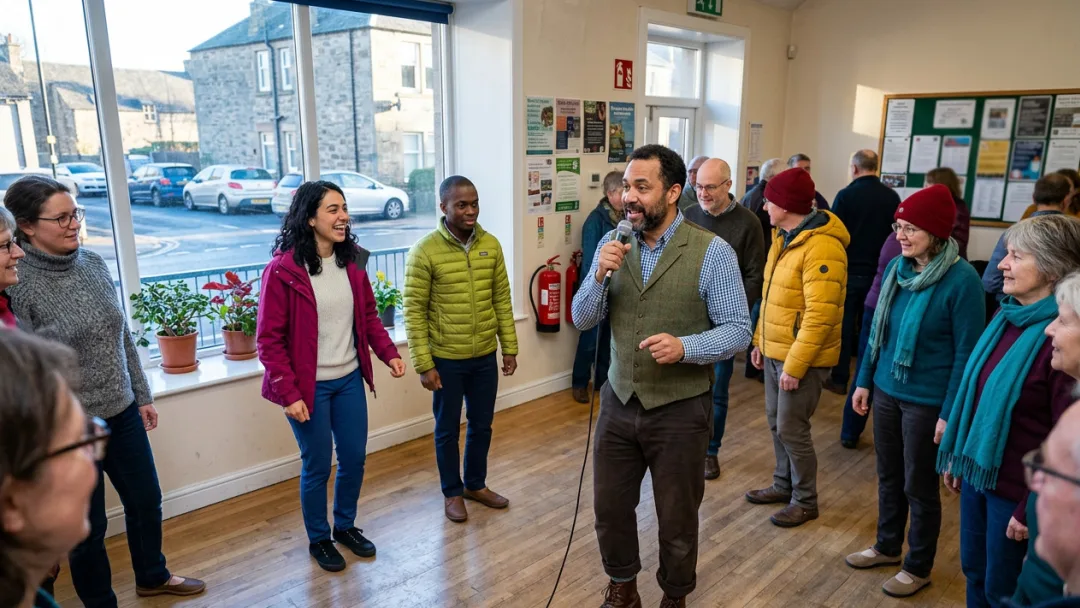
Check the participation details for three things: solo participants are welcome, figures are explained, and you don't need to register as a fixed couple. If there's no information about solo participation, ask the organizer exactly that. “Beginners welcome” describes the skill level, not automatic access without a partner.
Come to the dance floor for the introduction, not just when the first song starts. Leave your bag and jacket outside the walkways and silence your phone. You’re ready when both hands are free and you can hear the caller clearly.
While groups are forming, approach someone who isn’t partnered yet: „Shall we join this dance?“ Accept a no without asking for an explanation. Line up with your partner where the caller is gathering couples, rather than starting an extra line.
Follow the run-through and remember your starting position, your partner opposite you, and the way back. At a crossing, continue to the named destination instead of stopping in the middle of the passage. You know the route when you can find your partner again after the figure.
Start with the popular first figure and keep your steps short enough for the space available. Offer your hands loosely, without gripping their fingers. You’ll stay in the flow when your partner can follow you without being pulled along.
If you miss a figure, let others pass and look for the next shared starting point. Don't move back against the direction of movement to catch up on what you missed. Pick up the next clear cue as soon as you're safely back in formation.
Stay with your group until the announced end, as long as you feel comfortable, and thank your partner. Let go of hand contact afterward. A new formation is created for the next dance; your temporary pairing does not obligate anyone to another dance.
The right way
Not like this
Equipment
Orientation
Recovery
Ceilidh is pronounced roughly “Kay-lee,” with the emphasis on the first syllable. The term refers to a social gathering and is used in the context of dance for evenings featuring traditional dances. You don’t need to be able to work out the spelling from the pronunciation to follow the caller’s instructions on the dance floor.
You don’t need a kilt for a regular, informal Ceilidh. Comfortable everyday clothes are practical, as long as they don’t catch on your partner or restrict your steps. A festive occasion may call for different clothing, but the word Ceilidh alone doesn’t imply a particular dress code.
A Ceilidh evening isn’t automatically the same as a Scottish Country Dancing event. At a beginner-friendly Ceilidh, the focus is on dancing together socially, with the figures explained. Scottish Country Dancing can place more emphasis on set dances, step technique, and practiced formations. The terms therefore aren’t interchangeable descriptions of the skill level required.
Above all, you need to understand short instructions about direction and movement, not speak English fluently. The demonstrated practice run provides extra guidance. Stay calm and attentive during the explanation so you can hear important words. If you can’t understand the instructions at all, simply following others is not a safe basis.
You don’t have to copy every hopping movement the others do. When you’re starting out, you can do many sequences with gentle walking steps, as long as the direction, timing, and spacing are right. Keep your knees soft and avoid hard landings. If you’re in pain or feel unsteady, sit out rather than forcing the movement.
Wait for a new group to form instead of squeezing into the full formation. The number of places is part of each figure, and an extra pair can disrupt the paths and changes. Stay visible at the edge without blocking the entrance, and join the next formation after it has been fully explained.