Your next dance night in London
On udansa, you’ll find dance events in London that suit the occasion. This way, you can search specifically for opportunities to dance along instead of stage performances.

By Bernhard De LucaUpdated
On udansa, you’ll find dance events in London that suit the occasion. This way, you can search specifically for opportunities to dance along instead of stage performances.
After moving, sometimes it’s not the steps you’re missing, but familiar opportunities to dance them. An event’s name often tells you better than its music style what kind of evening to expect.
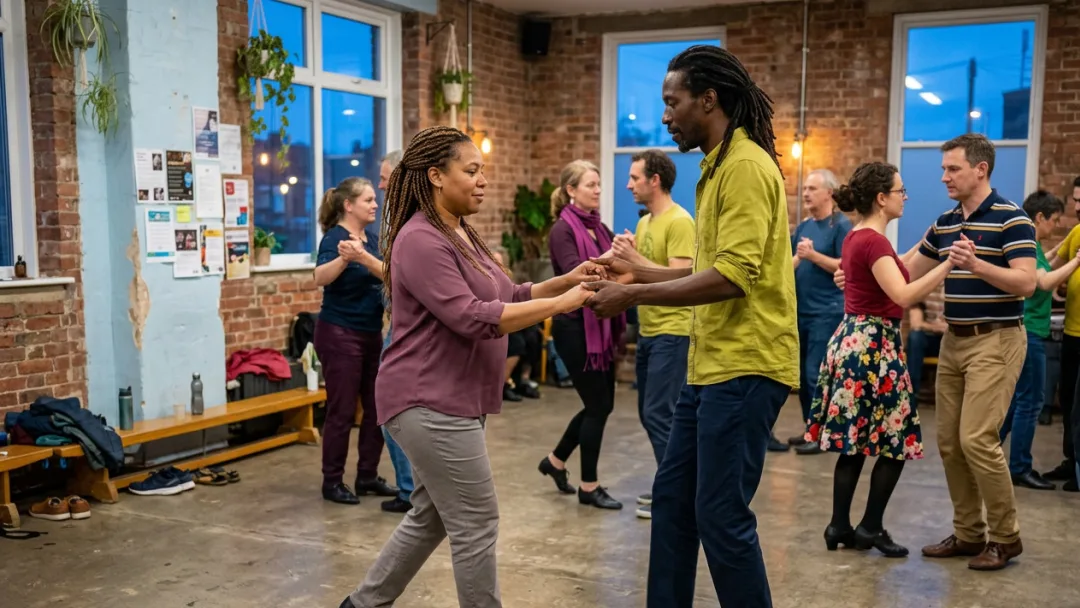
Social dance means dancing together in a social setting, without the expectation of performing or competing. An evening advertised as a social usually leaves room for open dancing rather than following a continuous lesson plan.
If you want to dance in London outside of class, it helps to distinguish between free dancing and guided participation. At a social, you choose your own steps. The music plays, people dance or take a break, and no one has to perform the same figure at the same time. A brief introduction beforehand doesn’t make the rest of the evening a class.
A party may be shaped more by its music mix: dancing solo, dancing side by side and changing partners are different from a format explicitly focused on partner dancing. A ball adds a formal occasion and possibly an organized schedule. The term dance evening alone doesn’t tell you much about that.
Group dances or Line Dance may be built around a shared sequence. You don’t need a regular partner for this, but you do need to stay oriented with regard to direction, rhythm and changes of position. Knowing how to observe dance movements helps more than trying to copy every movement as quickly as possible. Open to guests doesn’t automatically mean no prior experience is needed. A song everyone shares doesn’t create a shared routine either: free dancing allows for personal variations, while a group sequence requires recognizable steps.
The most common misunderstanding happens when a dance event is judged by its style rather than its purpose. Salsa on the program first describes the music and dance style. That does not mean that basic steps will be explained or that everyone will arrive with a partner. Likewise, a partner change does not mean that every person is available at all times.
On an open dance floor, an invitation is just that, an invitation. A friendly no ends it; unsolicited corrections do not turn it into a lesson. If you have little experience, you can stick to a simple basic step. Big turns, wide arm movements and unexpected lifts do not belong between couples standing close together.
A festival and a participatory event are not synonyms either. A program can include workshops, performances and open dance time side by side. The distinction between these elements is explained in a Line Dance festival between workshop and party. What matters for your evening is the part you actually take part in. In a group line dance, keep the intended distance; when dancing solo freely, move so that your neighbors do not have to interrupt their own dancing. Both call for attention, but in different ways.
What works
Misunderstanding
A familiar basic step is often enough for an entire dance if you adapt it to the music and available space.
The Notting Hill Carnival makes the difference between open dancing and organised participation especially clear. Its history brings together Caribbean music, costume design and movement through public streets. In 1959, Claudia Jones organised a Caribbean Carnival at St Pancras Town Hall. In 1966, Russell Henderson's Steelband made its way through Notting Hill at a children's street festival: music became a moving street procession.
The established carnival framework included Masquerade, Calypso, Soca, Steelpan and Sound Systems. Steelbands represent music played together on steelpans; Sound Systems provide amplified music. Masquerade combines costume and performance with an organised group. This explains why dancing alongside a procession is different from taking part in it. This history is not a promise of a current schedule or event date.
A public street does not turn a parade group into an open dance floor. Keep group routes and passageways clear. When dancing outdoors, the ground, weather and crowds also determine how much you can move: take short steps instead of expansive figures, and wear sturdy shoes instead of delicate soles. You can feel the music in your body without treating costumes or movements as arbitrary decoration. The cultural context is part of taking part, even if you are not learning choreography.
You decide song by song
An open dance format gives you room to sit out a song or keep your dancing low-key. You can focus on the rhythm and the connection without preparing a performance together.
You're part of a group that's made arrangements together
Joining an organized group gives you a shared framework, such as a costume, a sequence of movements, or a route as a group. The commitment can feel good: you know what you're contributing beyond your own dancing.
For an informal dance evening, comfortable everyday clothes and shoes suited to the floor are a good choice. Formal occasions may have a dress code. Outdoors, grip, weather protection and a sturdy sole matter more than delicate dance shoes; an extra light layer can help during breaks.
Yes, if the format does not require advanced skills, you can join in even if you know only a few basic steps. A social does not replace lessons, though. Small, safe movements are a better way to get started than figures whose lead or exit you have not yet mastered.
No, during open dance time you can skip songs and take breaks. You can also politely decline an invitation without having to give a reason. If you have agreed to take part in a group routine, however, sitting it out affects the group’s flow.
You can find current listed dance events in London using the event filter on udansa. Names like social, party or ball can give you an idea of what to expect, but they do not guarantee a particular format. Check the participation requirements there, including admission, minimum age, registration and whether you need to bring a partner.