Connect with others around a practice goal
On udansa, you can find dance partners in London to practice individual moves or short sequences with. Having a specific goal gives your search a clear purpose.

By Mary De LucaUpdated
On udansa, you can find dance partners in London to practice individual moves or short sequences with. Having a specific goal gives your search a clear purpose.
A dance figure can sometimes leave you stuck after class, right where practicing it together would help. A practice partner you can reach out to makes that possible, without a quick search having to turn into a long-term partner arrangement.
When searching in London, “intermediate” alone tells you little. Two people can have been dancing for a similar amount of time and still want to repeat completely different parts. One person knows many figures but loses the connection between them. The other knows only a few figures and wants to recall those without interruption. You’re a good match if you want to work on the same passage and both have something to contribute.
So describe the scope: a single figure, a transition, or a short sequence from class. Add whether you already know the sequence or still often need to remember the order. You don’t need a technical diagnosis of what’s going wrong. “I know the sequence, but I get stuck on the transition” is clearer than an uncertain explanation of the cause.
Practising together doesn’t replace lessons: you repeat what you already know instead of teaching each other unfamiliar technique. If you’re missing the basics for that, this guide can help you work out which dance classes in London suit your learning goal. The overview of finding a dance partner in London covers the broader search; here, the focus is on your specific practice needs.
For your search radius, what matters is the journey from your actual starting point. A meeting place near your usual route can be more practical than a closer location that requires extra changes. Plan your return journey too, not just how you’ll get there.
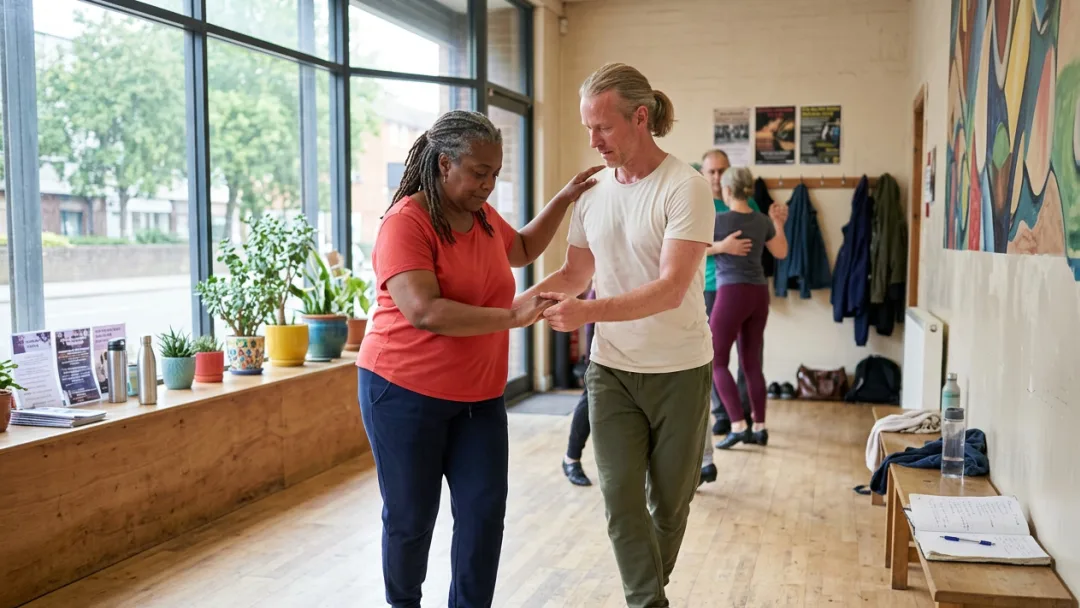
Choose a figure or short sequence from a previous lesson that you'd like to repeat. Write down its name or a clear description; the goal is specific enough if you can describe it in one sentence.
Add what you can already recall and where you get stuck. Also mention the version used in the course, if you know it: The same figure name can refer to different sequences that don't make sense to practice together.
Set aside a time slot for getting there, changing, practicing, and getting back. Example for your own planning: If you have two hours available and the round trip takes an hour, you’ll have less than an hour to dance once you factor in changing and breaks.
Use your available time to determine a maximum one-way travel time, and factor in walking and transfers. Include your usual starting points, such as home or work; only include an area in your search if the return trip also fits within your time window.
Use udansa to search in London and describe the specific goal you want to practice. You can also ask people from your class about the same passage: anyone who has learned it too already shares a common point of reference with you, even if they don’t necessarily need to practice the same things.
Assess responses based on three criteria: the same passage, a shared time slot, and routes that work for both of you. A higher dance level is no substitute for this alignment. Even highly experienced contacts are of little help if they actually want to practice completely different material.
With the right contact, note down which sequence you want to practice together and what timeframe you have for it. If you still can’t find any overlap, change just one search criterion, such as the area you can travel to, instead of giving up on your goal, timing, and dance style all at once.
Use the course filter to find current classes and dates in London if you'd like to supplement your practice with lessons.
Do this
Not like this
Narrowing down
Matching
Focus
No, what matters is that you both need to practice the selected passage. Different levels of experience can work as long as you both want to repeat it and neither person permanently takes on the role of teacher. If one person still needs to learn the sequence while the other only wants to refine details, your immediate goals are usually too different.
Your search radius should be large enough for the journey there, practice, and the return trip to fit into the time you have available. A fixed number of kilometres is not very meaningful. Start from where you will actually be before practicing, and allow for walking, transfers, and time to change.
Yes, you can look for a suitable practice partner even if you don't have your own space. To practice together, you will need enough room, a suitable floor, and permission to use the space for that purpose. An empty corner at a dance event is not automatically an available practice area.
Describe the passage by its beginning, its end, and the context in which you learned it. For example, you can mention the transition from a turn back into the starting position without explaining a technique. An unclear technical term is more likely to cause confusion than a simple description of what you both know from class.
First, relax a criterion that you can genuinely change. Maybe you can use a different time slot or travel a little farther. For now, keep your practice goal the same. If you give up all your boundaries at once, you may find a dance partner, but not someone to practice the passage you were looking for.
No, when you practice together, you repeat material you already know, while lessons teach new material and provide expert corrections. Feedback between practice partners can describe what happened, such as an interruption. That does not amount to a reliable technical diagnosis. Unfamiliar lifts, strenuous movements, or painful sequences should not be attempted on your own.