Find lessons that suit you
On udansa, you can find dance classes in Rome and sort them by your learning goal. That way, you can search specifically for fundamentals, practicing together, or personal feedback.

By Mary De LucaUpdated
On udansa, you can find dance classes in Rome and sort them by your learning goal. That way, you can search specifically for fundamentals, practicing together, or personal feedback.
A class can seem just right on paper and still feel too fast or too focused on small details. That’s often because lessons train different things, even when the same dance style is on the schedule.
In dance classes, progression means building from simple tasks to more challenging movements. New material builds on skills you've practiced before.
If you're looking for dance classes in Rome, the style name gives you a first indication. However, it doesn't tell you which skills the class develops. Within the same style, lessons can break down the fundamentals, teach a set sequence, or help you adapt familiar moves more freely to the music. That's why you can't assess a dance school based on the names of its classes alone.
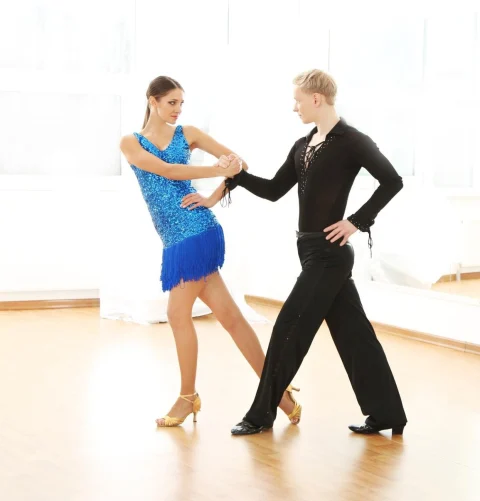
Partner dancing also involves connection and communication through movement cues. In a solo class, for example, the focus may be on coordination, body alignment, or expression. These differences describe learning tasks, not a ranking of the dances. A calm fundamentals class can be more challenging than a long sequence that you simply copy.
You should be able to describe your learning goal as a skill. “I want to keep the beat” is more specific than “I want to dance better.” Other concrete goals include changing direction with confidence or combining familiar moves on your own. A set routine, in turn, has a different goal from free application, as the guide to the difference between a choreography class and style instruction explains. Special occasions such as a wedding dance also need their own teaching framework.

The label “beginner” describes a stage of learning, not an age. You may have a lot of musical experience and still be starting from scratch with weight changes. Conversely, someone may be able to perform a movement reliably after practicing a few fundamentals carefully. The number of classes attended and the names of figures you remember are therefore only limited indicators.
For progression, what matters is whether you can maintain a familiar sequence without constantly watching a demonstration. This includes a stable stance, suitable step sizes, and the ability to pick up again after a mistake. Simply copying often masks difficulties with direction and weight transfer. The article about common observation errors when copying movements explains why a movement that looks similar is not necessarily the same movement.
Age tends to affect how a class is structured rather than set a rigid performance limit: concentration spans, range of motion, and recovery can vary. Children's classes have their own educational framework, while returning to dancing takes into account existing but possibly uncertain fundamentals. Among adults, an age difference says little about their ability to learn together. For more on this, see couples with an age difference in dance classes.
A good fit
Not a good fit
In the course filter on this page, you'll find the currently listed courses and dates in Rome for your learning goal.
A suitable class gives you tasks to work on and enough time to try out a correction.
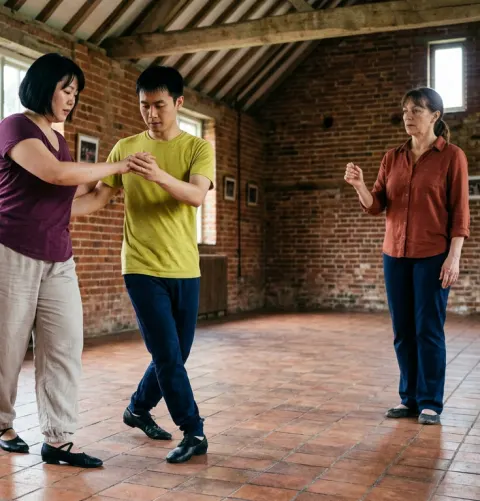
Group classes give several people the same task. You listen to explanations, watch a demonstration, and then try the movement yourself. Counting together makes it easier to stay oriented in the beat; individual corrections help address a visible deviation. The key teaching moment often comes between the explanation and the next attempt.
An ongoing course series can revisit and build on material. A compact workshop, on the other hand, focuses on one topic, but offers fewer opportunities during that session to reinforce something over longer breaks. Private lessons focus more closely on your movement. These formats differ in their practice setting, not necessarily in their quality.
How dance roles are organized is also part of the picture: a solo class does not require pairing up, while partner dancing requires a way to practise together. “Register without a partner” therefore does not automatically mean “dance alone.” Whether the class uses fixed pairs or rotating partners changes the experience during the lesson.
For your classes in Rome, it also helps to choose a format you can fit into your everyday life and keep up with. Short practice sessions between classes help you retain what you learn. Comfortable clothing and shoes suited to the style make it easier to practise, while clear explanations make corrections useful.
Bringing rhythm, movement, and application together
You want to develop different skills in parallel and still figure out what suits you. Recurring exercises show you how musicality, coordination, and movement quality are connected. A broad course framework gives these areas room without limiting every class to the same level of difficulty.
Work on a clearly defined skill
You already know which movement is holding you back or what goal you want to reach. A narrow focus allows for careful observation and repeated attempts under similar conditions. This focus is helpful when you want to track your progress on a specific task.
You need to understand the language of instruction well enough, and it is not automatically the same in every class. Demonstrations help you follow the movements, but they do not replace instructions about exertion, direction or contact. Check the language of instruction before booking if you are still unsure about it.
For your first class, comfortable everyday clothes and clean, comfortable shoes are suitable, unless the dance style requires special equipment. You should be able to move your knees and hips freely. The right shoes depend on whether you will be turning, jumping or dancing barefoot.
Yes, you can practise recognising and following a steady beat. Feeling unsure about music does not mean you are unsuited to dancing. A class with audible counting, simple weight shifts and manageable movement exercises gives you a chance to connect listening and moving.
Short, repeated practice sessions are usually more helpful than one long session right before your next class. A clearly defined task, such as a clean weight shift, is enough. You do not need to repeat the entire class sequence every time to reinforce a correction.