Join in with support
On udansa connect, you can find dance contacts in Rome who you can openly discuss space to move, breaks, and the support you need with.

By Bernhard De LucaUpdated
On udansa connect, you can find dance contacts in Rome who you can openly discuss space to move, breaks, and the support you need with.
You want to listen to music and join in dancing yourself, without having to negotiate obstacles at the entrance first. Good preparation makes your needs concrete instead of relying on a blanket label for the venue.
For your dance evening in Rome, the entire route matters: from the actual event entrance to the dance floor, the place to take a break and the restroom. A single ramp tells you little about whether you can later get between chairs or leave the room independently. A specific description is more helpful than the word “accessible” alone. Likewise, “low-barrier” does not automatically tell you which obstacles have been removed.
Dancing brings additional requirements beyond simply getting in. A wheelchair needs space to turn; with a walking aid, stepping sideways to avoid something can be difficult. If you dance while seated, you still need a clear area to move. A smooth surface can make it easier to roll, while loose rugs, cables and raised thresholds can interrupt movement. For people with visual impairments, a clear layout and unobstructed paths can be important; for people with sensory sensitivities, having an accessible place to retreat to matters too.
The search for an evening to dance along gives you a starting point, not an assurance that the event is accessible. If you’d like help preparing a message, the guide to dancing in Rome without Italian covers useful practical terms. What matters is whether the conditions described suit your needs for taking part, even if you’re more tired later than when you arrive.
Note what’s essential for you to participate, and distinguish it from your preferences. For example, write “step-free throughout” or “seat with a backrest” instead of “easy to access”; describe how you use the space, not your medical history.
If needed, note the width and length of your mobility aid, including any parts that stick out. Add whether you dance seated, with a walking aid, or switch between the two, and whether you need room to turn or a clear view of the movements.
Send the organizer your requirements in one message using these questions: “Is the route to the dance floor and restroom step-free? How wide are narrow passages, and what is the floor like? Is there an accessible seat or quiet area? Who will provide the agreed support?”
Match each answer to your needs list: specifically confirmed, not possible, or still open. “We’ll help somehow” describes neither a usable route nor available support; an unspecified doorway width remains unknown, even if the entrance is described as accessible.
Decide based on the must-have conditions whether this evening is right for you. If getting in requires carrying, a risky transfer, or assistance that hasn’t been confirmed, don’t plan to attend on that basis; another evening may be an alternative.
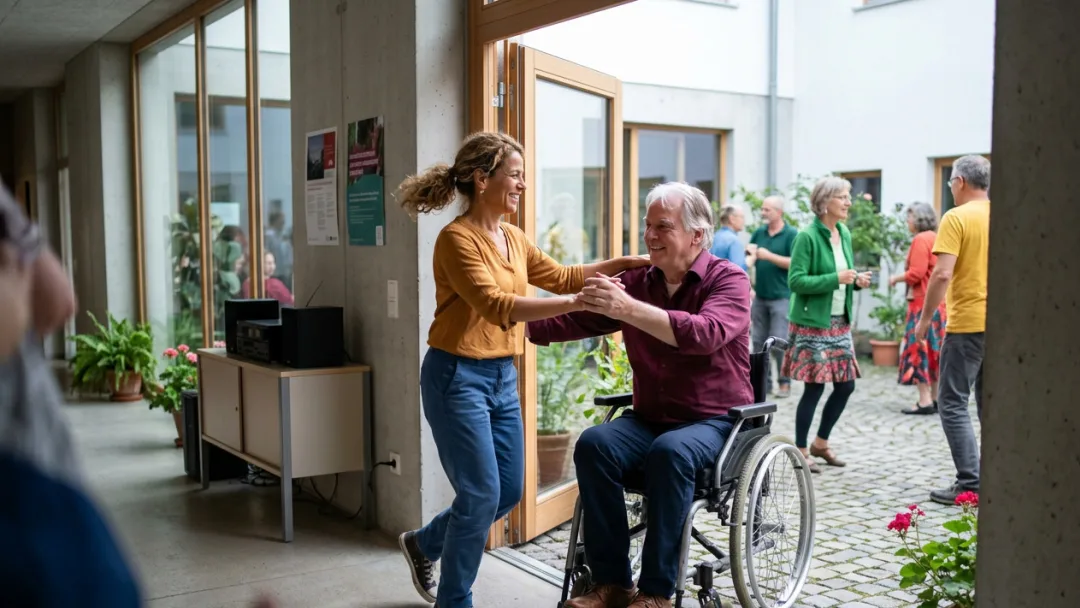
Agree on a stop signal and the kind of help you want from your dance partner: „Please guide only my hand, don’t push my wheelchair.“ Agree on small movements and a way to stop at any time; mobility aids should only be touched with your explicit consent.
Use the described entrance and first get your bearings between the dance floor, seating area, and exit. Start with a brief, small movement test; if you encounter unexpected obstacles, stay out of the crowd and avoid improvised assistance you don't want.
Do this
Not like this
Decision
Orientation
Adjustment
Yes, you can dance in a wheelchair without getting up or moving to another seat. Rhythmic arm movements, upper-body movements and even controlled changes of direction can be part of your dancing. What works depends on your mobility and your assistive device; a companion will not automatically push your wheelchair.
You do not have to share a diagnosis to describe your needs for a dance event. Practical details are enough for planning, such as a step-free route, a certain doorway width or a seat for breaks. Share only the personal information you think is useful for the support you want.
No, a ramp alone does not guarantee access that you can use. Its slope, surface, width and the space before and after it affect how usable it is. A heavy door or a tight turn along the route can also block access. That is why a ramp does not replace a description of the entire continuous route.
You do not have to continue with a dance event if the actual conditions prevent you from taking part. First, stay in a place where you feel safe and show the person in charge your saved confirmation. Do not accept an unwanted transfer or being carried as a last-minute alternative; your consent is still required, even under time pressure.
Yes, you may need support at a dance event even if you do not use a wheelchair. If you have a visual impairment, a brief orientation to the space may help; if you have a hearing impairment, a visible stop signal; if you tire easily, a seat within reach. Describe the specific situation where support would be helpful, so a companion does not take over your movements without asking.