Your first dance starts nearby
On udansa, you’ll find dance events in Rome to visit without a regular dance partner. You can plan your evening around a specific date.

By Bernhard De LucaUpdated
On udansa, you’ll find dance events in Rome to visit without a regular dance partner. You can plan your evening around a specific date.
Standing alone at the entrance can feel more daunting than taking your first step to the music. A small, manageable goal takes the pressure off: you don't have to dance every round or meet someone right away tonight.
If you go out in Rome without a companion, that initially describes only your arrival. On the dance floor, you can move freely to the music, join a guided sequence, or invite someone to dance for one song. These options require different levels of prior knowledge: free dancing lets you make your own small movements; for partner dancing, you need at least some familiarity with the basic step and your chosen role.
One admission ticket does not mean that someone will be assigned to dance with you. Announced partner rotations also do not automatically mean that a suitable partner will be available at all times. So plan a way to get started that does not depend on an immediate invitation: arrive, get a feel for the rhythm, and watch a round.
Rome also has a history of dance on stage: Teatro Costanzi opened as an opera house in 1880. But an evening at the theater is no substitute for an opportunity to dance yourself. For a general overview, check out going dancing in Rome. If you still need to learn the basic step for an announced partner dance, dance lessons in Rome can help you prepare, but it is not something to catch up on during an ongoing dance round. For this one visit, choose a format where you can actually get started with the knowledge you already have.
Check the participation details for solo attendance, reservations, entry requirements, and any possible introductions. If anything is unclear, ask the organizer a specific question: “Can I attend without a partner, and how do I get started as a solo guest?” A clear answer helps prevent false expectations.
Before heading out, decide what you want to start with: an introductory session on offer, simple freestyle movements, or a familiar basic step with a partner. Set a goal of one short dance rather than dancing through an entire evening. That way, your visit doesn't depend on receiving lots of invitations.
Take part in a scheduled introductory session from the start. If there is no introduction, take care of admission and the cloakroom first, before heading to the dance floor. Store loose items away from walkways; your phone and bag should neither swing around when you turn nor hit other people.
Listen to the pulse and observe where people are dancing and where they are waiting. Pay attention to pathways, spacing, and the start of new dances. You’re oriented when you spot an open opportunity to join without having to interrupt anyone mid-movement.
When partner dancing, ask someone who is taking a break: “Would you like to dance?” If needed, add which role you dance and that you’d like to stick to the basic step. Wait for a clear yes. When dancing freely, start at a distance, without grabbing a stranger’s hands.
Start with your easiest step and adjust its size to the space available. When dancing with a partner, keep a relaxed connection without pulling. If it becomes uncomfortable or painful, break contact and end the dance; you don't need to explain your personal reasons.
Thank your partner after the dance and let go of the connection instead of assuming you’ll dance another round. Step out of the dance area for a break. Then decide again: another dance, a moment to watch, or call it a night. Each of these choices makes for a complete evening.
Do it this way
Not like this
Preparation
Orientation
Decision
You need the skills required by the format you choose, but not perfect technique. Freestyle dancing gives you plenty of room to move. A partner dance evening without an introduction is better suited to you if you already know the basic step, rhythm and your role. A quick explanation from a guest is no substitute for an introductory class.
Yes, you can ask someone to dance yourself, regardless of your gender. If needed, mention your dance role so you don't start with different expectations. An invitation is for the agreed dance to begin with. It does not mean a personal date or an obligation to keep dancing together afterwards.
You can take a break, keep watching or leave for the evening without taking it as a judgment of you. People may be tired, need a break or not be a good match for your role right now. Ask another available person later instead of asking the same person again after they have declined.
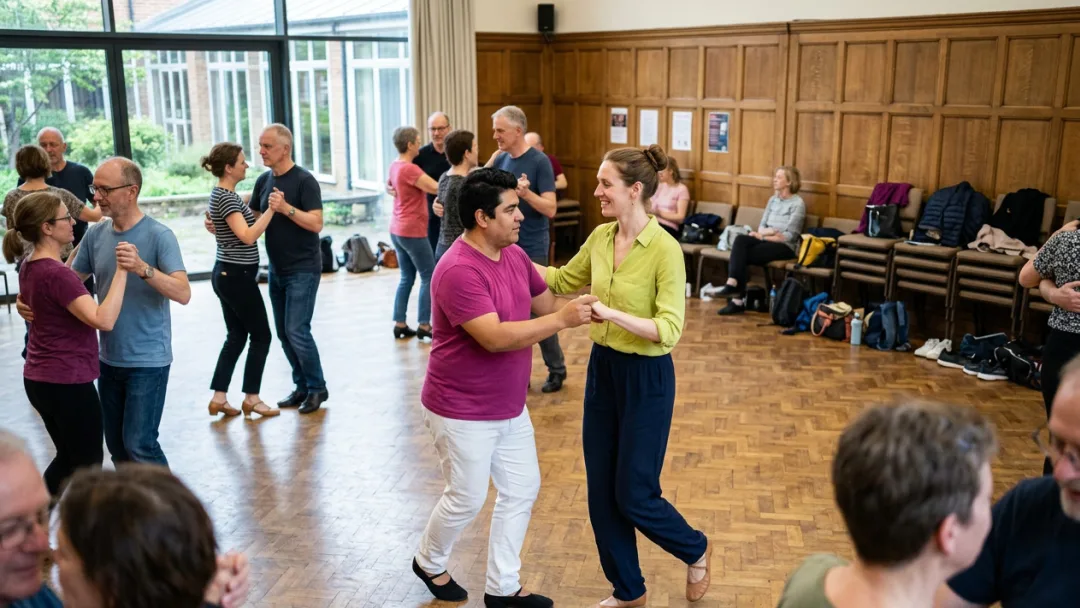
Join at the edge, leaving plenty of space, and start by following only the footwork. Focus on the instructor rather than several guests at once, as their movements may differ. Skip arm movements and turns until you can confidently identify the direction, and don't cross a moving line.
Yes, once a dance has ended, you can take a break without making any further plans. A thank you and a short sentence like “I'm sitting this round out” are enough. You don't have to exchange contact details or accept another invitation. Make sure to keep the entrance to the dance floor and the dance paths clear.
A clear “I want to stop” is enough to end a dance. Let go and move out of the way as soon as you can. If you're in pain or someone crosses a boundary, you don't have to wait until the song ends. If someone holds you or continues to pressure you, speak to the event staff.