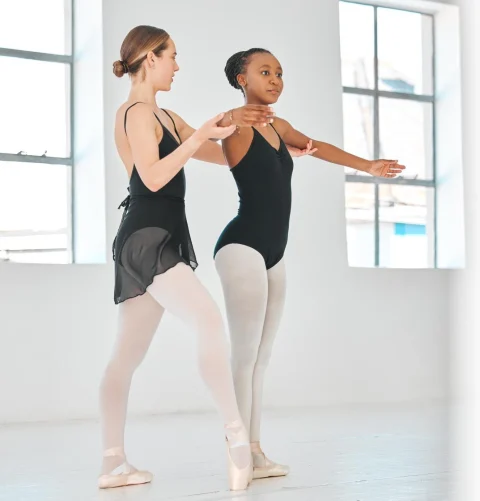
Your evening starts with joining in
On udansa, you can find people to go to a dance evening in Rome with. Going for the first time together can make it easier to take the step from watching to hitting the dance floor.

By Bernhard De LucaUpdated
On udansa, you can find people to go to a dance evening in Rome with. Going for the first time together can make it easier to take the step from watching to hitting the dance floor.
You want to get out on the dance floor after work or between two days of vacation. Whether you need to come up with your own steps or can follow a shared sequence has a bigger impact on the evening than whether it takes place indoors or outdoors.
Social dance refers to dancing together outside of classes, performances, and competitions. The term alone does not tell you which dance style is being played or how much experience you need.
The first thing to consider when going dancing in Rome is the role of the audience. Italian words can help you figure it out: spettacolo means performance, lezione means lesson, and serata danzante means dance evening. These are useful clues, not complete descriptions of what to expect. An evening can include a short introduction and then move on to free dancing.
Free describes your choice of movement, not necessarily the entry requirements. On an open dance floor with mixed music, you can start with simple weight shifts. At a style-specific social dance event, by contrast, dancers share musical and physical conventions. Guided participation offers a shared sequence, but it isn’t necessarily a lesson: the person at the front demonstrates without explaining every move in detail.
“Open Air” initially just describes the location. In 2026, Caracalla Danza took place at the Baths of Caracalla, with stage performances and guided dance sessions. That doesn’t mean you can assume there’ll be a freely accessible dance evening. For your own dancing, what matters is the participation format, not the dance history of a venue. The overview of dance options in Rome helps you find your bearings among classes, dance evenings, and performances.
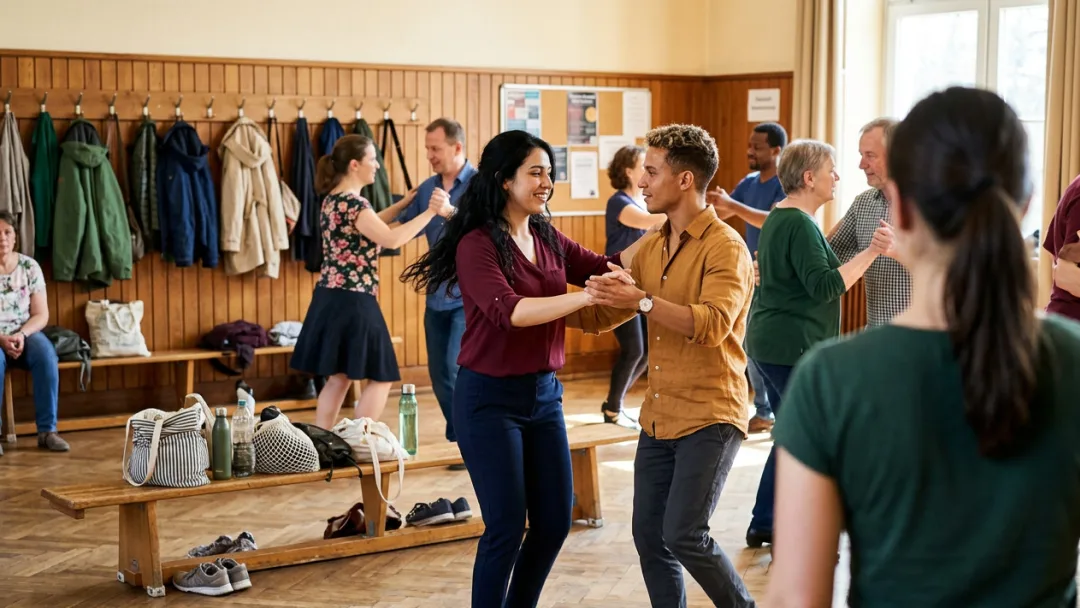
You arrive without anyone accompanying you and can already hear the music. When dancing solo freely, you can first pick up the rhythm from the sidelines without waiting for an invitation. In partner dancing, you get started with an invitation and a clear yes. A no needs no explanation, and a yes is for one dance together, not automatically for the whole evening.
With guided participation, the challenge is different: you have to recognize when a sequence begins and whether the instructions are being demonstrated as a mirror image. Turning sideways and changing directions can make even simple steps confusing. The guide to common mistakes when learning by watching explains this difference in more detail.
One practical benchmark can help: Can you keep the beat and rejoin after missing a move? Then you’re already keeping up with the sequence. If you have to look for each foot individually, it makes more sense to observe for now. In partner dancing with a specific style, say before you start that you only know the basic step. That way, your partner can lead with small movements instead of assuming you’re comfortable with turns just because you’re joining in. Your first visit alone doesn’t require you to put on a dance performance.
Correct
Misunderstandings
A good way to get started is to watch an entire song and only really start dancing along with the next one.
If you live in Rome or have just arrived, you can experience the same format repeatedly. During a short stay, though, each individual evening needs to work on its own. Skills you already have are more helpful than an ambitious change of style: a familiar basic step gives you room to enjoy the music and connect with others, while an unfamiliar partner dance demands much of your attention.
Imagine an evening after a long day on foot. A short sequence you can do together, with breaks, might suit you, while fast turns across several songs might not. Free dancing, on the other hand, can be less demanding because you can make your movements smaller and sit out songs. The effort depends on the actual movements, not on labels like “beginner” or “party.”
With a mixed format, the transition matters: a demonstrated sequence at the beginning doesn’t mean the free-dance portion that follows will be guided in the same way. Once the instruction ends, you’ll need either some simple moves of your own or familiar partner-dance steps. To choose, look for specific information about the style, the participation portion, and the free-dance time in the event description. That way, the evening remains a standalone outing instead of unintentionally becoming a substitute for a dance class. A performance, a class, and a dance floor meet different needs.
Familiar steps leave room for improvisation
You can pick up on a musical accent, leave out a figure, or stick with a simple basic step. This works if you prefer to decide for yourself and don't want to keep your eyes fixed ahead.
Shared cues carry the sequence
You can tell from the demonstration when the direction changes and which section repeats. This works well if a manageable sequence takes the pressure off and you enjoy dancing through the same routine as everyone else.
You don't need to be fluent in Italian to dance freely, but basic direction words can help with spoken instructions. “Destra” means right, “sinistra” means left, and “avanti” means forward. Demonstrations can make a lot clear, but they don't replace clear communication about physical contact and personal boundaries.
You can attend a social without any prior experience, but not every dance floor offers an easy way to join in. For partner dancing in a specific style, knowing the basic step and having a sense of rhythm can help. Watching or attending an introductory session that's explicitly advertised is a better fit than having to guess unfamiliar moves throughout an entire song.
Special dance shoes aren't necessary for every event, but suitable shoes are. Well-fitting everyday shoes are often enough for small, casual steps. Shoes with very grippy soles can put strain on your knees when turning, while delicate soles and high heels are especially unsuitable outdoors on uneven stone.
Leave a group sequence through the nearest open edge, without crossing other lines. If possible, wait for a clear moment and keep your distance from outstretched arms. When partner dancing, briefly let your partner know instead of breaking the connection mid-move.