Join in
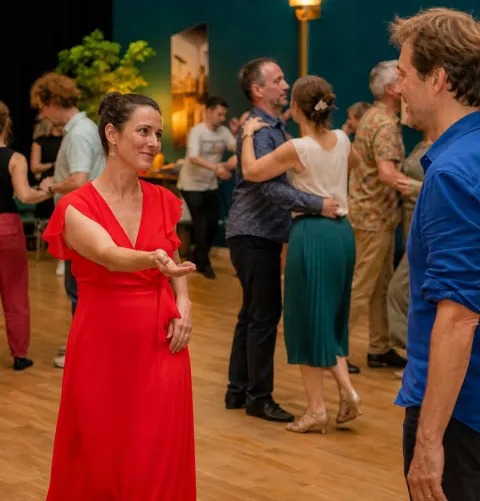
On udansa connect, you can find people in Rome to go to a dance evening with. Let them know you're looking for a guided, participatory dance session, not just a show.

By Bernhard De LucaUpdated
On udansa connect, you can find people in Rome to go to a dance evening with. Let them know you're looking for a guided, participatory dance session, not just a show.
You’re standing at the edge, people up front moving to the music, but your role is still open. Whether you watch or join in depends on the invitation and how things unfold, not on the energy in the room.
Animation is the Italian word for organized entertainment or the active involvement of guests. The term can include games, hosting, or guided movement and does not refer to a dance style of its own.
If you want to join in with guidance in Rome, a simple distinction helps: Who decides on the movement? In free dancing, that decision is yours or your dance partner's. In a guided participation segment, someone suggests a movement and makes it easy for the guests to follow. In a performance, the performers carry out their choreography while you experience it from the audience.
The visible movement can be similar. A side step followed by a clap could be part of a show, a sequence everyone joins in with, or your own dance. It is not the movement alone, but the relationship between the performers and the guests that defines the format. Here, guidance means that you are invited to follow the movement.
Rome also has a documented stage history: the Teatro Costanzi opened as an opera house in 1880, and the Ballets Russes later performed there. Such performances belong to the history of performance, not as evidence of a current opportunity to join in. The article about the dance history of the Teatro Costanzi puts this background into context. For an overview of the general opportunities to take part yourself, going dancing in Rome offers a broader perspective.
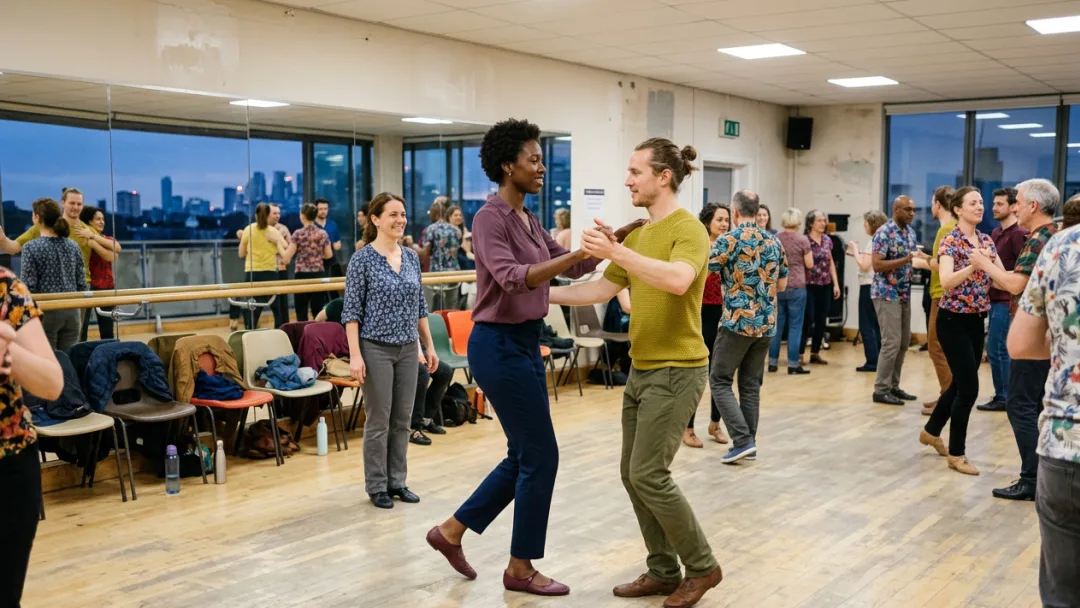
Animazione may appear on an event program without any steps being taught. A host may invite guests to clap, play a game, or take part in a group activity. Music accompaniment alone does not make it a participatory dance either. The description must make it clear that physical movements will be demonstrated for guests to follow.
Terms such as balli di gruppo, meaning group dances, suggest dancing together. But they do not prove that someone will explain the sequence: a group may also perform steps that are already familiar. A description such as “steps are demonstrated, and guests can follow along” is therefore more informative than a single keyword. Likewise, spettacolo, meaning a show or performance, does not initially imply an invitation to join in.
What matters is the activity described: demonstrating, repeating, and inviting guests to join in point to a guided participatory dance. Performing, presenting, and watching describe a show. Both may take place during the same evening. A show before an open dance floor remains a show while it is happening. Conversely, a short sequence danced together does not mean that every later dance is guided. This makes it possible to understand a program without taking its title as a promise that guests can participate.
That's right
Not like this
A dance floor shows you where movement is possible; an invitation shows you when you become part of the program yourself.
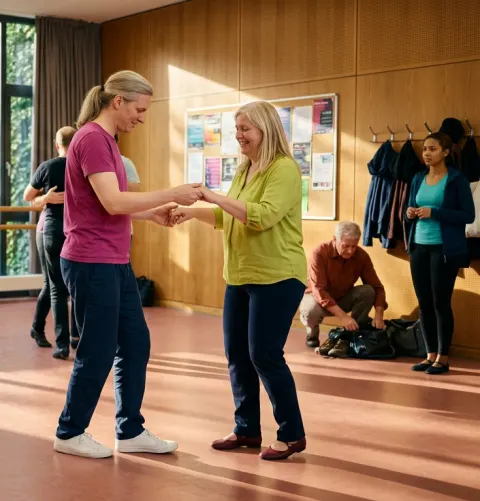
An accessible participatory segment gives you a chance to recognize a movement before the sequence changes significantly. For example, the instructor demonstrates a weight shift, repeats it to the music, and then adds an arm movement. Repetition creates a shared pattern. You do not have to copy every embellishment; what matters more is that you can grasp the direction of the movement and its timing.
Spoken cues and gestures serve different purposes. An audible count can mark the beginning, while a clearly demonstrated step shows the direction. When the two align, the movement becomes easier to understand. Difficulties can arise, for example, if you watch only the hands while the feet are already shifting weight. The guide to observation mistakes when copying dance movements explains these differences in more detail.
For your expectations, this means that a short participatory segment can give you an immediate connection to the music without systematically teaching dance technique. Individual corrections, structured learning material, or a particular learning outcome are not guaranteed. You take part in a guided movement activity. Whether it suits you also depends on whether you want to follow a shared sequence or create your own movements.
You respond physically to the instruction
As you dance along, you feel how a shift of weight fits the music. You can make your movements smaller and leave out individual arm gestures. Your contribution doesn’t have to look like the demonstration to be part of the sequence we do together.
You observe rhythm, space, and expression
As you watch, you can follow how movements respond to musical accents. Even without taking any steps yourself, you notice repetitions and differences between the dancers. Your spot off the dance floor gives you some space when you don't feel like joining in.
You don't necessarily need a dance partner for participatory dancing. Instructions can be given to individuals, a whole group, or couples. Only the described formation makes it clear whether you're copying movements on your own or dancing together; Animazione doesn't specify this.
You can join in without any dance experience if the movements are designed to be easy to pick up right away. Repeated side steps and simple weight shifts are easier to follow than long, uninterrupted sequences. The word Animazione alone, however, doesn't tell you anything about the difficulty.
An invitation to join in with Animazione doesn't mean you have to dance. You can watch or skip a participatory section. If you're already standing in the group, step out of the dance area during a pause so others can continue moving freely.
Animazione isn't the same as choreography. A choreography is a set sequence of movements that can feature in a show as well as in participatory dancing. Animazione, by contrast, describes the entertainment setting and the involvement of guests, not the specific sequence of steps.