Classical Technique5 minutes

Ballet for Adults in Münster: Getting Started

By Bernhard De LucaUpdated

In short
  • For your first ballet class as an adult in Münster, you need neither prior experience nor the ability to do the splits.
  • A suitable beginner class teaches body alignment, basic positions and musical phrasing before introducing longer combinations.
  • Your turnout is guided by your mobility, not by a prescribed foot angle.
  • You start with flat ballet slippers; pointe work is not part of your first fundamentals class.

The image of an effortlessly extended leg can make getting started unnecessarily intimidating. In class, you can focus on a much smaller task at first: placing one foot mindfully while continuing to breathe.

DefinitionTurnout

Turnout in ballet refers to the outward rotation of the legs from the hip joints. It is also known as en dehors.

Your body doesn't need a dancer's physique

If you're looking for adult ballet classes in Münster, having no dance experience isn't a reason to rule out a course specifically designated for beginners. You don't need a particular body shape either. First, you'll learn how to distribute your weight, align your knees and feet, and coordinate your arms independently of your legs.

Turnout is often misunderstood: feet turned far outward may look like ballet, but they say little about whether the position is controlled. If you turn only your feet outward and let your knees roll inward, you won't create a stable foundation. Keep the turnout small enough that your knees and feet can work in the same direction. Your pelvis shouldn't tilt forward.

Flexibility is something you develop in class, not something you have to prove beforehand. How flexibility can change through dancing also depends on active control. Holding your leg a little lower while avoiding compensation in your back is a worthwhile learning achievement. Sharp or joint pain, on the other hand, isn't a sign of effective training: stop the movement in question.
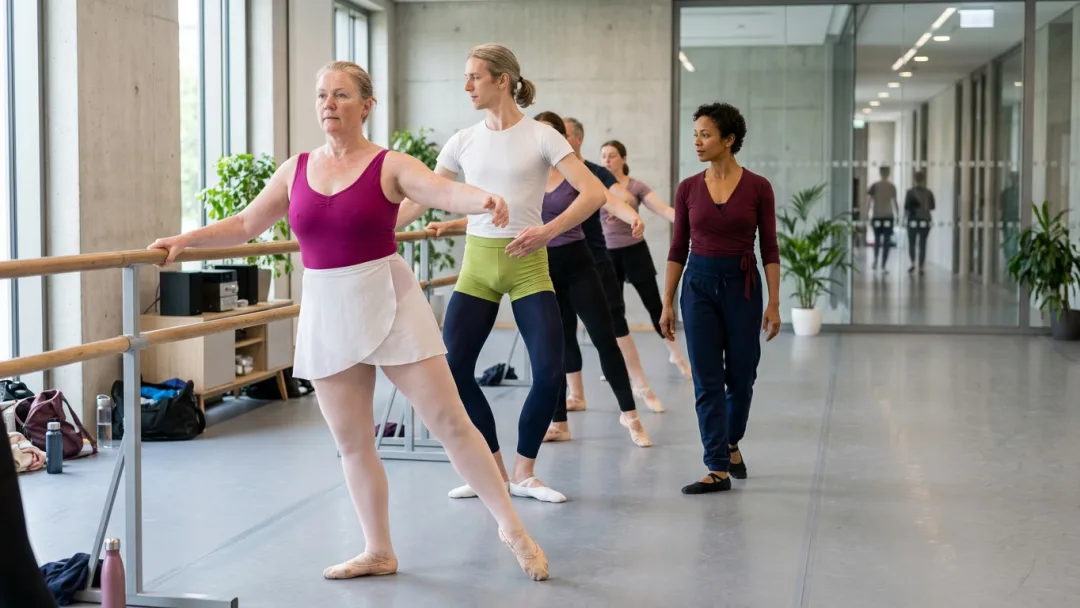
A small range of motion makes subtle differences in load and alignment easier to feel.

Beginner lessons make movement understandable

A classical ballet class often begins with exercises at the barre. It gives you light support as you get to know footwork, leg placement and weight distribution. You do not grip it to make up for a lack of balance with arm strength. A relaxed touch lets you feel how much stability you provide yourself.

Typical fundamentals include Plié, a knee bend with aligned legs, and Tendu, where the foot glides along the floor and extends. In classes for people with no prior experience, these terms are connected to the movement. Demonstrating alone is not enough: you need clear explanations of where your weight stays and which parts of your body move.

After that, exercises without the barre may follow, such as simple arm movements and steps across the room. Jumps are only added once you can work on preparation and landing. Music structures the beginning, duration and end of the movement. A good explanation connects the count to the task: you should be able to recognize when to bend, extend or arrive. Short sequences and repeated attempts make room for this, rather than overloading your memory with many new steps at once.

How to recognize a fundamentals class

That's right

  • Explain basic positions before the combination
  • Adapt corrections to your mobility
  • Reduce the music tempo for new exercises
  • Let students know before making physical contact to correct them

Not like this

  • Assume everyone knows French terms without explaining them
  • Force all feet into the same opening
  • Expect unfamiliar sequences to be done at full speed right away
  • Reposition someone's legs or pelvis without their consent

A small, well-controlled movement helps you learn more than a high leg that you can only achieve by compensating.

Ballet teacher for adults

The course title should match the learning goal

In adult ballet, age alone does not indicate level. An adult class may teach the basics or assume familiarity with positions and exercise sequences. For your first class, “no prior experience required” is therefore more informative than “for adults.” In the course description, you can look specifically for this requirement and a structured introduction to classical fundamentals.

“Barre” and ballet-focused fitness are not automatically the same as ballet instruction. Repeated leg exercises at a barre can be physically demanding without systematically teaching French movement terminology, arm positions or classical step combinations. Both forms have a clear purpose. What matters is whether you want to learn dance technique or mainly work out.

Regular foundational instruction lets you perform the same exercise again with a better understanding. For example, you might notice that you pull less on the barre when bending your knees, or stand more steadily when pointing your foot. These improvements are more concrete than the promise of becoming stage-ready quickly. Building muscle through dance also depends on the intensity and structure of your training. A ballet class therefore does not automatically replace every other kind of strength training. To get started, what matters most is that the technique, tempo and repetitions work well together.

Two class formats with different focuses

Technique

Building Classical Foundations

Positions, footwork and coordination

You learn recurring exercises and how to perform them precisely. Explanations, repetitions and personal corrections take center stage, while combinations remain short at first.

This is a good fit if you want to understand how a movement is built.

Training

Use ballet as a fitness boost

Effort, rhythm and flow of movement

A ballet-inspired fitness format uses exercises such as squats and leg exercises in longer sets of repetitions. The focus is on physical exertion, not necessarily on building a complete classical foundation.

It’s a good fit if you’re mainly looking for movement-focused training.

Frequently Asked Questions

  1. For beginners, close-fitting, stretchy clothing that lets you move your knees and hips freely is a good choice. A simple top with leggings is enough, unless there is a different dress code. Very loose trousers hide your leg position. Tie back long hair so you can see clearly while moving.

Ballet classes for adults in Münster

You can find classes and dates in Münster in the course filter on udansa, and search for beginner options that require no prior experience.

Your first step can be small

On udansa, you can find ballet classes for adults in Münster. Look for a beginner class where you can learn body alignment and footwork without any prior dance experience.

Your first step can be small