Competitive dance5 minutes

Competition dance partner in Münster: What needs to match athletically

By Mary De LucaUpdated

In short
  • When looking for a tournament partner in Münster, discipline, competition class, competition goals and available training time are among the most important details to share.
  • Your competition class describes your athletic level, but it does not automatically mean you are technically compatible.
  • Practicing together shows how you dance under pressure and respond to corrections.
  • A commitment only works when competition plans, training demands and the way you handle setbacks suit you both.

Competing in a tournament together also means repetition, travel, and days without visible progress. That’s why, when searching, what matters is which work you actually want to share with another person.

DefinitionCompetition class

Competition class refers to the regulated performance level you compete in at a dance sport tournament. It is distinct from the age group, which may also be relevant for classification.

Four Details Make Your Competition Goal Clear

If you're looking for a tournament dance partner in Münster, “ambitious” alone doesn't say much. It leaves open whether you want to compete for the first time, return after a break, or work toward moving up a level. A clear competition search therefore distinguishes between discipline, current competition level, goal, and training time you can commit to.

With the discipline, you specify Standard, Latin, or a combination of both. This affects the amount of work you do together: anyone pursuing both areas needs to develop different movement qualities and routines. Add context to your competition level, such as active competition experience, returning after a break, or not having competed yet. A level you attained some time ago and your current ability are not the same thing.

For your goal, a concrete example helps: “I’d first like to build a solid Latin program for my first competition.” Another might be: “With my existing competition experience, I’d like to work specifically toward better placements.” Both goals are serious, but they call for different work together.

Finally, training commitment means the amount you can sustain over time, including preparation periods before a competition. On udansa, details like these make your search clear. The general assessment of your previous dance experience remains a foundation, but it doesn't replace these competition-specific details.
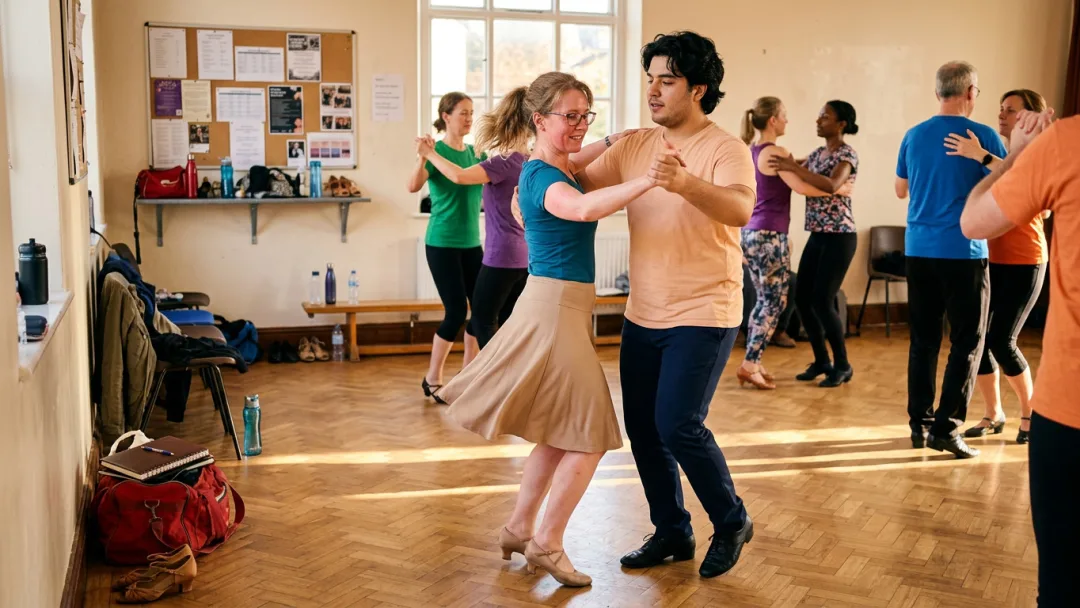
A shared plan should also include getting there and getting ready, not just the minutes on the dance floor.

The same class does not mean the same way of working

Two people can have a comparable competition classification and still dance very differently. One has a steady sense of rhythm but loses their posture during longer run-throughs. The other has more stamina but needs clearer coordination during transitions. These differences are not visible in a class designation.

In Standard, working together involves, among other things, moving through the space as a pair and maintaining a connection that holds up through changes of direction. In Latin, this also includes varying distances, coordinated actions and shared musical accents. A large repertoire of figures does not prove that these basics will remain reliable under the pressures of competition. The article on Quickstep speed and practice music shows, for example, how much tempo can change the movement.

That is why practicing together provides different insights than a description. A run-through of your routine shows whether your connection and timing hold up even when you are tired. Working on a single passage shows whether you understand corrections and can put them into practice together.

What matters is not being error-free, but being able to work through things together. A connection that does not work can be a technical issue you can solve. Constant pulling, physical pain or demeaning comments, on the other hand, are not a sound basis for a sporting commitment.

What Makes a Search Query Reliable

Do this

  • List the discipline and previous competition class separately
  • Pair a sporting goal with a timeframe
  • Be specific about how much training time you can reliably commit
  • After a trial, discuss your observations without assigning blame

Not like this

  • Only list “advanced” as your dance level
  • Leave “as successful as possible” as your only goal
  • Promise unlimited availability despite a busy schedule
  • After a trial session, list only the other person’s mistakes

A commitment to dancing should describe your shared day-to-day practice, not just the hope of achieving a good tournament result.

Dance Partner Search Editorial Team

A commitment connects goals with a manageable effort

A competition partnership commits you to preparing together. If one person wants to compete as soon as possible while the other first wants to change fundamental technique, a conflict can arise even when you have a good dance connection. The difference then lies in when you want to be competition-ready, not necessarily in how ambitious you are.

A reliable comparison therefore focuses on concrete commitments: the amount of work you do together, extra preparation before competitions, travel effort, and willingness to budget for competing. The amounts depend on your personal plan. What matters is that no one commits to an intensity that would only be possible during an unusually free week.

The importance you attach to results matters too. Some people first want to make a routine consistent under competition conditions. Others want to improve their rankings deliberately. Difficulties arise when you assess the same placement differently: one person sees it as a useful measure of where they stand, the other as a failure.

Before committing, you should have a clear idea of the shared day-to-day work you have in mind. That includes how you will handle injury-related breaks, missed preparation time, and disappointing results. You can enjoy dancing with someone and still realize that your athletic goals do not currently align. A considered refusal prevents an unspoken conflict over goals from becoming apparent only after a lot of preparation together.

Two achievable athletic goals

Getting started

Get ready for your first competition together

Build a competition routine without pressure to achieve results

You want to build a reliable routine and dance in a competition setting for the first time. That makes someone a good match who also sees feeling confident, sharing routines, and managing nerves as progress.

Moving up

Work strategically on your placements

Analyze results and work on weaknesses

You want to use your competition experience to achieve better results. A good match for you is someone who wants to analyze competitions and work on challenging technical areas, without treating every placement as a judgment on the partnership.

Frequently asked questions

  1. Yes, you can look for a partnership with competition goals even if you have never competed before. Describe your status as a planned first step rather than claiming a competition class you do not yet have. It is important that the other person is willing to work together on building a shared programme and to take your lack of competition experience into account.

Ballroom and Latin in Münster

Once you've narrowed down your discipline, you can find suitable courses in Münster here.

Your competition goal needs coordination

On udansa, you can search for dance contacts in Münster and clearly state your sporting expectations. This gives a potential competition partnership a clear basis for discussion even before your first practice together.

Your competition goal needs coordination